Cramer Says Nvidia at 23 Times Earnings Needs a Half Trillion Dollar Buyback
Jim Cramer wants Nvidia to announce the largest share repurchase in corporate history, and his valuation argument is harder to dismiss than his collateral logic deserves to be.

Jim Cramer used his Monday CNBC segment to make an argument that has become his signature line on NVIDIA (NASDAQ:NVDA | NVDA Price Prediction): the company is trading like a mature business while growing like a startup, and management should respond with the largest share repurchase in corporate history. He wants NVIDIA to quintuple its existing authorization and announce a half-trillion-dollar buyback, roughly a tenth of the company.
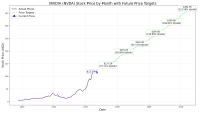
The premise rests on a valuation gap Cramer finds indefensible. “I think it’s absurd that Nvidia has an amazing order book and huge profitability, yet it trades at just 23 times this year’s earnings estimate,” he said, pointing to the underperformance since late October. The trailing multiple is 44x, but based on the $9.05 consensus for the fiscal year ending January 2027, the forward figure is closer to what Cramer described. That is a striking price for a business the CFO says will grow another approximately 70% in fiscal 2028.
Why The Valuation Gap Deserves a Serious Hearing
NVIDIA just reported $96.22 billion in quarterly revenue, up 105.85% year over year, with Data Center revenue of $89.02 billion growing 117%. Non-GAAP gross margin reached 75.0%, and management guided the October quarter to $108 billion, plus or minus 2%. These are the operating results of a company at full acceleration.
The stock has not moved in kind. NVIDIA is up 16.73% year to date and 25% over the trailing year, meaningful gains that still lag what triple-digit revenue growth would normally command. Cramer is right that a forward multiple in the low twenties on a business compounding this fast implies the market is pricing a demand cliff.
The counterargument is that the discount reflects real risk: circular financing, customer concentration, and an order book increasingly backed by NVIDIA’s own balance sheet. Management disclosed $279 billion in supply obligations and partnerships with Apollo, BlackRock, Blackstone, Brookfield, Goldman Sachs, and KKR to mobilize more than $500 billion in third-party capital. Jensen Huang acknowledged that “some will call this circular financing.”
Where the Collateral Argument Falls Apart
Cramer’s defense of NVIDIA’s role as the AI industry’s banker leans on a claim that does not survive scrutiny. “The chips retain their value. Worst case scenario, they repossess the GPUs, maybe even for the same price they sold them,” he said. That is the wrong way to think about depreciating silicon in a market where each generation devalues the prior one.
NVIDIA itself explained why. Management said Vera Rubin delivers “30X higher throughput per megawatt” and “35X lower token costs relative to Grace Blackwell Ultra.” A used H100 is worth what it can earn against a Rubin rack, and that math gets worse every cycle. A customer default would likely arrive precisely when the secondary market is most saturated.
A buyback does not fix that. Repurchases shrink the share count and support EPS, but they do not create end demand, diversify the customer base, or reduce vendor-financing exposure. NVIDIA already has approximately $99 billion remaining on its repurchase authorization after returning $26 billion to shareholders in Q2, per the Q2 FY27 earnings release. Quintupling it would be a signal without addressing the underlying demand risk.
Is NVDA Stock a Buy?


The competitive picture matters here. Advanced Micro Devices (NASDAQ:AMD) has a credible MI-series roadmap, and Broadcom (NASDAQ:AVGO) is building custom accelerators for hyperscalers who would rather not pay NVIDIA’s margin. Neither has closed the CUDA moat, and the broader buildout still has to be powered, cooled, and networked by somebody, which is why we pulled together seven AI-boom suppliers outside the chipmakers in a free report.
The bearish thesis on vendor financing is real, but the valuation asymmetry is larger. A business generating $21.34 billion of quarterly free cash flow at a forward multiple in the low twenties, with supply constrained through fiscal 2028, is being priced for a demand shock that management is not seeing. Cramer’s buyback plan is theater, but his read on the multiple is sound. The setup looks compelling on valuation, with the caveat that the customer-credit story is the risk worth watching closely.
Contact [email protected] for any questions or corrections.
Omor Ibne Ehsan is a writer at 24/7 Wall St. He is a self-taught investor with a focus on growth, cyclical, and dividend equities that have strong fundamentals, value, and long-term potential. He also has an interest in high-risk, high-reward investments such as penny stocks.