Cramer’s Radical Fix for Nvidia: 5x the Buybacks, Repurchase 10% of Stock
Jim Cramer went on air with a blunt message for Jensen Huang and a specific dollar figure that would force Nvidia to rethink how it spends its record-breaking cash pile.

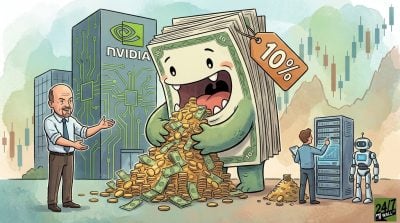
On the September 1, 2026, episode of Mad Money, Jim Cramer laid out an unusually specific piece of unsolicited advice for Nvidia (NASDAQ:NVDA | NVDA Price Prediction): quintuple the existing share repurchase authorization and use it to buy back roughly a tenth of the company. To be clear, this is Cramer’s opinion, and Nvidia has announced nothing of the sort. His comments do not reflect CNBC’s view and are not a specific inducement to invest.
What Cramer Actually Proposed
Cramer’s pitch borrows from the Apple (NASDAQ:AAPL) playbook: “I think they should do like Apple, which was also valued incorrectly, and repurchase a spectacular amount of stock. I quintuple, quintuple, the buyback authorization. Announced a monster half-trillion dollar buyback. Because there’s no better investment for Nvidia than Nvidia.”
He went further, adding that he would “contemplate quintuple the buyback authorization, quintuple it, announce a monster half trillion dollar buyback, repurchase a tenth of the company in a fairly aggressive fashion every day.”
For scale, Nvidia disclosed in its Q2 FY2027 release that it has approximately $99.0 billion remaining under its current authorization. The company carries a market capitalization in the multi-trillion-dollar range. As dated background from the May 20, 2026, Mad Money episode, Cramer had noted that Nvidia bought back nearly $20 billion of stock in that quarter and announced a new $80 billion program with close to $40 billion still on the prior one. That May characterization is not a statement of Nvidia’s current authorization status, but it frames what Cramer means by “quintuple.”
Why He Says the Market Has It Wrong
Cramer described the proposal as a market critique, not a company critique. “My plan is not an indictment of the company. It’s an indictment of the market. Wall Street’s not valuing Nvidia correctly,” he said. He pointed to the multiple: “I think it’s absurd that Nvidia has an amazing order book and huge profitability, yet it trades at just 23 times this year’s earnings estimate at a much lower P/E and then sold out years.” The 23x figure is Cramer’s characterization.
He also argued the stock has lagged. “From the close on October 28th to today, Nvidia stock is up 8.2%, the S&P 500 is up 10.7%. Yes, Nvidia’s underperformed,” he said, calling it a company that has “dramatically ratcheted up revenue expectations” while the stock “has barely moved.” Those performance numbers are his citation. Independent price data shows shares at $217.44 as of the September 1, 2026, close, with a one-month gain of 8.3% and a year-to-date gain of 16.6%.
Can Nvidia Afford It Without Starving Investment?
Cramer’s answer to the affordability objection was plain: “I think they could afford the level of buyback without scaling back their investments.” The recent numbers give the argument teeth. Nvidia posted Q2 FY2027 revenue of $96.22 billion, up 105.9% year over year, with non-GAAP gross margin of 75.0% and free cash flow of $21.34 billion. The company returned a record $26 billion to shareholders in the quarter, including $20 billion in repurchases and $6 billion in dividends.

Against that, capital commitments are stacking up. Supply obligations rose to $279.0 billion, largely tied to memory for Vera Rubin, and guarantee obligations are capped at $108.5 billion for AI cloud and data center partners. CFO Colette Kress told analysts, “Relative to our plan to return 50% or more of free cash flow, we have returned 60% on a year-to-date basis. And going forward, we intend to increase and return excess free cash flow net of strategic uses.” That framework prioritizes strategic investment first and buybacks second, which is the opposite of what Cramer wants.
What Would Have to Happen for This to Be Real
For any of this to move from talking point to policy, Nvidia’s board would have to authorize a repurchase program several multiples larger than the current one, and management would have to redirect cash currently earmarked for supply commitments, Frontier AI Lab investments (nearly $50 billion invested to date), and the $500 billion third-party financing platforms with Apollo, BlackRock, Blackstone, Brookfield, Goldman Sachs, and KKR. None of that has been signaled.
Cramer closed the segment with a call to action for Jensen Huang: “Mean it, show it, do it. It might be the best investment this amazing company’s ever made.” Whether Nvidia agrees is a separate question, and one investors will watch across the next several capital-return updates.


Contact [email protected] for any questions or corrections.
Trey has been an editor and author at 24/7 Wall St. for more than a decade, where he has published thousands of articles analyzing corporate earnings, dividend stocks, short interest, insider buying, private equity, and market trends. His comprehensive coverage spans the full spectrum of financial markets, from blue-chip stalwarts to emerging growth companies.
Beyond 24/7 Wall St., Trey has created and edited financial content for Benzinga and AOL's BloggingStocks, contributing additional hundreds of articles to the investment community.
Trey's editorial expertise extends across multiple publishing environments. He served as production editor at Dearborn Financial Publishing and development editor at Kaplan, where he helped shape financial education materials. Earlier in his career, he worked as a writer-producer at SVE. His freelance editing portfolio includes work for prestigious clients such as Sage Publications, Rand McNally, the Institute for Supply Management, the American Library Association, Eggplant Literary Productions, and Spiegel.
Outside of financial journalism, Trey writes fiction and has been an active member of the writing community for years, moderating workshop sessions at regional conventions.