Is Home Depot’s Dividend Safe if Housing Stays Frozen?
Home Depot's stock sits near a 52-week low and housing turnover has been frozen for four years, yet the company keeps writing dividend checks. Whether that streak survives depends on three numbers investors should watch closely.

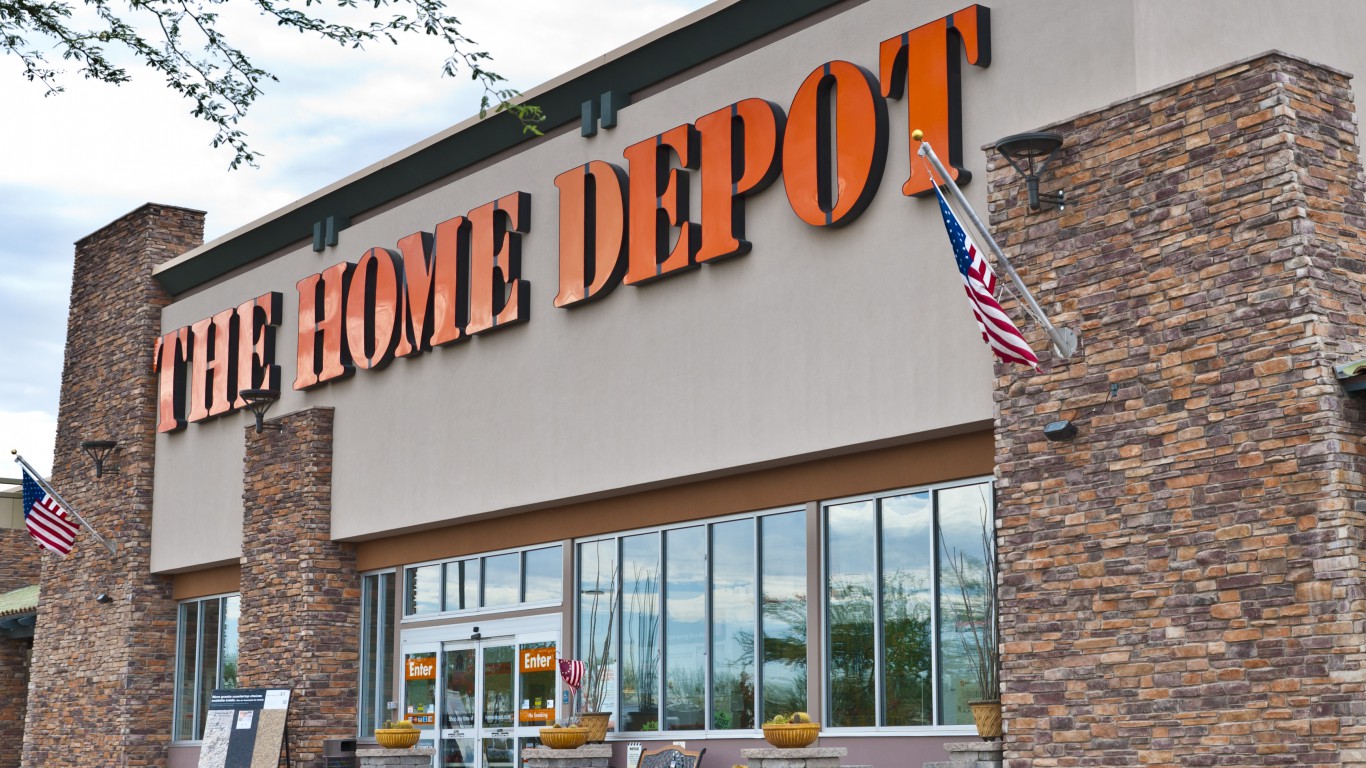
Home Depot (NYSE:HD | HD Price Prediction) closed at $293.20, down 11.8% in a month and 25.98% over the past year, trading near its 52-week low of $284.85. The slide lifted the yield to 3.13% and raises a pointed question: can a $9.32 annual payout hold if housing stays locked?

Housing Turnover Is Stuck at Record Lows
People who stay put skip the renovation that follows a move. Existing home sales fell to a 3.98 million annualized pace in August, the lowest reading of the past year. On the August earnings call, Richard McPhail offered no comfort:
“We’ve seen housing turnover at these low levels for four years now.”
He added there is “just no sign of an inflection point at this moment.” That pressure hits Lowe’s (NYSE:LOW) and Sherwin-Williams (NYSE:SHW) as well, since both depend on the same homeowner willingness to commit to projects.
Pros Are Doing the Heavy Lifting
Second-quarter comp sales rose 1.7% even as transactions fell 1.0%. Pro posted positive comps and outperformed DIY, and SRS, now above 1,340 locations, “comped above the company average.” Contractors doing repair work keep buying when discretionary projects slow. Billy Bastek acknowledged the split:
“Larger discretionary projects remain under pressure.”
Free Cash Flow Still Covers the Check

Fiscal 2025 free cash flow was $12.65 billion, down 22.54%, against $9.152 billion in dividends. This year looks stronger. Operating cash flow reached $6.032 billion in the first quarter and $5.39 billion in the second, with capex of $844 million and $880 million, versus quarterly dividends near $2.32 billion. Buybacks, which absorbed $7.951 billion in the fiscal year ended January 2024, have effectively stopped, leaving cash for the payout.
Debt Is the Real Constraint
Acquisitions left total debt at $62.567 billion against $2.085 billion in cash. Net debt/EBITDA stands at 2.65, interest coverage at 8.66, and net interest expense is guided near $2.3 billion. That leverage is manageable but leaves little room for generous raises.
Raise History Reveals Shrinking Increases
| Year | Quarterly Dividend |
|---|---|
| 2023 | $2.09 |
| 2024 | $2.25 |
| 2025 | $2.30 |
| 2026 | $2.33 |
This year’s bump was just 1.3%. Precedent matters here: through the last housing crash, the quarterly payout held flat at $0.225 from 2007 through 2009. Management froze it rather than cut it. The company has now paid 156 consecutive quarterly dividends. A smaller raise is not the same warning as a stretched yield, but the tells that a payout is in real trouble are worth knowing cold, and we listed the seven of them in a free report on dividend traps.
Verdict: The Dividend Is Safe, Raises Are Not
The payout survives a frozen market. CEO Ted Decker said in May that demand was “relatively similar to what we saw throughout fiscal 2025, despite greater consumer uncertainty and housing affordability pressure.” Guidance calls for EPS growth of flat to 4.0%, and the stock trades at roughly 21 times earnings.
Income holders should track three things: quarterly operating cash flow minus capex against the roughly $2.3 billion dividend, whether net debt/EBITDA rises above 2.65, and the size of February’s raise. A token increase would signal the 2008 strategy: hold, protect, wait for housing.
Contact [email protected] for any questions or corrections.
Chris Lange is a financial and geopolitical writer with more than a decade of experience covering a myriad of topics. He has published thousands of articles for 24/7 Wall St., with past coverage focused heavily on stocks, IPOs, healthcare, defense, global affairs, and technology.
His work has been quoted, or referenced by a number of outlets including Business Insider, USA Today, Yahoo Finance, MSN, The Motley Fool, and many other publications. A graduate of Southwestern University, he studied business with a focus on investments and has previous experience in banking and startups.
When not reading or writing the news, he is following his passion for Lacrosse, playing chess, or building solar projects with his dad.