Jim Cramer: Hyperscalers ‘Wrecked Their Balance Sheets’, But Apple Carries Twice Alphabet’s Debt
Jim Cramer called Apple's balance sheet pristine while slamming hyperscalers for wrecking theirs on AI data centers, but the actual filings tell a more complicated story about who is really carrying the heavier debt load.

This post may contain links from our sponsors and affiliates, and Flywheel Publishing may receive compensation for actions taken through them.
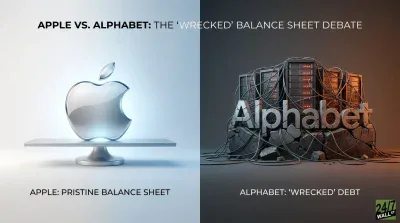
On Tim Cook’s final day as chief executive, Jim Cramer delivered a verdict that reframes the entire hyperscaler debate. Speaking on Mad Money on August 31, 2026, he called Apple’s balance sheet “pristine…the envy of the industry, maybe any industry” while accusing the AI infrastructure giants of the opposite sin.
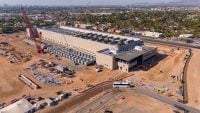
“The hyperscalers have wrecked their balance sheets to build these data centers. They’re the ones to worry about, not Apple.”
Apple (NASDAQ:AAPL | AAPL Price Prediction) closed FY2025 with $112.377 billion in total debt, $73.733 billion in equity, and retained earnings of negative $14.264 billion. Alphabet (NASDAQ:GOOG), the poster child for AI capex excess, closed the same year with $415.265 billion in equity and only $59.291 billion of debt.
Reading the Filings Side by Side
Apple carries nearly twice the total debt Alphabet does, and its debt-to-equity ratio sits at 1.5241 versus Alphabet’s 0.1428. The negative retained earnings are the direct arithmetic of the buybacks Cramer praised in the same breath: Apple has repurchased $62.094 billion of stock in the nine months through June 27, 2026, on top of $90.711 billion in FY2025.
Alphabet’s leverage jumped fast this year. Long-term debt more than doubled from $46.547 billion at year-end 2025 to $98.165 billion by June 30, 2026, funding CapEx guided to $175 billion to $185 billion for 2026. The buyback program was suspended in Q2 2026. Free cash flow flipped to negative $5.86 billion.
Why the Market Isn’t Punishing Apple
Cramer’s framing survives scrutiny for a reason: liquidity. Apple holds $39.544 billion in cash and $84.118 billion in long-term investments, a cushion that dwarfs the near-term maturities. Net debt to EBITDA sits at 0.528, and interest coverage on Alphabet’s side remains at 175.3x. Both companies remain financially sound.
Investors have voted with their wallets. Apple is up 16.87% year to date through September 2, 2026, versus Alphabet’s 8.56% gain. Apple trades at a 42 P/E multiple, roughly triple Alphabet’s 14.


What to Watch as Ternus Takes Over
Bloomberg reports the John Ternus era begins after Cook’s 2,300% stock gain, with CNBC flagging AI challenges and a memory crunch ahead. If Apple accelerates its own AI infrastructure build, the buyback pace will collide with capex needs, and the “pristine” label will face its first real test. All that hyperscaler spending has to be powered, cooled, and networked by someone, and we pulled together seven suppliers doing exactly that in a free AI infrastructure report.
Contact [email protected] for any questions or corrections.
After two decades of patrolling the dark corners of suburbia as a police officer, Rich Duprey hung up his badge and gun to begin writing full time about stocks and investing. For the past 20 years he’s been cruising the markets looking for companies to lock up as long-term holdings in a portfolio while writing extensively on the broad sectors of consumer goods, technology, and industrials. Because his experience isn’t from the typical financial analyst track, Rich is able to break down complex topics into understandable and useful action points for the average investor. His writings have appeared on The Motley Fool, InvestorPlace, Yahoo! Finance, and Money Morning. He has been featured in both U.S. and international publications, including MarketWatch, Financial Times, Forbes, Fast Company, and USA Today.