Tesla vs. BYD: One Stock Could Be Poised for a Bigger Comeback
Tesla just posted record deliveries while its margins cratered, and BYD keeps selling millions of cars to a stock market that barely notices. Only one of these EV giants is actually set up for a bigger move from here.

Tesla (NASDAQ: TSLA | TSLA Price Prediction) and BYD (OTC: BYDDF) just closed another earnings cycle on very different footing. Tesla posted record Q2 2026 deliveries of 480,126 vehicles but watched margins buckle. BYD, the volume king of global new-energy vehicles, keeps grinding out cars while its stock quietly drifts. One of these names is priced for a rebound. The other is already staging one.
Record Deliveries Meet A Margin Squeeze
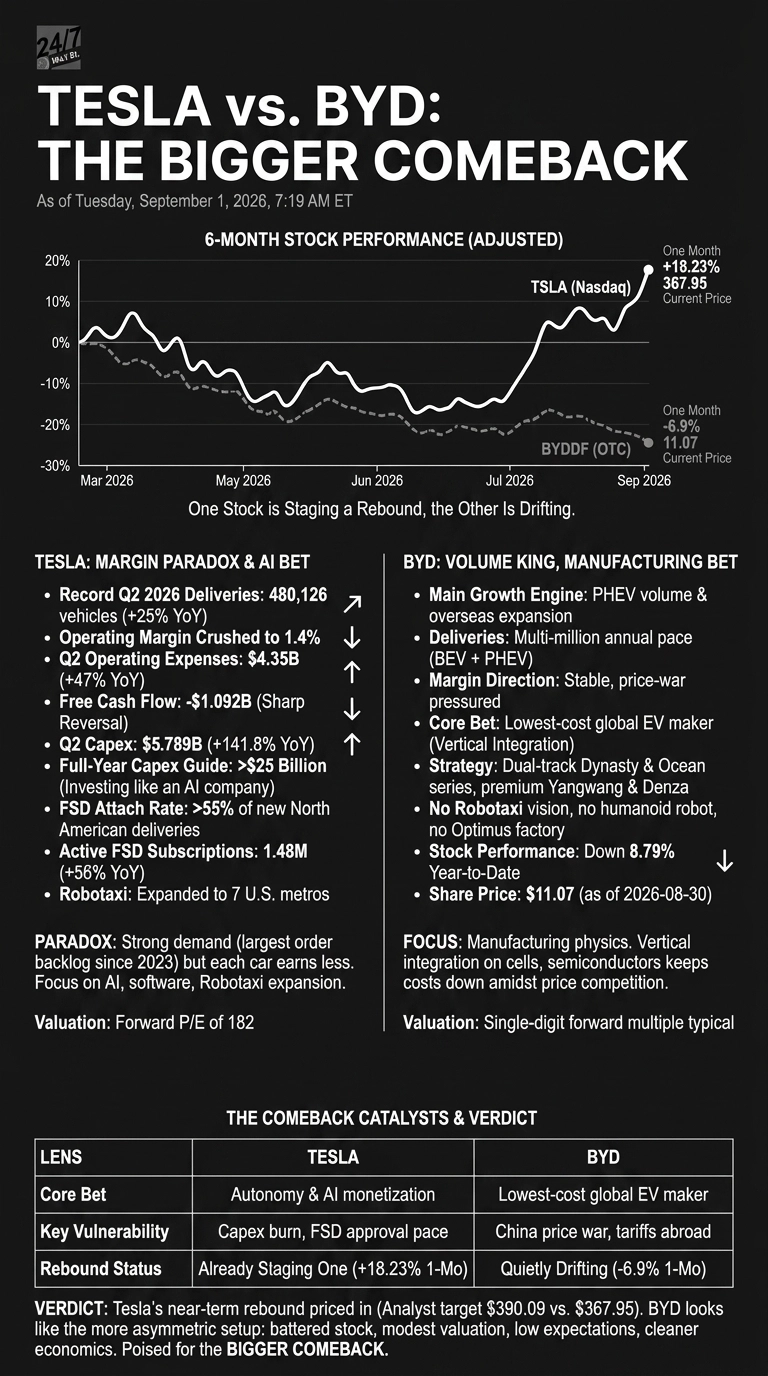
Tesla’s $28.24 billion in revenue beat the Street, yet non-GAAP EPS of $0.33 missed by 38.51%. Operating margin collapsed to 1.4% as operating expenses jumped 47% year over year.
CFO Vaibhav Taneja told investors Tesla exited the quarter with “our largest order backlog since 2023“, and Elon Musk called Model Y “the best-selling car of any kind in the world”. That is the paradox: demand is strong, but each car earns less.

BYD has been the opposite story. Its dual-track Dynasty and Ocean series, plus premium Yangwang and Denza brands, keep expanding across Europe, Southeast Asia, and Latin America.
DM 5.0 plug-in hybrids let BYD dodge range-anxiety pushback in emerging markets, while Blade Battery costs stay among the industry’s lowest. Volume is the moat.
| Business Driver | Tesla | BYD |
| Main Growth Engine | FSD, Robotaxi, energy storage | PHEV volume, overseas expansion |
| Q2 Deliveries | 480,126 | Multi-million annual pace (BEV + PHEV) |
| Margin Direction | Compressing | Stable, price-war pressured |
Software Bets Versus Steel And Batteries
Tesla is spending like an AI company. Capex more than doubled to $5.789 billion, free cash flow flipped to negative $1.092 billion, and management guided full-year capex above $25 billion.
Musk framed the tradeoff bluntly: “It’s okay to be a little less capital efficient if we get things done sooner.” FSD attach rates topped 55% of new North American deliveries, and active subscriptions hit 1.48 million. Robotaxi now runs in seven U.S. metros.
| Lens | Tesla | BYD |
| Core Bet | Autonomy and AI monetization | Lowest-cost global EV maker |
| Valuation Signal | Forward P/E of 182 | Single-digit forward multiple typical |
| Key Vulnerability | Capex burn, FSD approval pace | China price war, tariffs abroad |
BYD’s bet is manufacturing physics. Vertical integration on cells, semiconductors, and drivetrains keeps unit costs down while Chinese price competition rages. There is no Robotaxi vision, no humanoid robot, no Optimus factory. That simplicity is why BYD trades like an industrial company.
Next Catalysts Will Decide The Comeback
For Tesla, I am watching whether Cybercab ramp and Optimus production narrow the gap between spending and profit. Robotaxi miles growing “more than 10% a week” is impressive, but the market wants margin recovery. TSLA is up 18.23% over the past month, hinting sentiment already turned.

For BYD, the swing factor is overseas share. European tariffs and softer Chinese pricing have pulled shares down 18.72% over the past year.
Why I Think BYD Has The Bigger Comeback Setup
Tesla is executing, but the stock already carries an analyst target of $390.09 against a current $367.95. Most of the near-term rebound is priced in.
BYD looks like the more asymmetric setup to me. Deliveries keep climbing, valuation stays modest, and expectations are low after a 8.79% year-to-date drop.
For investors focused on autonomy optionality who can stomach margin volatility, Tesla offers that exposure. For those tracking a battered global EV leader with cleaner economics and room for multiple expansion, BYD screens as the more asymmetric setup based on current data.
Contact [email protected] for any questions or corrections.
Vandita Jadeja is a financial publisher with over a decade of experience writing about financial topics, including investment, savings, retirement, insurance and banking. Vandita is a Chartered Accountant who loves to debunk financial concepts for readers.
Her work has appeared on sites that include The Motley Fool, InvestorPlace, and Benzinga. She covers investing and focuses on stock picks and price prediction for 24/7 Wall St.
When not looking for the next stock investment opportunity, she can be found traveling, reading, chasing sunsets and enjoying her iced latte.