The 5 Biggest Risks Americans Don’t Think About Behind the Data Center Boom
Half a trillion dollars in AI infrastructure spending looks like a Wall Street windfall, but the hidden costs are landing somewhere else entirely, and most Americans have no idea they are already on the hook.

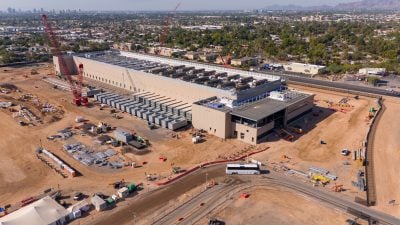
The four largest cloud buyers are on pace to spend roughly half a trillion dollars this year building AI infrastructure, and the number keeps climbing.
Microsoft (NASDAQ:MSFT | MSFT Price Prediction) alone committed $115.95 billion in fiscal 2026 capital expenditures. Meta Platforms (NASDAQ:META) narrowed its 2026 CapEx guide to $130 to $145 billion. Alphabet (NASDAQ:GOOGL) spent $44.92 billion in Q2 alone, up 100.14% year over year. Amazon (NASDAQ:AMZN) burned $54.21 billion in Q2.
Wall Street loves it. But households should look closer.
1. Your Power Bill Is Financing the Buildout
Data centers could account for 9.1% of all U.S. electricity consumption by the end of the decade, per EIA figures cited to the House Energy and Commerce Committee. Residential electricity prices already grew 6.4% in 2024 and are forecast to keep rising through 2027. Utilities are asking regulators to fund new transmission. Homeowners are on the tab.
2. Water in the Wrong Places
U.S. data center water use hit roughly 66 billion liters in 2023, more than triple the 2014 level. A single hyperscale campus in Denver projects up to 805,000 gallons a day, the equivalent of about 16,100 residents. White House AI Czar David Sacks amplified a community backlash story about a Washington state town this week, signaling that water permitting is becoming a political constraint, not just an engineering one.
3. Your 401(k) Is a Concentrated AI Bet
NVIDIA (NASDAQ:NVDA) now sits at a $5.46 trillion market cap and represents 7.58% of the SPDR S&P 500 ETF. Combined, NVDA, MSFT, GOOGL, AMZN, and META make up 23.76% of the index. The VIX is at 14.55, in the bottom 4.3% of its 12-month range. Every passive index buyer is long AI capex, and volatility is priced for calm.
4. Pristine Balance Sheets Are Levering Up
Alphabet’s free cash flow turned negative $5.86 billion in Q2, long-term debt climbed from $46.5 billion to $98.2 billion, and the buyback was suspended. Meta’s free cash flow collapsed 91.31% to $784 million, with long-term debt at $83.66 billion. They are borrowing at a 4.70% 10-year Treasury yield, sitting in the 98th percentile of the past year.

5. The Circular Financing Problem
NVIDIA invests in Anthropic. Anthropic buys NVIDIA chips through Amazon and Microsoft cloud contracts. Alphabet booked a $99.03 billion gain on equity securities in Q2. NVIDIA’s Q2 guide of $91 billion excludes China entirely. If any hyperscaler blinks on CapEx, the demand chain, the equity marks, and the debt service assumptions all move together.
What to Watch
Meta already traded human capital for compute capital, cutting 8,000 employees in May with $1.18 billion in severance while raising its CapEx ceiling. META stock is down more than 24% over the past year even as spending accelerated. The next signal: whether Q3 free cash flow at Alphabet and Meta recovers, or whether the debt window at 4.70% starts to close. If it closes, the buildout gets rationed, and everything downstream reprices.
Contact [email protected] for any questions or corrections.
Joel South covers large-cap stocks, dividend investing, and major market trends, with a focus on earnings analysis, valuation, and turning complex data into actionable insights for investors.
He brings more than 15 years of experience as an investor and financial journalist, including 12 years at The Motley Fool, where he served as an investment analyst, Bureau Chief, and later led the Fool.com investing news desk. He has also co-hosted an investing podcast and appeared across TV and radio discussing market trends.