One Number Tells Me Nvidia Stock Could Go Much Higher
A single data point buried in Nvidia's latest earnings call flipped my read on where this stock is actually headed, and the market has not caught up yet.


One number in NVIDIA’s second quarter fiscal 2027 earnings call reframed the entire AI trade for me: management’s guidance that revenue will grow approximately 70% in fiscal 2028, and that the outlook is supply-constrained rather than demand-constrained. That single data point tells me the market is still underpricing this story.
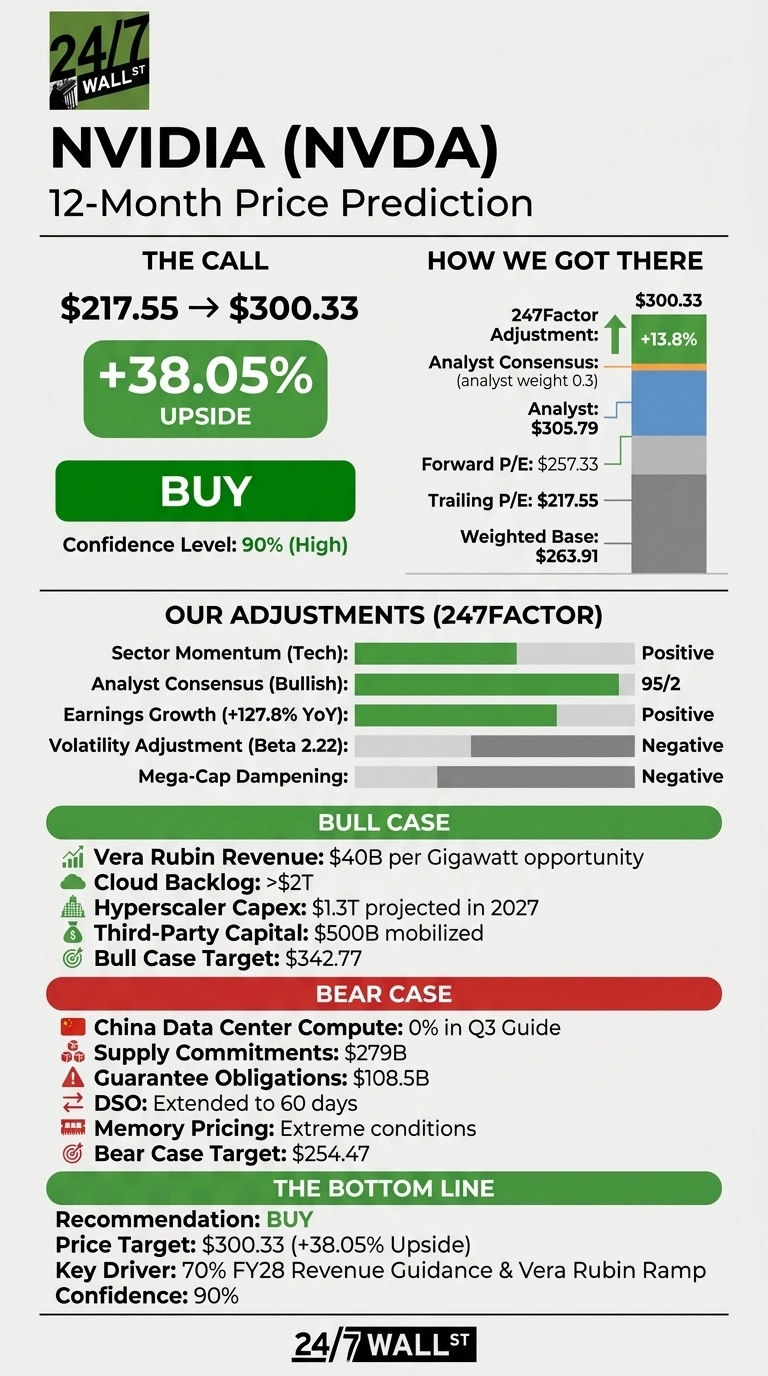
NVIDIA (NASDAQ:NVDA | NVDA Price Prediction) trades at $217.55. Our 24/7 Wall St. price target for NVIDIA is $300.33 over the next 12 months, implying 38.05% upside. The recommendation is buy, with confidence at 90%, which we classify as high.
24/7 Wall St. Price Target Summary
| Metric | Value |
|---|---|
| Current Price | $217.55 |
| 24/7 Wall St. Price Target | $300.33 |
| Upside | 38.05% |
| Recommendation | BUY |
| Confidence Level | 90% |

A Blowout Quarter That Set the Stage
NVIDIA is up 14.49% over the past month and 16.79% year to date, though it slipped 4.57% on August 28 after earnings.
Q2 FY27 revenue hit $96.22 billion, up 105.85% year over year, with Data Center revenue reaching $89.02 billion and non-GAAP EPS of $2.22 beating consensus by 6.29%. Q3 guidance calls for $108 billion, plus or minus 2%. Jensen Huang put it plainly: “AI has reached its inflection point. It’s doing useful work. Its tokens are productive and profitable. Now, compute is revenue.”
Why Bulls See a Breakout to $342
The bull case rests on Vera Rubin economics. NVIDIA’s revenue opportunity expanded from roughly $18 billion per gigawatt on Hopper to $40 billion per gigawatt on Vera Rubin, with cloud industry backlog now greater than $2 trillion and top-five hyperscaler capex projected at $1.3 trillion in 2027.
Add the $500 billion third-party capital pool with Apollo, BlackRock, Blackstone, Brookfield, Goldman, and KKR. Our bull scenario points to $342.77, and analyst consensus already sits at $305.79 across 58 buys and 10 strong buys.

What Could Go Wrong
Q3 guidance excludes China Data Center compute revenue entirely, and Hopper shipments to China are less than 1% of Data Center revenue. Supply commitments surged to $279 billion, guarantee obligations sit at $108.5 billion, and DSO stretched from 45 to 60 days.
Management warned of extreme pricing conditions in memory with margins bottoming at 71% to 72% in Q4. Insider activity trended net selling. Bulls argue the DSO extension reflects investment-grade customers pre-committing capacity. Our bear scenario still lands at $254.47, above today’s price.
How NVIDIA Compares to AMD and Broadcom
AMD (NASDAQ:AMD) is the closest pure-play GPU competitor and won a landmark 6-gigawatt OpenAI commitment. AMD’s Q2 FY26 revenue was $11.54 billion, up 50.1%, with Data Center at $6.72 billion. AMD trades at a trailing P/E of 175 versus NVIDIA at 44, keeping our NVIDIA target within a reasonable range.
Broadcom (NASDAQ:AVGO) is the custom-ASIC alternative hyperscalers use to reduce NVIDIA dependency. AVGO’s Q2 AI semiconductor revenue reached $10.80 billion, up 143%, with Q3 guided to $16 billion. Broadcom’s $1.75 trillion market cap on smaller revenue makes NVIDIA’s $96 billion quarterly base look reasonably valued at 27x earnings.
Bottom Line on the Setup
The 24/7 Wall St. price target is $300.33, our recommendation is buy, and confidence sits at 90%. The tipping factor is the 70% FY28 revenue guide under supply constraints.
The bull thesis strengthens if Vera Rubin volume ramps into calendar 2027 as promised. The setup weakens if memory pricing gets severe enough that FY28 gross margin drops below 70%. On balance, the risk-reward skew leans constructive.
NVIDIA Price Prediction 2026-2030
| Year | 24/7 Wall St. Price Target |
|---|---|
| 2026 | $245 |
| 2027 | $300 |
| 2028 | $375 |
| 2029 | $455 |
| 2030 | $537 |
These projections assume NVIDIA continues executing on the Vera Rubin ramp and hyperscaler capex durability. Meaningful upside or downside could come from AGI-driven inference demand or policy-driven China reopening.
The chipmaker gets the headlines, but the power, cooling, and networking suppliers behind these data centers are worth their own look (we profiled seven of them in a free report here).
Contact [email protected] for any questions or corrections.
Vandita Jadeja is a financial publisher with over a decade of experience writing about financial topics, including investment, savings, retirement, insurance and banking. Vandita is a Chartered Accountant who loves to debunk financial concepts for readers.
Her work has appeared on sites that include The Motley Fool, InvestorPlace, and Benzinga. She covers investing and focuses on stock picks and price prediction for 24/7 Wall St.
When not looking for the next stock investment opportunity, she can be found traveling, reading, chasing sunsets and enjoying her iced latte.