Prediction: Pepsi Stock Could Surprise Wall Street in 2027
PepsiCo shares have quietly slipped while rivals rallied, but a confluence of international momentum, a massive buyback, and a portfolio overhaul is building pressure beneath the surface. Here is the case for why 2027 could be the year the market…

I’ve watched PepsiCo (NASDAQ:PEP | PEP Price Prediction) trade like a stock the market has forgotten. Shares are down 0.71% year-to-date and off 2.25% over the past year, even as CEO Ramon Laguarta pushes through the biggest portfolio refresh in years.
Q2 delivered the fastest volume growth since 2022, U.S. salty snacks flipped from share loser to share gainer, and international revenue is on pace to cross $40 billion this year. With shares near $141, let me walk through what it would take for Pepsi to reach $175 in 2027.

Why Wall Street Sees a Slow Grind Higher
The Street’s consensus 12-month price target sits at $155, roughly 10% above the current quote. Analysts model $8.98 in 2027 EPS on $101.9 billion in revenue, up from $8.56 EPS on $98.9 billion in 2026. Coverage is deep, with 23 EPS analysts tracking the name.
Estimates have drifted lower (the 2027 EPS average was $9.15 ninety days ago), which reflects management’s warning that results could land “towards the low end of the EPS range.” Still, Pepsi has beaten expectations in 4 consecutive quarters, so the modeled numbers may prove conservative.

Path to $175 Per Share
At $141, PEP trades at roughly 16x 2027 EPS of $8.98. A move to $175 would push the multiple to about 19x, still below the S&P 500’s forward P/E near 22x and well beneath Pepsi’s own historical 23x trailing multiple.
In other words, the path to $175 hinges on the market re-rating PEP back toward its long-run average as growth reaccelerates, with only modest EPS progress required.
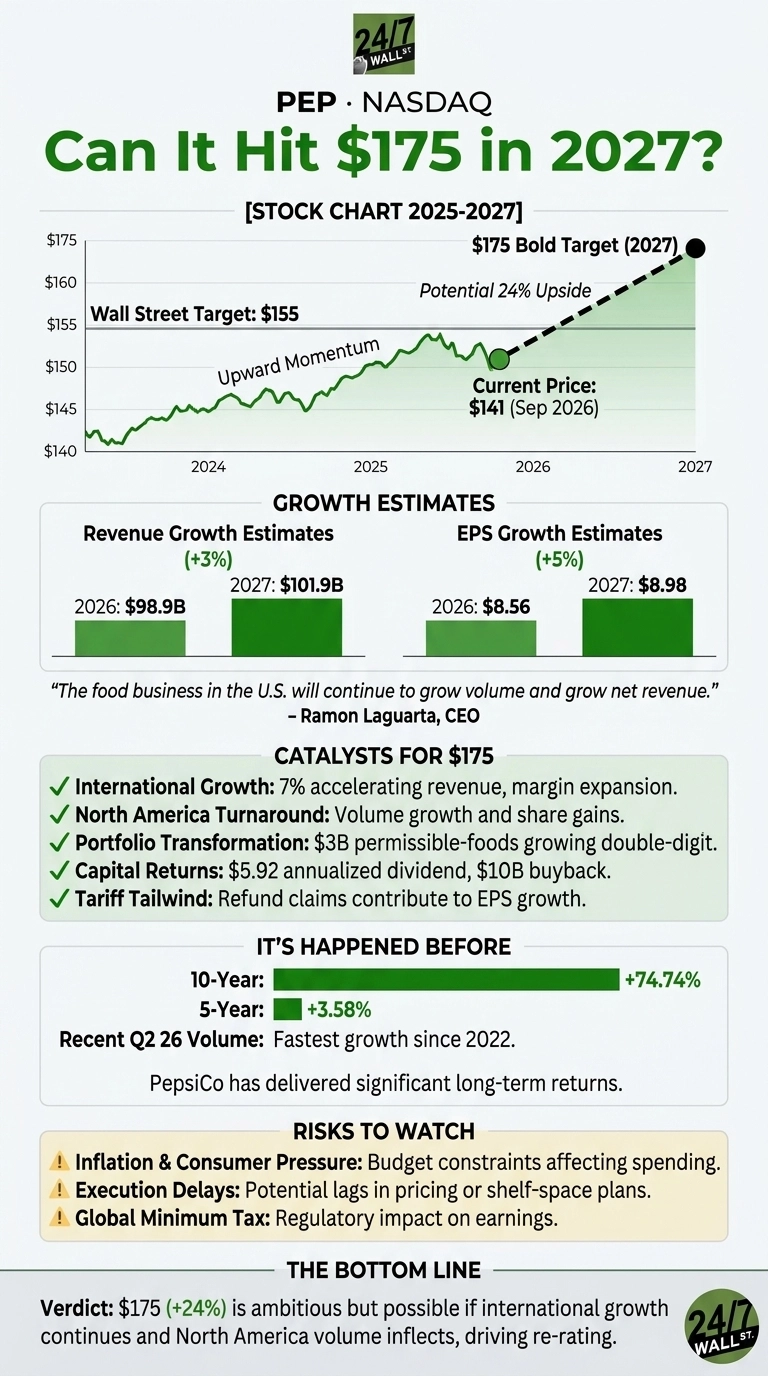
Here’s what could get it there:
- International engine. International operating margin grew by a full point in Q2, with 7% accelerating revenue growth across EMEA, Asia Pacific, and Latin America.
- North America turnaround. Laguarta said “the food business in the U.S. will continue to grow volume and grow net revenue in the coming quarters,” aided by shelf-space gains and affordability execution.
- Portfolio transformation. The permissible-foods portfolio is already $3 billion and growing almost double-digit, with poppi, Siete, Naked, and Doritos Protein scaling.
- Capital returns. A $5.92 annualized dividend, the 54th consecutive annual hike, and a $10 billion buyback authorization underwrite total return.
- Tariff tailwind. Management said refund claims will contribute “about one full point of EPS growth for the year.”

Historical Returns Say $175 Is Reasonable
A move from $141 to $175 is roughly 24% in price, or closer to 28% with dividends. That’s above Pepsi’s five-year total return of 3.58%, but well within its 10-year gain of 74.74%.
With a beta near 0.36, PEP tends to move in modest ranges, yet mid-20% snapbacks off multi-year lows have happened repeatedly for consumer staples aristocrats when sentiment turns.
Bottom Line on $175
Hitting $175 requires a modest re-rating to 19x forward earnings plus mid-single-digit EPS growth. Wall Street is already halfway there with a $155 target, and a bull-case scenario reaches $172.52 by September 2027.
If international keeps compounding, PFNA volume inflects, and the buyback shrinks the share count, $175 becomes the natural landing spot. Returns like that shouldn’t be expected every year, but we’ve outlined the blueprint for how Pepsi could deliver outsized returns in 2027.
Contact [email protected] for any questions or corrections.
Vandita Jadeja is a financial publisher with over a decade of experience writing about financial topics, including investment, savings, retirement, insurance and banking. Vandita is a Chartered Accountant who loves to debunk financial concepts for readers.
Her work has appeared on sites that include The Motley Fool, InvestorPlace, and Benzinga. She covers investing and focuses on stock picks and price prediction for 24/7 Wall St.
When not looking for the next stock investment opportunity, she can be found traveling, reading, chasing sunsets and enjoying her iced latte.