Prediction: This Out-of-Favor Dividend Stock Could Have Significant Upside
PepsiCo sits near a 52-week low while the rest of the market chases AI momentum, and the gap between where it trades and where the fundamentals point is getting harder to ignore.


PepsiCo (NASDAQ:PEP | PEP Price Prediction) has become a genuinely out-of-favor name in a market obsessed with AI and momentum. The stock trades near its 52-week low of $129.55, sports a 4.31% dividend yield, and is coming off four consecutive quarters of beating consensus EPS estimates. Our 24/7 Wall St. price target for PepsiCo is $152.80, implying meaningful upside from current levels.
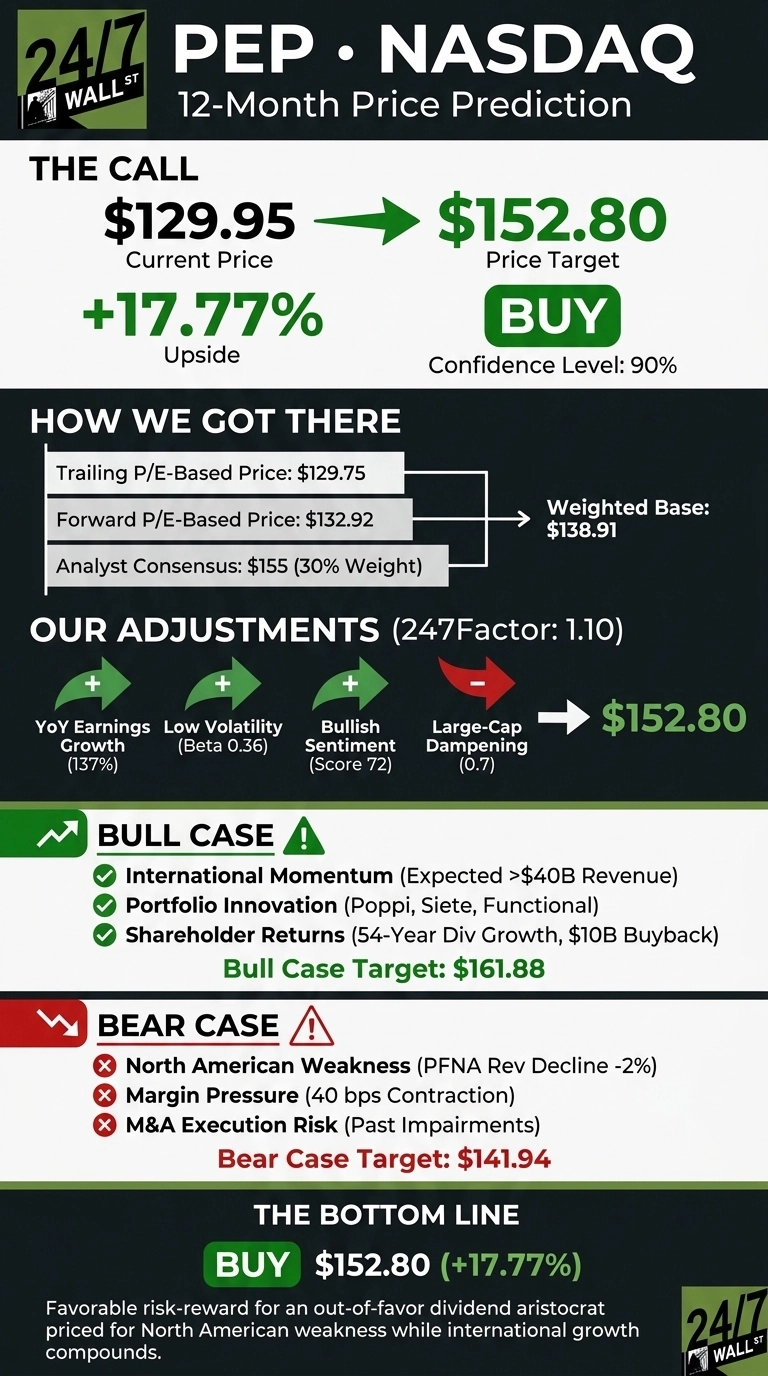

24/7 Wall St. Price Target Summary
| Metric | Value |
|---|---|
| Current Price | $129.95 |
| 24/7 Wall St. Price Target | $152.80 |
| Upside | 17.77% |
| Recommendation | BUY |
| Confidence Level | 90% |
Why Pepsi Is Trading Where It Is
PepsiCo shares are down 6.7% year to date and 7.88% over the past month.
Q2 pressure came from PepsiCo Foods North America revenue declining 2% and core operating margin contracting 40 basis points. International results offset: LatAm Foods +15%, Asia Pacific Foods +12%, EMEA +10%, and IB Franchise +11%.
Q2 core EPS came in at $2.20 on revenue of $24.18 billion, up 6.4% year over year. CEO Ramon Laguarta noted “fastest growth in volumes since 2022”.

Why Bulls See a Breakout Ahead
The bull case rests on international momentum, portfolio innovation, and shareholder returns. Management expects international business to cross $40 billion this year, with operating margin up a full point in Q2. Poppi, Siete, functional hydration, protein snacks, and zero-sugar beverages offer reinvention optionality.
The $10 billion buyback authorization through 2030 plus 54 consecutive years of dividend growth mean shareholders get paid to wait. Bull scenario points to $161.88, and Street consensus sits at $155, with 29 bullish analysts against 4 bearish.

What Could Go Wrong
The bear case centers on North America, where the U.S. consumer remains pressured by inflation, hurting convenience and gas channel conversion. Q2 core operating margin contracted 40 basis points, and management flagged results may trend to the low end of the EPS range.
Prior impairments on Rockstar ($1.993B) and Be & Cheery show M&A execution has been imperfect. Operating cash flow of $12.087 billion in FY25 comfortably funds the dividend. Our bear scenario lands at $141.94, still above today’s price.
How PepsiCo Compares to Coca-Cola, Mondelez, and Keurig Dr Pepper
Coca-Cola (NYSE:KO) trades at a premium with forward P/E of 25 and 2.36% yield.
Mondelez (NASDAQ:MDLZ) trades at forward P/E of 18 with 3.22% yield.
Keurig Dr Pepper (NASDAQ:KDP) trades at forward P/E of 12, but trailing P/E of 31 reflects 90% earnings decline from recent charges.
| Company | Forward P/E | Dividend Yield |
|---|---|---|
| PepsiCo | ~16 | 4.31% |
| Coca-Cola | 25 | 2.36% |
| Mondelez | 18 | 3.22% |
| Keurig Dr Pepper | 12 | 2.93% |
The peer set makes our 24/7 Wall St. price target look conservative. PepsiCo trades at a meaningful discount to Coke and Mondelez on forward earnings while offering the highest yield in the group.
Where the Risk-Reward Stands
The 24/7 Wall St. price target of $152.80, buy rating, and 90% confidence reflect a stock priced for North American weakness while international compounds.
The setup improves if management stabilizes U.S. foods and lets international and buyback drive returns. The thesis weakens if PFNA volumes worsen and dividend growth becomes the only story. For a dividend aristocrat near lows, risk-reward looks favorable.
Extending our model forward, here is where PepsiCo could trade assuming current trajectories and shareholder-return policies hold.
| Year | 24/7 Wall St. Price Target |
|---|---|
| 2026 | $135 |
| 2027 | $157 |
| 2028 | $175 |
| 2029 | $193 |
| 2030 | $207 |
These projections assume PepsiCo executes on international expansion and productivity. Significant upside or downside could result from U.S. consumer recovery, tariff shifts, or M&A outcomes on poppi and Siete.
Contact [email protected] for any questions or corrections.
Vandita Jadeja is a financial publisher with over a decade of experience writing about financial topics, including investment, savings, retirement, insurance and banking. Vandita is a Chartered Accountant who loves to debunk financial concepts for readers.
Her work has appeared on sites that include The Motley Fool, InvestorPlace, and Benzinga. She covers investing and focuses on stock picks and price prediction for 24/7 Wall St.
When not looking for the next stock investment opportunity, she can be found traveling, reading, chasing sunsets and enjoying her iced latte.