Pepsi’s Fall Continues: One Prominent Firm’s Resolute Target Implies 41% Gains Moving Forward
PepsiCo has shed nearly 7% this year while the S&P 500 climbed double digits, yet one prominent firm refuses to abandon a price target that towers far above Wall Street consensus and hinges on a very specific set of dominoes…


PepsiCo (NASDAQ:PEP | PEP Price Prediction) currently trades at $129.75, while the average Wall Street analyst target sits at $155. That leaves shares roughly 19% below where the sell side collectively thinks the stock belongs.
PepsiCo is the snack and beverage giant behind Pepsi, Lay’s, Doritos, Gatorade, Mountain Dew, Quaker, and recently acquired poppi. A 54th consecutive annual dividend increase and defensive consumer staples profile normally command a premium multiple that has quietly evaporated in 2026.
The gap matters because BNP Paribas Exane still carries a $183 price target on the stock, implying roughly 41% upside from here.
Consumer Squeeze and North American Stumbles Drove the Slide
Shares have slid 8% over the past month and sit 6.85% lower year to date, badly lagging the S&P 500’s 11.7% gain. In Q2, PepsiCo Foods North America revenue fell 2%, core operating margin contracted 40 basis points, and PBNA operating margin dropped about 90 basis points.
CEO Ramon Laguarta said: “The consumer is worse than what we had anticipated and driven mainly by gas prices.” Delayed pricing investments and convenience store weakness added pressure. Management reaffirmed full-year guidance but warned results “may be towards the low end of the EPS range” previously provided.
Why BNP Paribas Sees a Path to $183
The bull case leans on international momentum, productivity-driven margin recovery, and a defensive cash flow profile the market is underweighting. BNP Paribas Exane trimmed its target to $183 from $195, yet that mark stands as the current high-water target. Goldman Sachs sits at $180, cut from $183.
International numbers are compelling. In Q2, Latin America Foods grew 15%, Asia Pacific Foods grew 12%, International Beverages Franchise grew 11%, and EMEA grew 10%. Laguarta expects the international business to cross $40 billion this year, calling it “a big driver of growth for us in the coming years.” Global organic volume growth hit its highest year-to-date rate since 2022.
Wall Street overall is cautious. Among 24 analysts, the split is 4 Strong Buy, 3 Buy, 16 Hold, and 1 Sell. Q3 EPS estimates have slid, but Q4 consensus has seen 12 upward revisions in the trailing 7 days.
For $183 to hit, North American volume must stabilize while international compounds and tariff refunds worth roughly one point of EPS growth flow through. The bull camp has not blinked.
Coke Holds Firm, Mondelez Sags, Keurig Runs Flat
Beverage-and-snack peers have held up better. Pepsi’s decline is largely its own story.
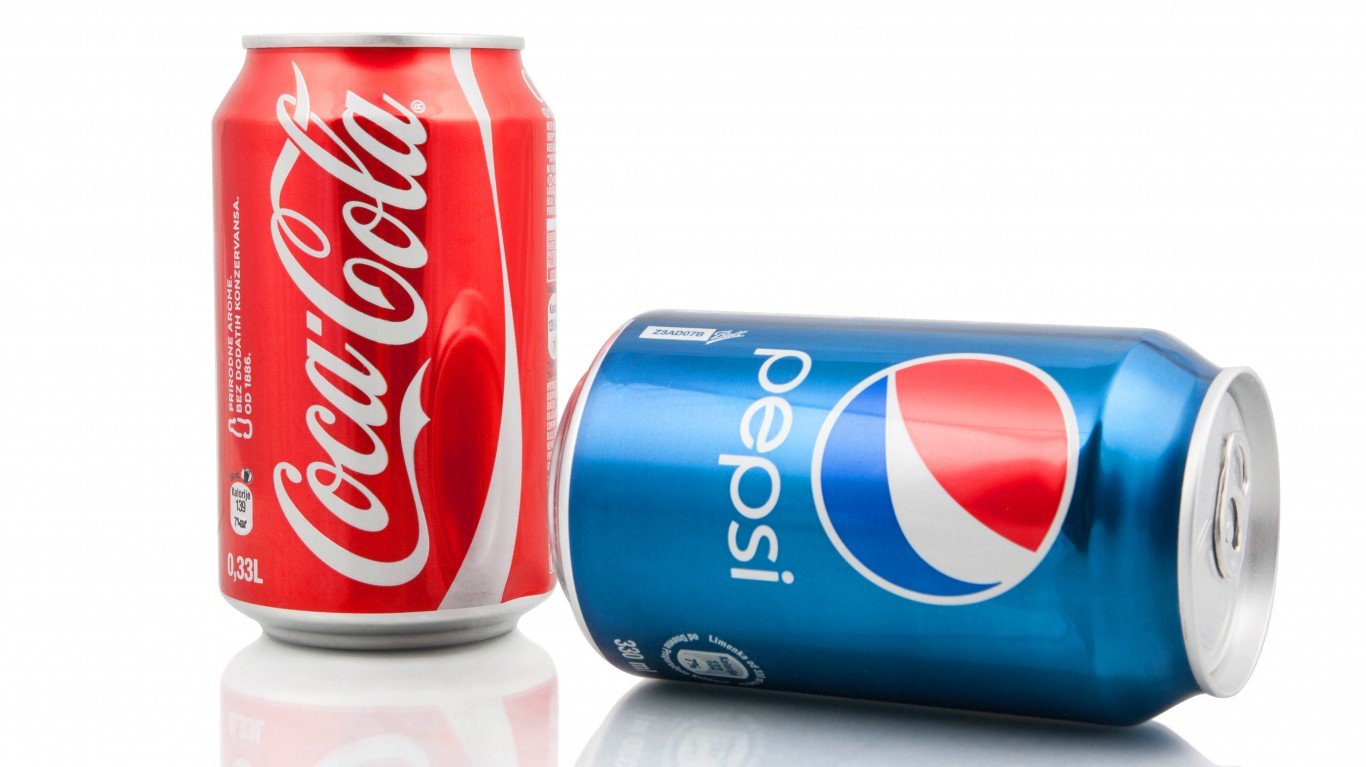
Coca-Cola (NYSE:KO) trades at $88.15 against a $94.70 average target, implying about 7% upside. The stock sits near its 52-week high of $91.94 with a bullish 7 Strong Buy, 12 Buy, 4 Hold, 1 Strong Sell mix.
Mondelez International (NASDAQ:MDLZ) sits at $60.85 versus a $69.13 target, roughly 14% implied upside. Cocoa inflation has weighed on the snack maker, and a 5 Strong Buy, 10 Buy, 9 Hold split reflects mixed conviction.
Keurig Dr Pepper (NASDAQ:KDP) trades at $30.96 against a $36.21 target, about 17% upside. A 5 Strong Buy, 8 Buy, 5 Hold mix skews bullish, but a 31 trailing P/E leaves less valuation cushion.
What 41% Upside Looks Like in Data
Pepsi trades at $129.75 with a $155 consensus target, roughly 19% implied upside, while BNP Paribas Exane’s $183 target implies about 41%. Forward FY26 EPS is estimated at $8.5598, rising to $8.9754 in FY27, putting the forward P/E near 14.
Shares are down 8.02% over the past month, 4.82% over the past week, and 6.85% year to date. The S&P 500 is up 11.7% year to date over the same window. A 4.31% dividend yield and a $10 billion buyback authorization through February 2030 offer a floor.
Bull Case at $129, or a Value Trap With a Yield?
The bull case works here if North American volume inflects in the back half as delayed pricing executes, international keeps compounding double-digits, and tariff refunds land as expected. If those line up, the $155 consensus is reachable and BNP’s $183 is not far-fetched for a Dividend Aristocrat near 14x forward earnings with a 4%-plus yield.
The bear case holds if U.S. consumer weakness is structural rather than cyclical, if GLP-1 headwinds pressure snack volumes long term, or if margin recovery keeps slipping.
On balance, the setup skews cautiously constructive. The yield, buyback, and international engine make the risk/reward notable at these levels, though the full 41% BNP move requires more North America proof.
Contact [email protected] for any questions or corrections.
Alex Sirois is a financial writer with experience spanning both retail and institutional investing. He has written for InvestorPlace and held roles at BNY Mellon and Bernstein, giving him a perspective that bridges Main Street portfolios and Wall Street analysis.
Alex holds an MBA from George Washington University and has built his career across multiple industries, including e-commerce, education, and translation — a breadth of experience that informs how he breaks down complex financial topics for everyday investors. His writing is conversational, actionable, and grounded in long-term, buy-and-hold investing principles.
At 247 Wall St., Alex focuses on delivering analysis that is both accessible and useful, with a clear emphasis on helping readers make more informed decisions with their money.