AMD’s Whole AI Story Has One Threat It Cannot Ignore: Broadcom
AMD is posting explosive AI growth, but one rival is quietly locking in the same hyperscaler customers through a strategy that could shrink AMD's market before anyone notices the ceiling.

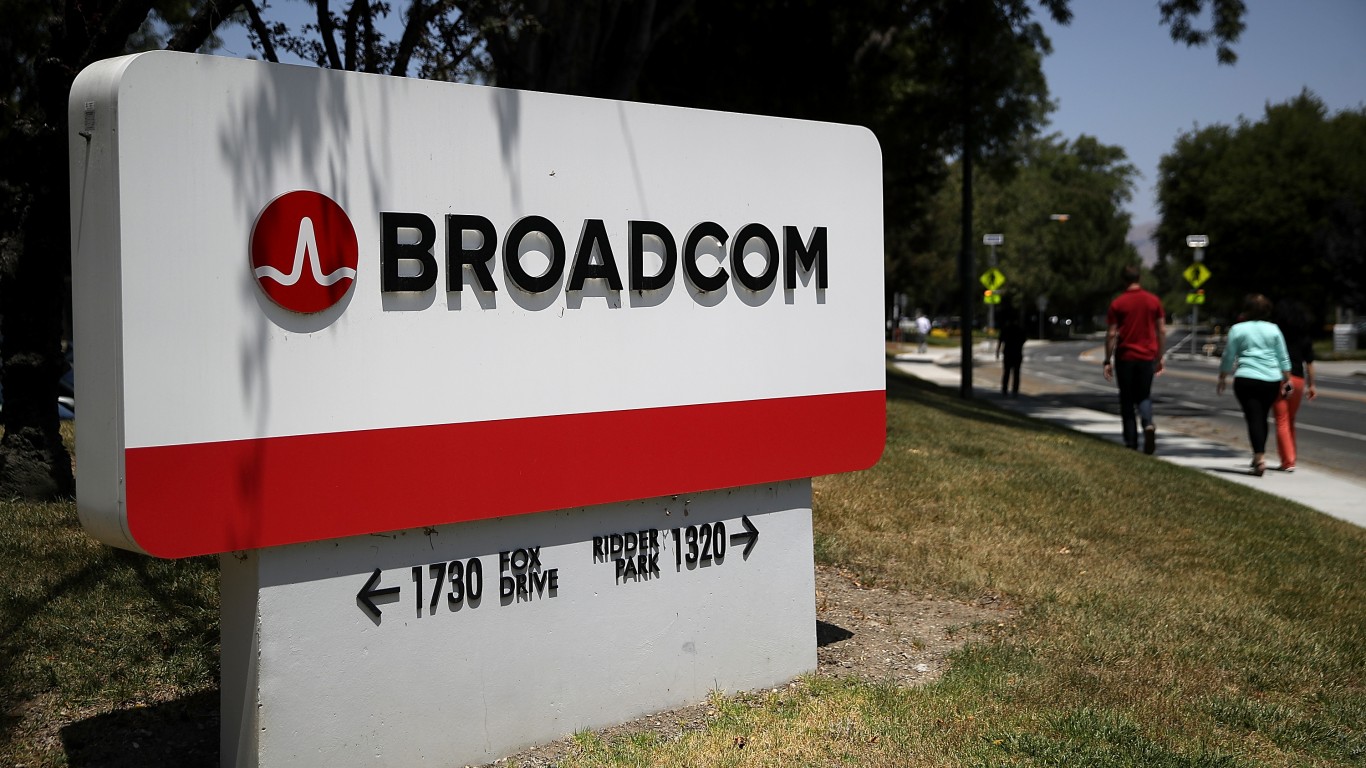
AMD (NASDAQ: AMD | AMD Price Prediction) and Broadcom (NASDAQ: AVGO) both just delivered blockbuster AI quarters, but the two chipmakers are chasing the same dollars from opposite ends. AMD is selling merchant Instinct GPUs and EPYC CPUs into any datacenter that will buy them. Broadcom is co-designing custom silicon inside a handful of hyperscalers. That contrast is why Broadcom poses a structural threat to AMD’s general-purpose GPU story.
Instinct Scales, but Broadcom’s XPUs Land Harder
AMD’s Q2 FY2026 revenue hit $11.54 billion, up 50.1% year over year, with Data Center at $6.72 billion and +107% growth. Lisa Su said “Data Center revenue more than doubled year-over-year” and now expects Data Center segment revenue to more than double again in 2027. That is real momentum, and Helios shipments start later in Q3 2026.
Broadcom’s Q3 FY2026 was on a different scale. Revenue reached $29.59 billion, up 85.5% year over year, and AI semiconductor revenue alone was $16.70 billion, growing 221% YoY and 54% sequentially. Hock Tan guided Q4 AI revenue to $21.7 billion, up 236% YoY, and sketched a fiscal 2027 AI outlook near $115 billion with supply already secured. The Q3 operating margin of 67.9% is in a different weight class than AMD’s 27% non-GAAP operating margin.
Merchant GPU Bet vs. Custom Silicon Moat
| Lens | AMD | Broadcom |
| Core AI Product | Instinct MI350/MI450, Helios racks | Custom XPUs, Tomahawk Ethernet |
| Anchor Customers | OpenAI, Meta, Anthropic, Microsoft | Google, Anthropic, OpenAI, Meta |
| Key Risk | Export controls, memory supply, ROCm ecosystem | Customer concentration, indebtedness |
The uncomfortable overlap: three of AMD’s marquee AI customers, OpenAI, Anthropic, and Meta, are also building custom accelerators with Broadcom. Tan argued that a co-developed XPU “will outperform any GPU” and can run at “half the cost of a GPU”. If frontier labs shift training and inference to their own silicon, AMD’s total addressable market at those accounts shrinks even as it ships MI450s.
2027 Ramp Is the Real Signal to Track
The near-term optics favor AMD. Shares are up 195.18% over one year and 135.63% over six months, while Broadcom has cooled, down 14.44% in the past month. I want to see whether Helios yields improve on schedule and whether AMD’s $1.4 trillion 2030 AI accelerator TAM assumption holds once Broadcom is delivering multi-tens of billions of TPUs to Google annually.
Why I Would Own Broadcom for the Structural Story
Personally, I lean Broadcom here. The $13.66 billion free cash flow quarter, the 15th consecutive dividend increase, and a customer roster that is effectively pre-selling 2028 capacity give it a defensive quality AMD cannot match yet. AMD is the more exciting story, especially if you believe merchant GPUs win outside the top four labs, and Reddit’s bullish sentiment scores of 72 and 74 reflect that enthusiasm. But if custom accelerators keep eating frontier workloads, Broadcom is the one collecting the toll. I would rather own the toll booth (we reverse-engineered what the biggest tech winners looked like early and put the traits into a free playbook you can grab here).
Contact [email protected] for any questions or corrections.
Alex Sirois is a financial writer with experience spanning both retail and institutional investing. He has written for InvestorPlace and held roles at BNY Mellon and Bernstein, giving him a perspective that bridges Main Street portfolios and Wall Street analysis.
Alex holds an MBA from George Washington University and has built his career across multiple industries, including e-commerce, education, and translation — a breadth of experience that informs how he breaks down complex financial topics for everyday investors. His writing is conversational, actionable, and grounded in long-term, buy-and-hold investing principles.
At 247 Wall St., Alex focuses on delivering analysis that is both accessible and useful, with a clear emphasis on helping readers make more informed decisions with their money.