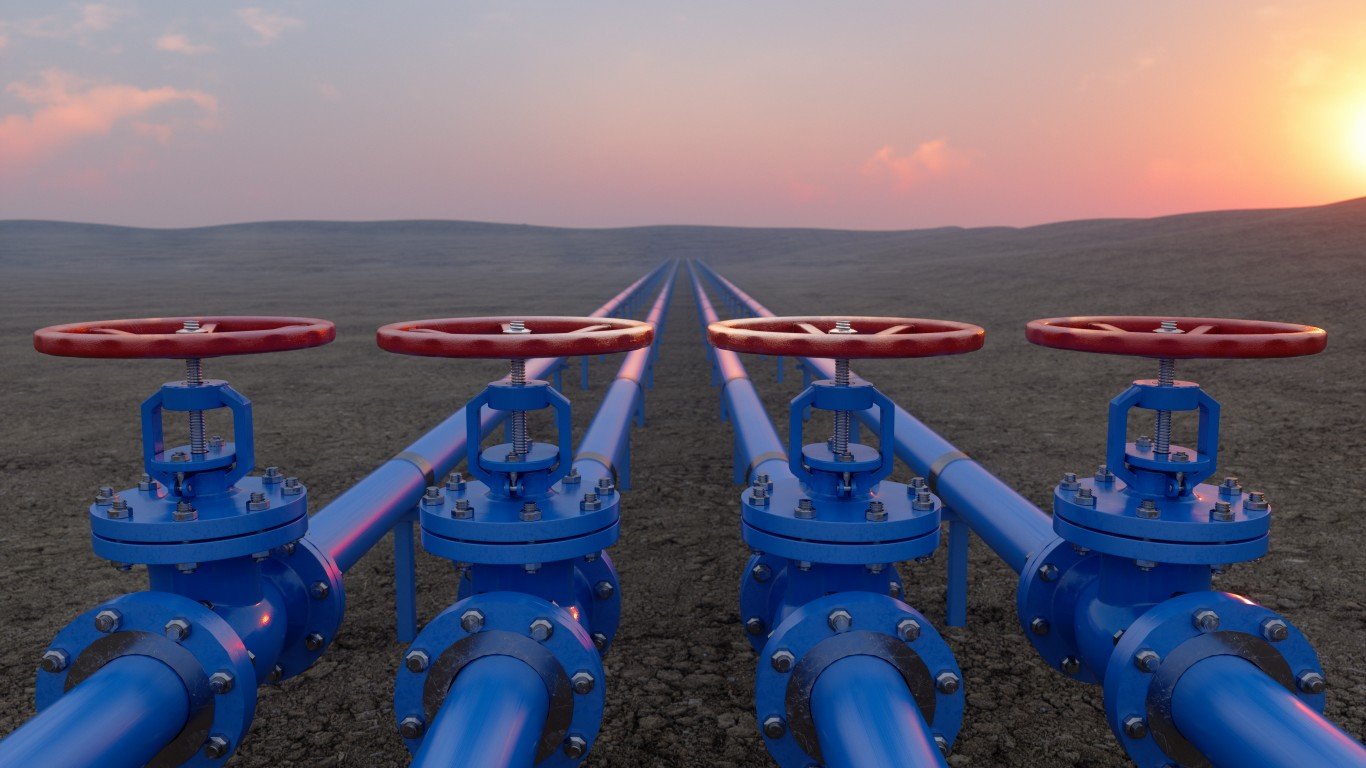
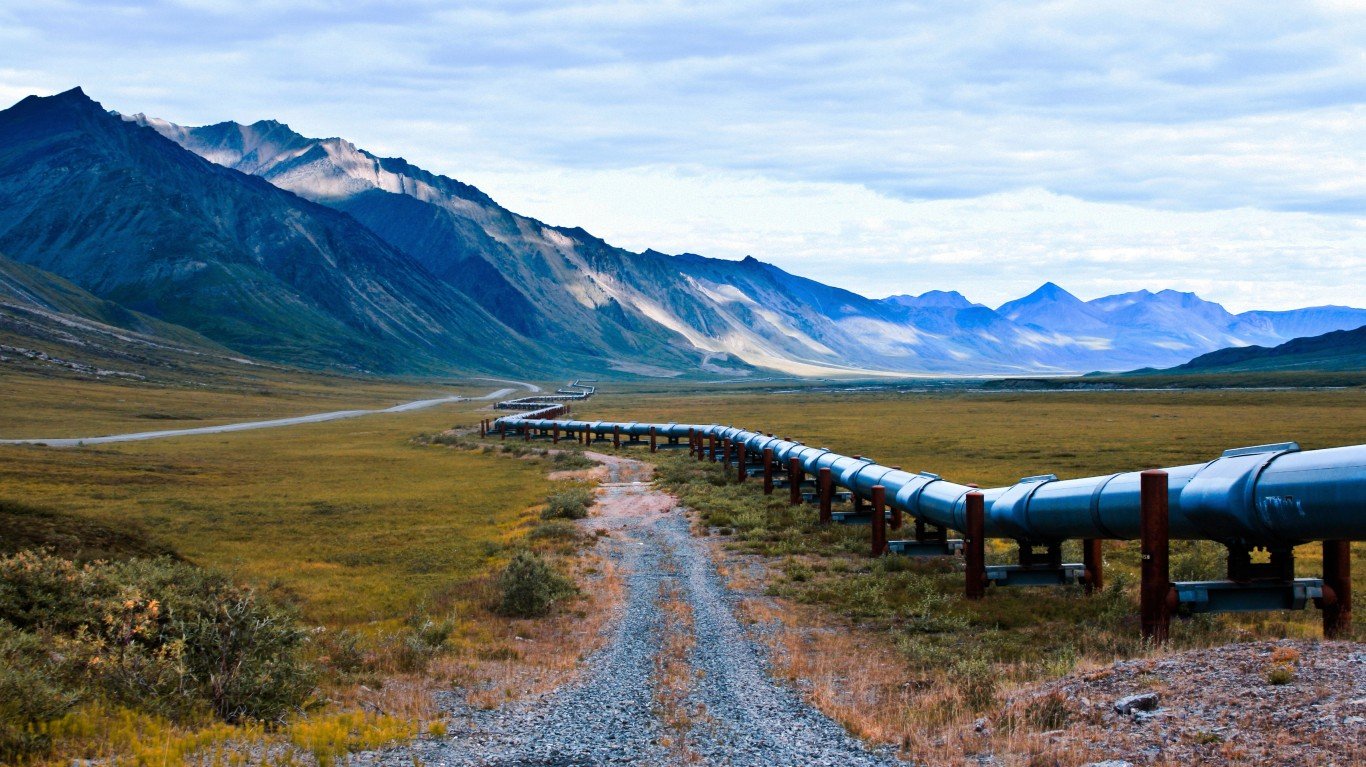
5 Pipeline Stocks Built to Make Money at Any Oil Price
Most energy investors watch oil prices and worry, but a handful of pipeline operators collect their fees whether crude crashes or surges. Five midstream names raised their payouts in 2026, and the math behind why they can keep doing it…

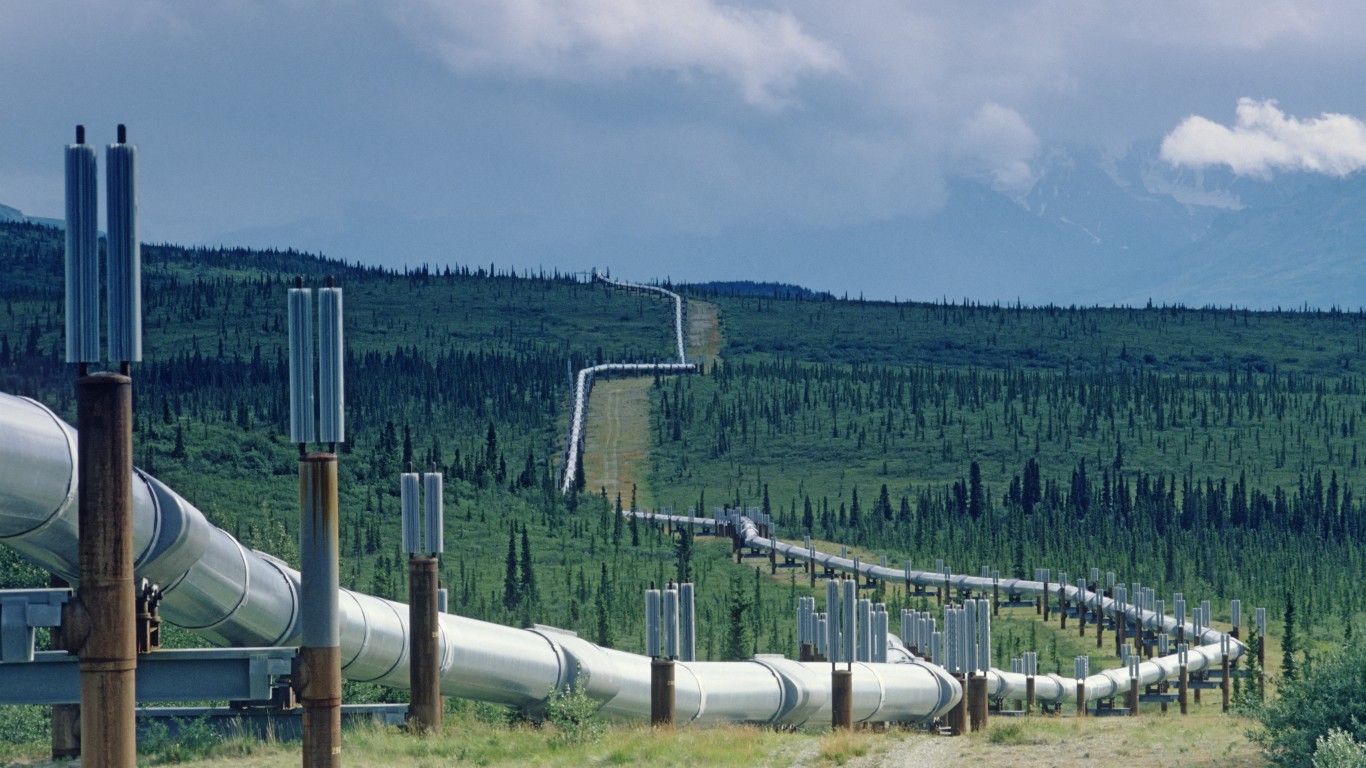
The Middle East disruption in April and May pushed energy back into the headlines, but the way most income investors think about energy is backwards. Pipeline operators get paid on volume moved under long-term contracts, which is why Enterprise Products Partners just posted a record $2.83B in Q2 2026 adjusted EBITDA on record equivalent pipeline volumes of 14.7 MMBPD. The five midstream names below share that toll-road model, and each one raised its distribution in 2026.
Enterprise Products Partners
Enterprise Products Partners (NYSE:EPD | EPD Price Prediction) pays a quarterly distribution of $0.56 per common unit, or $2.24 annualized, at a recent price of $38.94. Q2 2026 operational distributable cash flow was a record $2.3B, providing 1.9x coverage of the cash distribution, and management applied $1.1B of the quarter’s DCF to internally funded growth capex and buybacks after paying $1.2B in distributions. Distributions have stepped up every year in the recent record: $0.515 in early 2024, $0.535 in early 2025, $0.55 in early 2026, and now $0.56.
The bull case for income is coverage, self-funding, and a live buyback. EPD has a $5.0B buyback program, 34% utilized, with $405M repurchased over the trailing 12 months. Total debt principal is roughly $33.5 billion, with a weighted average life of approximately 17 years, a weighted average cost of 4.7%, and about 97% fixed-rate, which insulates the distribution from rate shocks. CEO Jim Teague said “demand for U.S. energy, natural gas, liquids, petrochemical feedstock, and export services continues to drive utilization across our system,” leaving Enterprise well positioned.
Risk: NGL and crude differentials can swing quarterly margins, and management said the roughly $200 million Q2 benefit from acute global demand in April and May has since “largely normalized.”
Kinder Morgan
Kinder Morgan (NYSE:KMI) declared a Q2 2026 dividend of $0.2975 per share, or $1.19 annualized, a 2% year-over-year increase, at a recent price of $31.40. Q2 free cash flow after capex was $978M and operating cash flow was $1.96B. Net debt-to-adjusted EBITDA finished Q2 at 3.6x, at the low end of the target range, and Moody’s upgraded KMI to Baa1 in Q1 2026, matching the BBB+ equivalent from the other two agencies. The dividend has stepped from $0.2825 in early 2024 to $0.2875, then $0.2925, and now $0.2975 in 2026.
The bull case is contract quality. Roughly 92% of KMI’s $9.6B project backlog is natural gas, and more than 60% supports power generation and local distribution demand. Executive Chairman Rich Kinder said “the natural gas growth story remains very positive as demand for LNG export volumes and gas for electric generation continues to grow,” adding that KMI can fund projects “almost completely with our internally generated cash flow while still continuing to pay a solid and growing dividend and maintaining a debt to EBITDA ratio at the lower end of our targeted range.” Management now expects full-year 2026 adjusted EBITDA more than 5% above budget and adjusted EPS more than 12% above budget.
Risk: capex is climbing fast. Q2 capex hit $982M, up 52% year-over-year, with refined products volumes down 5% and crude/condensate volumes down 16%. Execution slippage on major FID projects would eat into that leverage cushion.
Williams Companies
Williams Companies (NYSE:WMB) pays a quarterly dividend of $0.525, or $2.10 annualized in 2026, a 5% increase from $2.00 in 2025, at a recent price of $74.15. Q1 2026 adjusted EBITDA was $2.254B (+13% YoY), Q2 was $1.921B (+6% YoY), and 2026 AFFO guidance is $6.085B to $6.315B. Leverage sits at a midpoint of ~4.1x for 2026 baseline, or ~3.75x pro-forma including the Momentum Midstream deal. The dividend history shows $0.475 quarterly through 2024, $0.50 through 2025, and $0.525 in 2026.
The bull case is pure-play natural gas transmission plumbing directly into the AI-power and LNG buildout. Transco, Northwest Pipeline, MountainWest, Gulfstream, and the newly announced $5.5B acquisition of Momentum Midstream, adding 4,000-plus miles of pipe in the Haynesville corridor at ~8.5x projected 2027 EBITDA, position WMB against projected Gulf Coast LNG demand growth of ~20 Bcf/d over the next 10 years. Project Neo, a $2.3B behind-the-meter power play with 682 MW, and the Aristotle pipeline commissioned for Ohio data centers, plug the company into the power-demand curve. Management raised 2026 adjusted EBITDA guidance to $8.3B to $8.5B, with the midpoint up $200M.
Risk: 2026 growth capex was raised to $7.3B to $7.9B, Q2 capex of $1.83B was up 89% year-over-year and well ahead of operating cash flow, and the Momentum acquisition still faces HSR regulatory review.
ONEOK
ONEOK (NYSE:OKE) raised its quarterly dividend 4% to $1.07 per share in January 2026, or $4.28 annualized, at a recent price of $95.43. Roughly 90% of 2025 earnings were fee-based, and 2025 adjusted EBITDA reached $8.02B (+18% YoY). The company extinguished nearly $3.1B of long-term debt in 2025. Recent quarterly dividend history: $0.99 in 2024, $1.03 in 2025, and $1.07 in 2026.
The bull case is designed durability. 2026 guidance calls for adjusted EBITDA of $7.9B to $8.3B and adjusted EPS of $5.04 to $5.87 on WTI assumptions of just $55 to $60 per barrel, so cash flow is engineered to hold even in a soft crude environment. Integrated NGL, natural gas gathering and processing, natural gas pipelines, and refined products, plus $475M of cumulative EnLink and Medallion synergies through YE 2025 with ~$150M more expected in 2026, give OKE unusual density across the fee-based midstream footprint. A $2B share repurchase program is authorized, with $62M repurchased in 2025.
Risk: management explicitly cited moderating producer activity if WTI stays at $55 to $60 per barrel, plus NGL commodity-price sensitivity net of hedging and integration risk from EnLink and Medallion.
Energy Transfer
Energy Transfer (NYSE:ET) declared a Q2 2026 distribution of $0.34 per common unit, or $1.36 annualized, described as the nineteenth consecutive quarterly distribution increase and more than 3% higher than Q2 2025, at a recent price of $21.50. Q2 2026 adjusted EBITDA was $5.07B (+31% YoY), Q1 was $4.94B (+20% YoY), and Q1 2026 distributable cash flow was $2.70B. Management targets “a long-term annual distribution growth rate of 3 to 5 percent, and maintaining our leverage targets of 4 to 4.5 times EBITDA.”
The bull case is diversified fee-based scale plus rising guidance. 2026 adjusted EBITDA guidance was raised twice this year to $18.8B to $19.1B, with 2026 growth capex of $5.6B to $5.9B. The Hugh Brinson pipeline is ramping to 1.5 Bcf/d by September 2026, the Nederland NGL export expansion is fully subscribed for another 240,000 bpd ethane and 55,000 bpd LPG, and management said 100% of the ethane export expansion is committed under long-term agreements running into the 2040s. Q2 NGL exports rose 25%, NGL transport volumes hit a record, and crude oil transport set another record.
Risk: rising interest expense drove the Q1 EPS miss ($947M versus $809M), and the MLP structure issues a K-1 to US taxable holders, an administrative wrinkle for retirement accounts and casual investors.
Bringing the Toll Road Thesis Together
These five names all share one trait: distributions funded by contracted, throughput-driven cash flow rather than a bet on the direction of crude. EPD and ET pair coverage with a clear pattern of quarterly and annual increases. KMI and WMB anchor the natural gas transmission buildout that will feed LNG docks and power plants for the next decade. OKE combines heavy fee-based mix with an aggressive synergy runway from EnLink and Medallion. If the goal is getting paid whether oil goes up or down, these are the businesses built for the job (living off the checks without selling shares is the whole idea behind the dividend ladder we laid out in a free guide here).
Contact [email protected] for any questions or corrections.
Chris Lange is a financial and geopolitical writer with more than a decade of experience covering a myriad of topics. He has published thousands of articles for 24/7 Wall St., with past coverage focused heavily on stocks, IPOs, healthcare, defense, global affairs, and technology.
His work has been quoted, or referenced by a number of outlets including Business Insider, USA Today, Yahoo Finance, MSN, The Motley Fool, and many other publications. A graduate of Southwestern University, he studied business with a focus on investments and has previous experience in banking and startups.
When not reading or writing the news, he is following his passion for Lacrosse, playing chess, or building solar projects with his dad.