Verizon Stock Is Near a 52-Week High. Here’s Why I’m Still Bullish.
Verizon has quietly staged one of the year's most surprising large-cap comebacks, but the real question is whether the stock's best days are still ahead or already priced in.

Shares of Verizon (NYSE:VZ | VZ Price Prediction) have quietly become one of the year’s most interesting large-cap turnaround stories. The stock has climbed 29.5% year to date and sits within striking distance of its 52-week high.
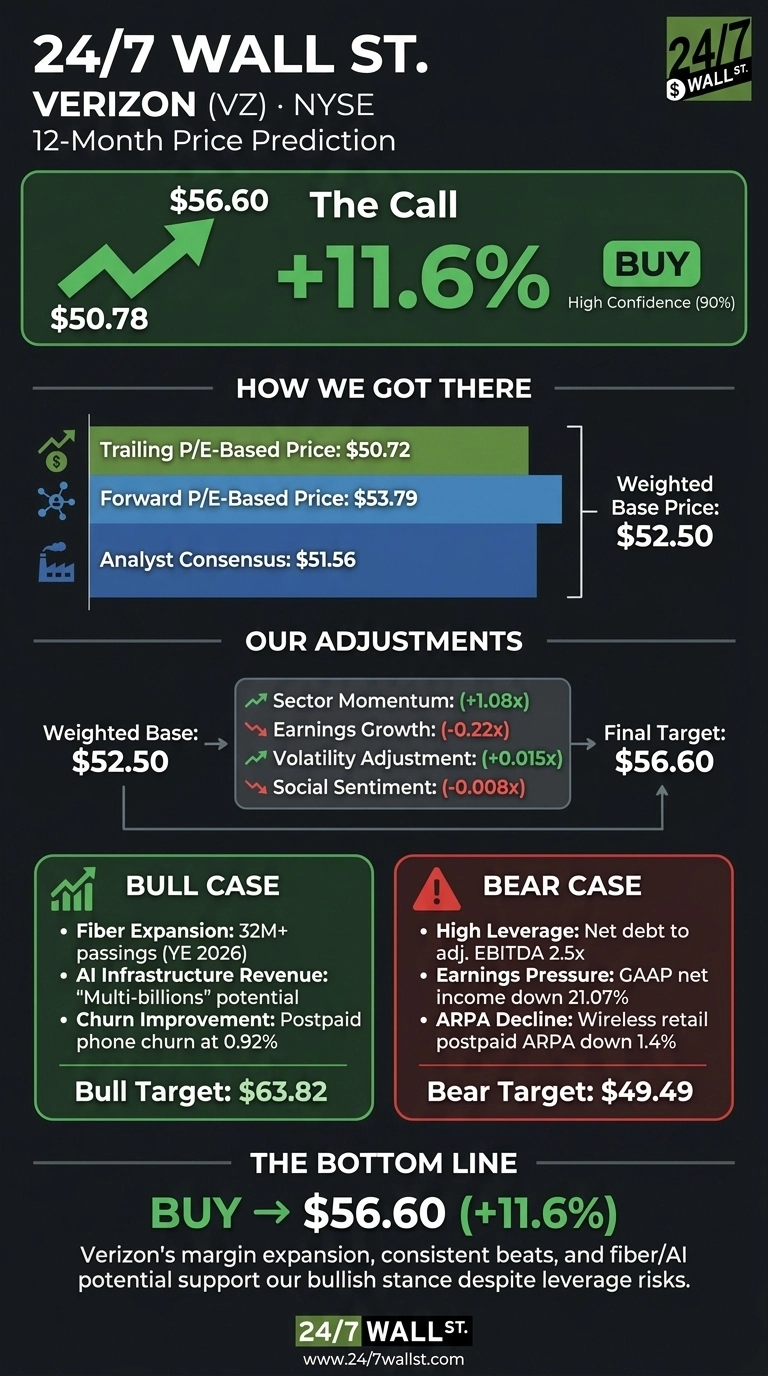
Even so, our proprietary model still sees room to run. Our 24/7 Wall St. price target for Verizon is $56.60, implying 11.6% additional upside from the current $50.78 quote. The model rates this a buy with high confidence.

| Metric | Value |
|---|---|
| Current Price | $50.78 |
| 24/7 Wall St. Price Target | $56.60 |
| Upside | 11.6% |
| Recommendation | BUY |
| Confidence Level | 90% |
A Turnaround That Is Actually Working
Verizon’s Q2 2026 report, delivered on July 24, 2026, marked its sixth consecutive earnings beat. Adjusted EPS came in at $1.30 versus a $1.27 consensus, on revenue of $34.25 billion.
Adjusted EBITDA margin expanded to 40.1% from 37.1%, postpaid phone net adds swung to 184,000 from a loss of 9,000 a year earlier, and free cash flow jumped 27.12% to $6.426 billion.
Management raised FY26 adjusted EPS guidance to $4.99 to $5.04 and lifted the buyback target to $4.5 billion. CEO Dan Schulman called it “a structural inflection point across our entire business.”

Why Bulls See a Breakout Above $60
The bull case is grounded in three levers. First, fiber. Verizon expects to exceed 32 million fiber passings by year-end, with a medium-term goal of 40 to 50 million. Fiber-broadband connections already grew 43.3% YoY to 10.9 million.
Second, AI infrastructure. Schulman flagged discussions with hyperscalers around dark fiber, lit fiber, and 5G assets that could unlock “multi billions in revenues.” Carriers are only one slice of that buildout, and we profiled seven other companies powering, cooling, and connecting AI data centers in a free report here.
Third, churn. Postpaid phone churn improved to 0.92%, and every basis point compounds. If the AI-revenue narrative materializes, our bull-case path lands at $63.82.

What Could Go Wrong
Verizon carries $136.5 billion in unsecured debt and net leverage rose to 2.5x from 2.2x post-Frontier. GAAP net income fell 21.07% on $1.8 billion in special items, wireless retail postpaid ARPA slipped 1.4% to $168.35, and FWA net adds dropped 30.6%.
Bulls would counter that the special items are non-recurring and adjusted EBITDA still grew 7.2%. In a bear scenario, our model floor is $49.49.
How Verizon Stacks Up Against AT&T and T-Mobile
AT&T (NYSE:T) is the closest strategic analog. Its Q2 2026 adjusted EPS of $0.65 beat by 10.71%, with fiber reaching 38.6 million locations and postpaid phone net adds of 432,000.
AT&T’s $179 billion market cap trades at a modest discount to Verizon’s $210.98 billion, but AT&T is guiding to $45 billion+ in shareholder returns through 2028, roughly matching Verizon’s return profile on a smaller base.
T-Mobile US (NASDAQ:TMUS) is the growth benchmark. Q2 revenue rose 7.85% to $22.79 billion, with Core Adjusted EBITDA margin at 50.2%. Postpaid ARPA of $152.91 and a market cap of $202.7 billion imply investors pay a premium for growth.
That premium is exactly why Verizon’s yield-and-turnaround setup at a lower implied multiple makes the 24/7 Wall St. price target look reasonable rather than aggressive.
Verizon Price Prediction 2026-2030
The model’s verdict: Buy, with a 24/7 Wall St. price target of $56.60 and 90% confidence. Margin expansion, six straight beats, and a $2.83 forward dividend that funds patience.
The bull thesis strengthens if Verizon delivers Q3 service revenue growth near the guided 3% and continues repaying Frontier debt. The thesis weakens if leverage climbs above 2.7x or postpaid churn ticks back above 1%.
| Year | 24/7 Wall St. Price Target |
|---|---|
| 2026 | $52.17 |
| 2027 | $56.35 |
| 2028 | $61.67 |
| 2029 | $66.40 |
| 2030 | $70.53 |
These projections assume Verizon executes on its fiber build-out, extracts Frontier synergies, and captures early AI-infrastructure revenue. Meaningful upside or downside would come from either a hyperscaler-scale AI network deal or a resurgence in promotional wireless competition.
Contact [email protected] for any questions or corrections.
Vandita Jadeja is a financial publisher with over a decade of experience writing about financial topics, including investment, savings, retirement, insurance and banking. Vandita is a Chartered Accountant who loves to debunk financial concepts for readers.
Her work has appeared on sites that include The Motley Fool, InvestorPlace, and Benzinga. She covers investing and focuses on stock picks and price prediction for 24/7 Wall St.
When not looking for the next stock investment opportunity, she can be found traveling, reading, chasing sunsets and enjoying her iced latte.