Uber Continues Its Free Fall: One Pro Analyst Says It Will Double in the Near Future
Uber has shed more than 30% from its highs while posting record free cash flow, and at least one top Wall Street analyst thinks the market has it spectacularly wrong about where this stock belongs.

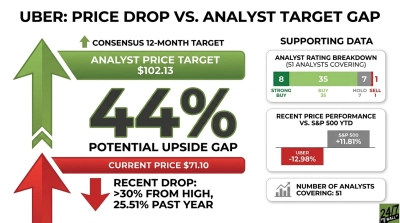
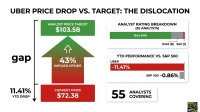
Uber shares are trading at $71.10, well below the Wall Street consensus 12-month price target of $102.13. That leaves a roughly 44% gap between where the stock trades today and where the analyst crowd thinks it belongs.
Uber (NYSE:UBER | UBER Price Prediction) runs the largest global ride-hailing and food-delivery marketplace, layered with a fast-scaling advertising business, a 50-million-member Uber One subscription, and a growing role as the connective tissue for third-party robotaxi fleets. Wall Street has spent the last two years treating it as the default winner in mobility. The problem is that the stock has not cooperated.
Since peaking near $101.99 over the past year, shares have slid steadily. The dislocation has grown wide enough that at least one senior analyst says the stock could roughly double from here.
A 30% Slide From the Highs Despite Record Cash Flow
Uber is down more than 30% from its 52-week high, and the damage has accelerated recently. Shares fell 7% in the past week alone and 25.51% over the past year, an unusually violent move for a company generating record free cash flow.
The catalyst is a string of top-line disappointments. Q2 FY2026 revenue of $14.19 billion missed consensus by 0.5%, and EPS of $0.81 came in below the $0.83 estimate. That followed a Q1 miss and a Q4 miss driven by a $1.6 billion equity revaluation headwind. Mobility revenue grew just 1% year over year in Q2, a sharp deceleration that spooked investors even though management attributed most of the pressure to a U.K. business-model change worth roughly 400 basis points of margin optics.
Layer in worker-classification overhang, competitive noise around Waymo and Tesla robotaxis, and a temporary buyback slowdown tied to about $4 billion deployed toward Delivery Hero stock, and you get a market that stopped rewarding the underlying operating story.
Why Evercore Sees Uber Nearly Doubling to $150
The bull case starts with Evercore ISI analyst Mark Mahaney, whose $150 price target stands as the active Street high. That implies roughly 111% upside from current levels. Mahaney anchors the call on three pillars: the Uber One subscription flywheel, where members spend roughly 3x more than non-members; accelerating free cash flow conversion funding aggressive buybacks; and expansion into higher-margin verticals like advertising, grocery, and travel.
The underlying numbers back the thesis. Gross Bookings grew 22% year on year in Q2 to more than $58 billion, marking the fourth consecutive quarter above 20%. Non-GAAP EPS grew 35%, and trailing 12-month free cash flow crossed $10 billion for the first time. Management said buybacks will rebuild in “months, not quarters.”
Analysts see Uber as the ecosystem winner in autonomy. The platform is live in seven cities with AV partners, on track for 15 cities by year end, with NVIDIA‑powered vehicles planned in 28 different cities globally by 2028. Consensus 2026 EPS has risen from $2.9558 ninety days ago to $3.2927, with 27 upward revisions against just 2 downward in the trailing month.
Of the analyst coverage, 8 rate it Strong Buy, 35 Buy, 7 Hold, and 1 Sell. That is a strongly bullish posture heading into a stock that has done the opposite of what its coverage suggested.
Peers Sold Off Together, But Grab Shows the Cleanest Upside
The gig-economy peer group fell as a bloc, not just Uber. Every major name is negative year to date while the broader market has climbed.
Lyft (NASDAQ:LYFT) trades near $14.90, down 23.08% year to date, against a consensus target of $19.84 for roughly 33% upside. Ratings skew Hold-heavy at 4 Strong Buy, 11 Buy, 29 Hold, and 1 Strong Sell.
DoorDash (NASDAQ:DASH) sits at $197.25, off 12.91% year to date, versus a $254.43 target implying about 29% upside. Coverage is bullish with 8 Strong Buy, 27 Buy, and 10 Hold.
Grab Holdings (NASDAQ:GRAB) trades at $3.04 after a brutal 39.08% year-to-date decline, but analysts peg fair value at $5.86, implying roughly 93% upside with a unanimous Buy skew of 5 Strong Buy and 21 Buy.
Grab carries the largest consensus upside on paper, but its Southeast Asia exposure and thinner earnings base make the setup riskier. Among the U.S.-scaled operators, Uber’s 44% consensus gap is the widest, and Mahaney’s $150 call is a full standard deviation above the crowd.
Numbers That Frame the Setup
Uber trades at $71.10 with a market cap near $149 billion, a forward P/E of 17, and a return on equity of 37.2%. The $102.13 consensus target reflects 51 covering analysts.
Year to date, Uber is down 12.98% while the S&P 500 is up 11.81%. That is a roughly 25-point relative underperformance for a company that just posted 35% non-GAAP EPS growth. Reddit sentiment on wallstreetbets sits at a bullish 78, hinting that retail is beginning to lean into the dislocation.
Where I Actually Land on Uber Here
The bull case rests on the view that reported revenue-growth optics are noise and the real story is $10 billion in trailing free cash flow, restored buybacks within months, and a genuine lead position in commercializing autonomous fleets. That is the path back toward $102, and Mahaney’s $150 case if margin expansion and AV monetization arrive on schedule.
The bear case rests on the view that Waymo and Tesla robotaxis structurally cap Mobility growth, Delivery Hero integration eats years of capital, and worker-classification battles compress margins. In that world, the recent misses are early evidence of a slower-growth Uber, and the price target catches down to the price.
The weight of evidence leans bullish. Free cash flow, gross bookings growth, and analyst revisions are all pointing up while the stock points down. That kind of divergence usually resolves in favor of the fundamentals.
Contact [email protected] for any questions or corrections.
Alex Sirois is a financial writer with experience spanning both retail and institutional investing. He has written for InvestorPlace and held roles at BNY Mellon and Bernstein, giving him a perspective that bridges Main Street portfolios and Wall Street analysis.
Alex holds an MBA from George Washington University and has built his career across multiple industries, including e-commerce, education, and translation — a breadth of experience that informs how he breaks down complex financial topics for everyday investors. His writing is conversational, actionable, and grounded in long-term, buy-and-hold investing principles.
At 247 Wall St., Alex focuses on delivering analysis that is both accessible and useful, with a clear emphasis on helping readers make more informed decisions with their money.