These 5 Boring Stocks Are Quietly Crushing the Market and Making Investors Rich
Trash haulers, elevator servicers, and a fastener distributor sound like the least exciting investments imaginable, yet a handful of these overlooked operators have quietly outpaced the market for a decade while most investors chased flashier names.

This post may contain links from our sponsors and affiliates, and Flywheel Publishing may receive compensation for actions taken through them.

The case for boring rests on arithmetic. Waste bills get paid. Elevators need annual inspections. Fasteners keep coming out of vending machines bolted to plant walls. As one small data point: over the last decade, Fastenal (NASDAQ:FAST | FAST Price Prediction), an industrial distributor most investors have never walked into, has returned 529.21% on a split-adjusted basis. Below are five US-listed operators whose customers do not leave in a hurry.
Waste Management: Pricing Discipline in a Bag
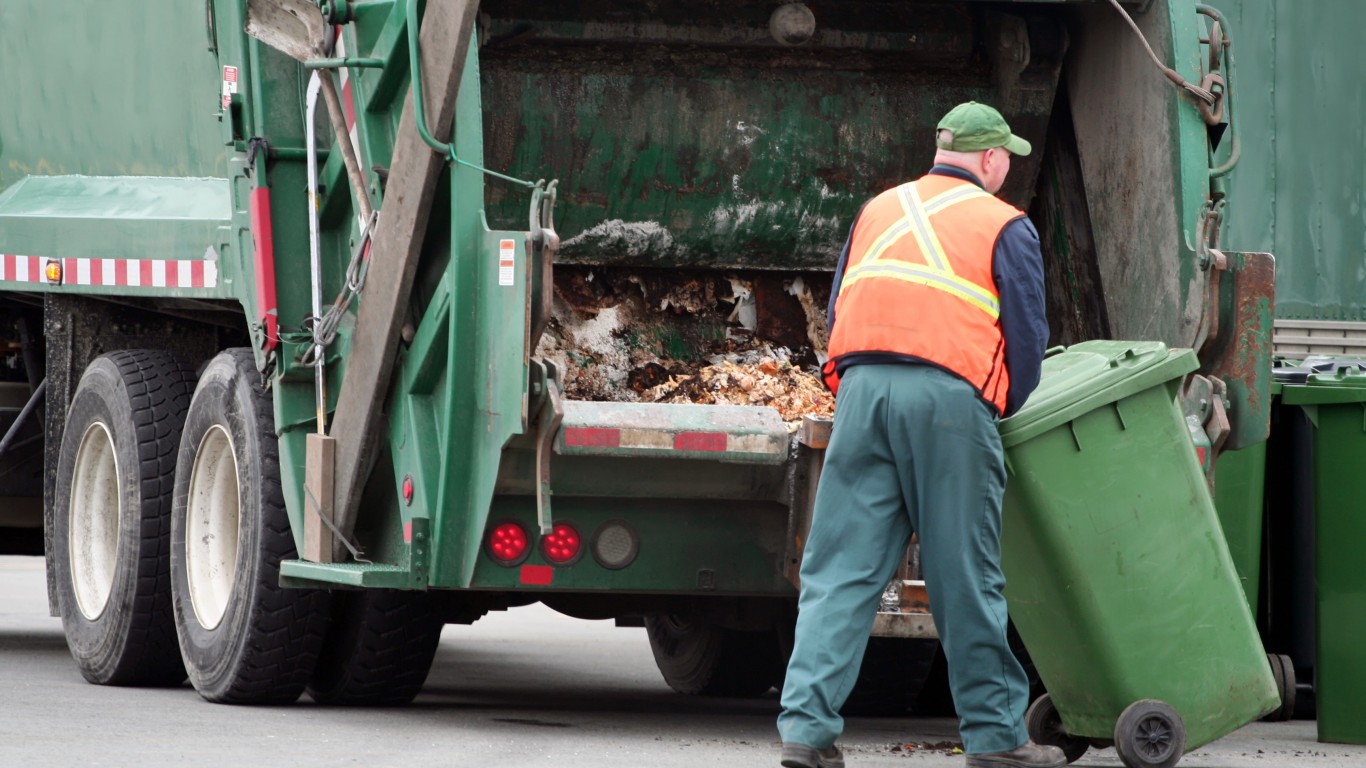
Waste Management (NYSE:WM) picks up trash, buries it in landfills it already owns, recycles what it can, and, following the Stericycle deal, hauls medical waste. Demand does not really turn off. In Q2 2026, with volumes soft, the company still posted core price of 5.7% and Collection & Disposal yield of 3.6%, and management noted that collection operating costs rose less than 1.7% against labor inflation of roughly 4%. That price-to-cost spread, held through a period management described as “not falling off a cliff in any way,” is the durable part of the story.
On returns, the quarterly dividend has stepped up from $0.75 in 2024 to $0.825 in 2025 to $0.945 in the three 2026 records, extending an uninterrupted quarterly sequence that runs from 2020-03-05 through 2026-09-11. The ten-year price return is 300%. The risk worth noting is that commercial volumes were pressured by lost national accounts, and full-year collection and disposal volume is expected to decline by approaching 1%. In this case, the price is doing the work not so much the volume.
Otis Worldwide: The Elevator You Cannot Uninstall
Otis Worldwide (NYSE:OTIS) sells elevators, escalators, and moving walkways, then services them for decades. The installed base is roughly 2.5 million units, and switching a maintenance provider on a working elevator is a decision most building owners defer. Service organic sales grew 9% in Q2 2026, with modernization organic growth of 24% and modernization backlog up 26% at constant currency. CEO Judy Marks described the aging-equipment opportunity as a “multi-year into the 2030s ramp”.
The quarterly dividend has climbed each year since the 2020 spin, from $0.20 in 2020 to $0.44 in the latest 2026 records. The risk is real: new equipment sales in China declined high teens, service margin fell 170 basis points on ramp costs and inflation, and the stock is down 19.94% year to date. Owners have been reminded that even durable service annuities re-rate when margins slip.
Fastenal: Vending Machines Bolted to Plant Walls
Fastenal distributes fasteners and maintenance, repair, and operations supplies through roughly 3,200 in-market locations and, more importantly, through FASTBin and FASTVend units installed inside customer facilities. As of Q2 2026 there were 140,789 weighted installations, up 6.5% year over year, and contract customers accounted for 75.8% of revenue. Pricing added roughly 290 basis points to Q2 sales growth, and operating margin was maintained through a five basis point improvement despite gross margin contracting about 75 basis points. Return on invested capital, per management, is in the low 30s.
Dividends have been paid on a recurring basis with records dating back to 1999-02-24, with recent quarterly amounts stepping from $0.22 to $0.24 to $0.26 across late 2025 and 2026. The ten-year price return is 529.21%. The risk here is that gross margin faces continued pressure from tariff-related costs (a roughly 40 bps GM headwind in Q2) and from customer mix shifting toward large accounts that carry lower gross margins.
Costco Wholesale: Renewal Rate as Moat
Costco Wholesale (NASDAQ:COST) sells staples, private-label goods under the Kirkland Signature brand, and gasoline to members who pay in advance for the privilege. The number that matters most is renewal. In Q3 fiscal 2026, the worldwide renewal rate was 89.7% and the U.S. and Canada rate was 92.2%, with 82.9 million paid members. Comparable sales rose 9.8% for the quarter, and executive members, who spend and visit more, reached 41.2 million. Management’s stated philosophy: “Our goal is to be the first to lower prices and the last to raise them.”
The recurring quarterly dividend rose from $1.16 in 2024 to $1.30 in 2025 to $1.47 in the latest 2026 records, with periodic special dividends separately, including $15 on 2023-12-27. The ten-year price return is 604.02%. The risk is the valuation on the other side of that history: a trailing P/E of 45 leaves little room if renewal or traffic falters. Management also flagged longer-term inflationary effects from higher oil prices and further tariff impacts as items it is monitoring.
Rollins: Pest Control on a Recurring Ticket
Rollins (NYSE:ROL) operates Orkin, HomeTeam, and roughly twenty other pest-control brands across residential, commercial, and termite services. The revenue is largely recurring: customers on contract get treated on a schedule and stay on the schedule. Q2 2026 revenue rose 7.91%, with organic growth of 5.7%, termite and ancillary up 10.5%, and commercial up 8.6%. Management said there had been “no notable shifts or deterioration in customer retention trends” and no customer hesitancy on price.
The quarterly dividend was raised from $0.165 in 2025 to $0.1825, held steady across the four most recent quarterly records. Leverage sits at one times. The ten-year price return is 205.45%. The clear risk is that the recurring model does not shield the whole business: Q2 EPS of $0.32 missed the $0.34 estimate as consumer-initiated residential lead volume weakened, one-time residential rodent demand fell “30 to 50%” in some parts of the second quarter, and the stock is down 41.47% year to date. Even boring businesses have quarters that hurt.
None of these companies will be the best-performing name in any given month, and one of them, on today’s screen, is a good reminder that boring businesses still take drawdowns. The annual yield is modest across the group, at 1.64% for WM and 0.59% for Costco. Modest yields plus decades of raises is the whole game here, and we ranked ten names with the longest streaks by valuation in a free Dividend Kings report. What matters is that the underlying revenue does not depend on anyone’s excitement. That is usually enough.
Contact [email protected] for any questions or corrections.
Chris Lange is a financial and geopolitical writer with more than a decade of experience covering a myriad of topics. He has published thousands of articles for 24/7 Wall St., with past coverage focused heavily on stocks, IPOs, healthcare, defense, global affairs, and technology.
His work has been quoted, or referenced by a number of outlets including Business Insider, USA Today, Yahoo Finance, MSN, The Motley Fool, and many other publications. A graduate of Southwestern University, he studied business with a focus on investments and has previous experience in banking and startups.
When not reading or writing the news, he is following his passion for Lacrosse, playing chess, or building solar projects with his dad.