Micron Sits Far Below Wall Street’s Target. Here’s What Gets It There.
Micron's stock has already sprinted hundreds of percent, yet Wall Street's consensus target is even higher while one valuation model tells a very different story about where the price actually belongs.


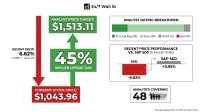
Micron Technology (NASDAQ:MU | MU Price Prediction) traded at $933.44 in the Sept. 15 pre-market session, against a Wall Street consensus analyst target of $1,513.11. The market cap has already climbed above $1.1 trillion. The gap between price and target is unusually wide for a name whose earnings are printing at record levels.
Why This Price-Target Gap Breaks the Pattern
Most price-target-gap stories start with a stock that has collapsed and left analyst targets stranded above it. Micron ran up into this gap. The stock is up 223.8% year to date and 487.7% over the trailing year, off a 52-week low of $154.65. Consensus stands above a stock that has already sprinted. The past week has been softer, with shares down 9.1%, and while chip stocks broadly slipped after tech leaders publicly called for an AI slowdown, no specific catalyst for the Micron move is confirmed.
Valuation Split That Explains Everything
The core disagreement lives inside Micron’s own price-to-earnings ratio (P/E). On trailing earnings, our valuation model produces a price of $924.03, essentially where the stock trades. On a forward-P/E basis, the model produces $408.64. That is an enormous spread. Trailing EPS is $44.28, and Wall Street expects $73.44 for fiscal 2026 and $156.07 for fiscal 2027. Forward P/E of 6 looks cheap only if those numbers hold. The memory is deeply cyclical, and a low forward multiple layered on peak earnings is the classic memory-cycle trap.
High bandwidth memory, or HBM, is the stacked-DRAM product bolted onto AI accelerators. Training and inference are memory-bandwidth-bound, so every accelerator sold pulls Micron content with it. That is the demand story sitting under the earnings ramp.
All that HBM demand traces back to the broader AI infrastructure buildout, and the memory suppliers are only one slice of it. (We pulled together seven companies solving AI’s biggest bottlenecks in a free report you can grab here.)
Analyst Wall That Is Almost Uncontested

Coverage is one-sided, with a consensus that reads 92% bullish and 0% bearish. Estimate revisions keep drifting higher: the fiscal 2027 EPS average has climbed from $112.17 ninety days ago to $156.07. When a rating wall is this uniform, that uniformity is itself a signal to weigh. The CEO framed the case on the fiscal Q3 call: “AI is still in very, very early innings” and described memory as elevated “to a strategic asset.” Analyst targets remain just one data point to weigh, especially when sentiment is fully committed to a single thesis.
Where Our Model Parts Ways With Wall Street

Our model returns a one-year base case of $963.62, a bull case of $1,345.57, and a bear case of $716.22, at high confidence, with a Hold recommendation. Base-case upside from the model’s input price is 4.28%. That is a direct disagreement with the $1,513.11 consensus target. Even the model’s bull case falls short of the Street’s average. The base case sits just above the live quote, so the model reads the stock as near fair value while the sell side reads it as substantially undervalued. For context, Micron has run so hard that the S&P 500’s year-to-date move looks minor next to the 223.8% gain here.

Verdict on a Stock Priced for Perfection
The bull thesis rests on memory pricing extending the current up-cycle, HBM4 ramping at the pace management described (over $1 billion in HBM4 revenue already shipped, with 12-high tracking “twice as fast as HBM3E 12-high”), and the 16 Strategic Customer Agreements converting into the roughly $100 billion of cumulative minimum-price revenue that management laid out. The bear thesis argues that the forward P/E of 6 is masking peak-cycle EPS. In that case, prices roll over, forward estimates reset, and the trailing-versus-forward spread closes the wrong way.
There is reason to lean with the model rather than the target. The business is in the best cycle of its history, but consensus is priced for it to keep working, and a one-sided rating wall tends to underweight cycle risk. The next earnings report, the date of which the company has not formally confirmed, is the checkpoint. If gross margin holds near the ~86% guide and SCA volume keeps building, the bull case becomes harder to dismiss.
Contact [email protected] for any questions or corrections.
Trey has been an editor and author at 24/7 Wall St. for more than a decade, where he has published thousands of articles analyzing corporate earnings, dividend stocks, short interest, insider buying, private equity, and market trends. His comprehensive coverage spans the full spectrum of financial markets, from blue-chip stalwarts to emerging growth companies.
Beyond 24/7 Wall St., Trey has created and edited financial content for Benzinga and AOL's BloggingStocks, contributing additional hundreds of articles to the investment community.
Trey's editorial expertise extends across multiple publishing environments. He served as production editor at Dearborn Financial Publishing and development editor at Kaplan, where he helped shape financial education materials. Earlier in his career, he worked as a writer-producer at SVE. His freelance editing portfolio includes work for prestigious clients such as Sage Publications, Rand McNally, the Institute for Supply Management, the American Library Association, Eggplant Literary Productions, and Spiegel.
Outside of financial journalism, Trey writes fiction and has been an active member of the writing community for years, moderating workshop sessions at regional conventions.