The Memory Market Could Be Entering a Golden Age for Micron
Micron has already posted five-year returns that most stocks never see in a lifetime, and Wall Street analysts are nearly unanimous that the run is not over. Here is what it would actually take to get the stock to $1,600…

This post may contain links from our sponsors and affiliates, and Flywheel Publishing may receive compensation for actions taken through them.
Few large-cap stocks have run harder in the past year than Micron Technology (NASDAQ: MU | MU Price Prediction). The Boise-based memory maker is the only U.S.-headquartered producer of DRAM and NAND at scale, and CEO Sanjay Mehrotra has spent the past four quarters telling investors that “AI has elevated the value of memory”.
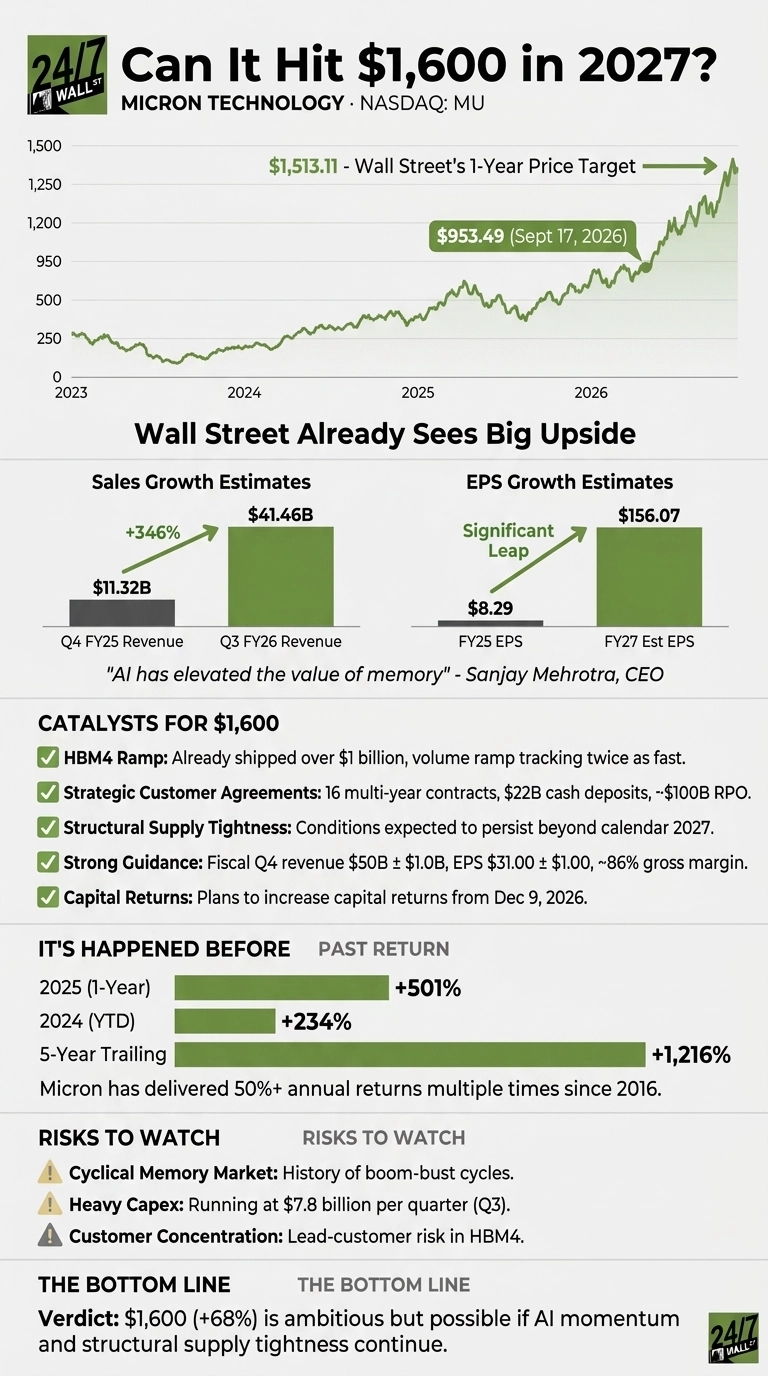
The market is finally believing him. Shares are up 234.28% year-to-date and 501.33% over the past year, riding a supercycle in high-bandwidth memory (HBM) that Mehrotra says has “structurally transformed” the industry.
With the stock at $953.49, here is the path to $1,600 in 2027.

Wall Street Already Sees Big Upside From Here
The analyst community is unusually aligned. The consensus 12-month price target sits at $1,513.11, with 44 of 48 covering analysts at buy or strong buy and zero sells. That target implies roughly 59% upside from today.
Estimates keep climbing: the fiscal 2027 EPS consensus has moved from $112.17 ninety days ago to $156.07 today, and Micron has beaten expectations in each of the last four quarters, with surprise margins of 5.94%, 21.33%, 39.74%, and 23.79%. When a company keeps outpacing rising estimates, actual results usually land higher than the model.

Path to $1,600 Per Share
The math here is unusually friendly. Fiscal 2027 EPS estimates of $156.07 put Micron at just roughly 6x forward earnings, versus the S&P 500’s 22x. Getting to $1,600 would require only about 10x forward EPS, still a meaningful discount to the market.
Catalysts that could close that gap:
- HBM4 ramp: Micron has already shipped over $1 billion in HBM4 revenue, with the 12-high volume ramp tracking twice as fast as HBM3E 12-high.
- Strategic Customer Agreements: The company has signed 16 multi-year take-or-pay contracts covering roughly 25% of revenue, with $22 billion in cash deposits and letters of credit backing them. RPO already sits near $100 billion.
- Structural supply tightness: Management expects tight conditions to persist beyond calendar 2027, with data-center DRAM and NAND bit shipments projected to more than double from two years ago.
- Guidance trajectory: Fiscal Q4 guidance calls for record revenue of $50 billion ± $1 billion and non-GAAP EPS of $31 ± $1, with gross margin near 86%.
- Capital returns: Beginning December 9, 2026, Micron plans to increase capital returns and eventually return 100% of excess cash to shareholders.

Micron Has Done This Kind of Run Before
Getting to $1,600 requires roughly 68% more upside. Ambitious, but Micron has posted 50%+ annual gains in 2016, 2017, 2023, 2024, and 2025, and the trailing five-year return already sits at 1,216.24%.
The stock’s beta of 2.22 confirms it moves in outsized swings in both directions, so another year of large gains during a demand cycle this strong is well within its historical range.
Bottom Line on $1,600
The bear case is real. Memory is cyclical, capex is running $7.8 billion per quarter, and lead-customer concentration in HBM4 matters. But at 6x forward earnings with take-or-pay contracts, structural supply tightness, and gross margins pushing 86%, a re-rating to 10x forward is hardly heroic.
If Mehrotra is right that memory has become “a strategic asset” in the AI stack, $1,600 in 2027 is a stretch worth taking seriously.
Setups like this, where a company shows up early with pricing power and multi-year contracts, are exactly the traits we cataloged in a free playbook on spotting the next Nvidia-style winner. Returns like this shouldn’t be expected every year, but we’ve outlined the blueprint for how Micron could see outsized returns in 2027.
Contact [email protected] for any questions or corrections.
Vandita Jadeja is a financial publisher with over a decade of experience writing about financial topics, including investment, savings, retirement, insurance and banking. Vandita is a Chartered Accountant who loves to debunk financial concepts for readers.
Her work has appeared on sites that include The Motley Fool, InvestorPlace, and Benzinga. She covers investing and focuses on stock picks and price prediction for 24/7 Wall St.
When not looking for the next stock investment opportunity, she can be found traveling, reading, chasing sunsets and enjoying her iced latte.