Dell’s AI Backlog Surge Positions Stock for $600+ as Server Revenue Doubles
Dell's AI order pipeline has grown so fast that even longtime bulls are debating whether the stock has priced it in yet, and the answer depends on one number buried in the backlog.

This post may contain links from our sponsors and affiliates, and Flywheel Publishing may receive compensation for actions taken through them.
Few names in the AI trade have quietly compounded like Dell Technologies (NYSE:DELL | DELL Price Prediction). Shares are up 335.77% year to date, yet the story is still early.
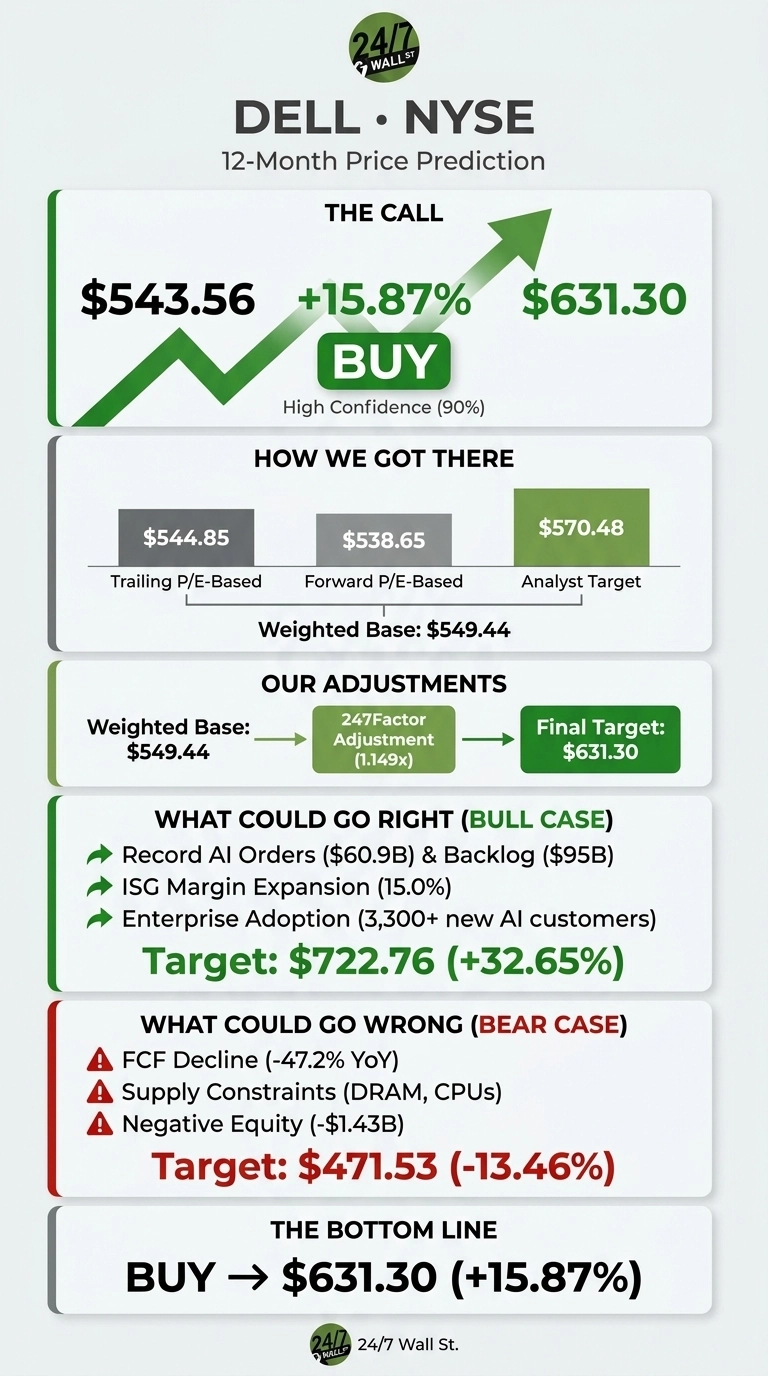
Our 24/7 Wall St. price target for Dell is $631.30, roughly 15.87% above the $543.56 close, with a buy recommendation and high (90%) confidence.
| Metric | Value |
|---|---|
| Current Price | $543.56 |
| 24/7 Wall St. Price Target | $631.30 |
| Upside | 15.87% |
| Recommendation | BUY |
| Confidence | 90% |

A Quiet Giant Reprices as AI Orders Explode
Dell has run 10.74% in the past month and 334.13% over the past year, trading near the $567.75 52-week high.
The catalyst was Q2 FY27 (reported September 1, 2026): revenue of $46.97 billion, up 57.75%, and non-GAAP EPS of $7.04 that beat consensus by 43.69%.
AI-Optimized Server revenue doubled to $16.40 billion, AI orders hit a record $60.90 billion, and backlog reached $95 billion. Management raised full-year FY27 revenue guidance by $25 billion to $192 billion and non-GAAP EPS to $25.50. Dell also joins the S&P 100, a passive-flow tailwind.

Why Bulls See $722 in Play
The bull thesis rests on the pipeline. CEO Jeff Clarke said Dell has booked “more than $130 billion in AI server orders” over the last 12 months, and management sees AI representing 75% of all data-center demand by 2030. Full-year AI server revenue is guided to $74 billion, up 200%.
Non-GAAP operating margin already expanded to 12.6% from 7.7%, and ISG margin jumped to 15.0%. If enterprise adoption keeps compounding (Dell added 3,300 AI customers in three quarters), our bull-case scenario points to $722.76, a 32.65% return.

What Could Go Wrong
The bear case centers on mix-driven margin compression and cash conversion. Q2 free cash flow fell 47.22% year over year to $986 million, and shareholders’ equity is negative $1.43 billion.
Supply is constrained across DRAM, NAND, CPUs, and optical components. Bulls counter that heavy working-capital build reflects a $95 billion backlog being staged as demand remains firm. Our bear-case one-year target is $471.53, a 13.46% drawdown.
How Dell Compares to HPE and Supermicro
Hewlett Packard Enterprise (NYSE:HPE) is the closest enterprise-infrastructure peer, but its Q3 FY26 revenue growth of 32.72% and FY27 EPS growth framework of 16%-20% trail Dell’s 148% guided EPS growth. HPE’s server segment grew just 35.3% versus Dell’s traditional server growth of 122%.
Super Micro Computer (NASDAQ:SMCI) is the pure-play AI server comp, trading at a P/E of 10x, but FY26 operating cash flow was negative $6.81 billion and gross margin swung from 6.3% to 17.5% in two quarters.
Dell’s 28x trailing multiple looks reasonable given its scale, cash returns, and diversified portfolio. The peer set makes our 24/7 Wall St. price target look measured given Dell’s scale and diversified portfolio.
Dell Price Prediction 2026-2030
The 24/7 Wall St. price target of $631.30 with high confidence reflects a company converting a multi-year AI infrastructure cycle into real operating leverage. The setup strengthens if backlog conversion continues near the current pace and ISG margins hold above 15%.
The picture weakens if AI gross margins compress further while free cash flow keeps sliding. On balance, the data favors continued execution, and the same buildout powering Dell’s backlog is lifting a wider set of suppliers we mapped in a free report on seven AI infrastructure names that aren’t chipmakers.
| Year | 24/7 Wall St. Price Target |
|---|---|
| 2026 | $576 |
| 2027 | $631 |
| 2028 | $708 |
| 2029 | $749 |
| 2030 | $808 |
These projections assume Dell continues executing on AI infrastructure demand at current guidance. Significant upside or downside could come from enterprise AI adoption rates, supply-chain relief, or margin trajectory as AI mix rises.
Contact [email protected] for any questions or corrections.
Vandita Jadeja is a financial publisher with over a decade of experience writing about financial topics, including investment, savings, retirement, insurance and banking. Vandita is a Chartered Accountant who loves to debunk financial concepts for readers.
Her work has appeared on sites that include The Motley Fool, InvestorPlace, and Benzinga. She covers investing and focuses on stock picks and price prediction for 24/7 Wall St.
When not looking for the next stock investment opportunity, she can be found traveling, reading, chasing sunsets and enjoying her iced latte.