Oracle’s 2026 Cratering: This Pro Is Sure It Will Nearly Triple in the Next 12 Months
Oracle just delivered a blowout quarter and its shares cratered anyway, but a handful of Wall Street analysts are calling the selloff the opportunity of the year with a price target that would nearly triple your money.

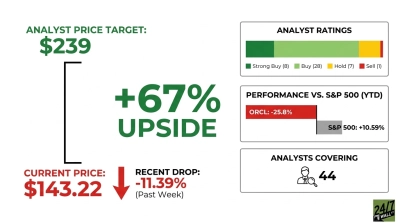
Oracle (NYSE:ORCL | ORCL Price Prediction) currently trades at $143.22, while Wall Street’s consensus 12-month price target sits at $239, an implied upside of roughly 67%. That is only the average. Guggenheim’s John DiFucci and Mizuho’s Siti Panigrahi both hold a Street-high $400 target, roughly 2.8 times the current price.
Oracle is the enterprise database incumbent that pivoted hard into AI cloud infrastructure over the past two years. Its OCI platform has become a preferred training environment for OpenAI and other AI leaders, and management just delivered a quarter that would normally send shares higher.
Capex Sticker Shock Overrode a Blowout Quarter
Capital allocation concerns drove Oracle’s slide. Shares are down 11.39% in the past week and 25.8% year to date despite Q1 FY27 results that beat on both lines. Adjusted EPS of $1.92 cleared the $1.7391 estimate, revenue grew 29.61% to $19.345 billion, and cloud infrastructure revenue surged 121%. Remaining performance obligations reached $664 billion, up $209 billion year over year, with more than $30 billion in fresh AI contracts booked during the quarter.
Concerns sit below the top lines. Q1 capex hit $28.5 billion, free cash flow ran negative $5.4 billion, and full-year FY27 capex now runs $90 billion to $95 billion. Interest expense jumped 55% to $1.4 billion. Oracle completed a $20 billion at-the-market equity issuance and plans to raise roughly $40 billion more this fiscal year. Shares are down 52.76% over the past year, roughly 56% below the $325.79 52-week high.
Why the Bull Camp Refuses to Blink
Analysts largely held ground through the drawdown. Coverage splits 8 Strong Buy, 28 Buy, 7 Hold, 1 Sell, and 0 Strong Sell, with the $239 consensus implying about 67% upside. That sits well above the 40% threshold where an analyst gap starts to look like conviction rather than lagging models.
The anchor is that $664 billion RPO backlog and management guidance that roughly half converts to revenue over the next 36 months. Oracle delivered 850MW of AI capacity and more than 300,000 GPUs in a single quarter, nearly triple the Q4 pace, with GPU utilization at 97.9% and expiring contracts repricing at a 20% premium.
DiFucci and Panigrahi’s $400 view rests on OCI’s RDMA network winning hyperscaler, OpenAI, and enterprise GenAI training workloads, multicloud database expansion via Oracle Database@Azure, @AWS, and @Google Cloud, and operating margin accretion as capacity ramps. Full-year FY27 guidance was raised to at least $90 billion in revenue and $8.10 in non-GAAP EPS. Chairman Larry Ellison also canceled his previously disclosed plan to sell Oracle stock days after the report.
Hyperscaler Peers Held Up While Oracle Broke
Oracle fell alone. The hyperscaler and enterprise AI cloud peer group is broadly flat to up on the year.
Microsoft (NASDAQ:MSFT) trades at $490.30 against a $572.92 target, roughly 17% upside. Shares are up 1.38% year to date. Ratings split 14 Strong Buy, 38 Buy, and 3 Hold, with no sells. Azure just crossed $100 billion in annual revenue.
Amazon (NASDAQ:AMZN) sits at $245.96 versus a $328.17 target, about 33% upside. AMZN is up 6.56% year to date. Ratings run 15 Strong Buy, 44 Buy, and 2 Hold. AWS just re-accelerated to 37% growth.
International Business Machines (NYSE:IBM) trades at $237.49 against a $245.35 target, only about 3% upside. Shares are down 19.82% year to date after a Q2 miss. Ratings split 3 Strong Buy, 10 Buy, 10 Hold, 1 Sell, and 1 Strong Sell. Analyst targets are estimates rather than guarantees, but Oracle’s implied upside dwarfs the group, before layering in the $400 bull case.
Numbers Behind Oracle’s Selloff
ORCL currently trades at $143.22 against a $239 consensus 12-month target for roughly 67% upside. Coverage is deep at 44 analysts and heavily positive: 8 Strong Buy, 28 Buy, 7 Hold, 1 Sell, and 0 Strong Sell. Forward P/E of 18 and PEG of 0.81 look undemanding for a business expected to reach $90 billion in FY27 revenue.
Shares are down 25.8% year to date and 52.76% over the past year. The S&P 500 has gained 10.59% year to date. Recent 30-day FY27 and FY28 EPS revisions carry three upward marks and zero downward, suggesting the sell-side has not blinked.
Where I Actually Land on Oracle
The bull case works if management can convert even a quarter of that $664 billion RPO on schedule without another dilutive equity round, and if GPU utilization holds above 95% as capacity scales. That path gets shares back toward $239 without heroic assumptions. The $400 case from Guggenheim and Mizuho additionally requires operating margins to expand as infrastructure scales and multicloud database revenue to keep compounding at triple-digit rates.
The bear case takes over if capex keeps rising faster than the RPO backlog converts. FY26 free cash flow of negative $23.686 billion is a material drag, and $40 billion of planned FY27 financing means the balance sheet gets more leveraged before it gets better. Concentration in OpenAI-linked contracts adds real overhang risk if any of those deals slip.
On balance, the setup skews cautiously bullish. The consensus gap is large enough, and operating momentum real enough, that the current price looks like it is discounting a worst case Oracle has not yet delivered.
Contact [email protected] for any questions or corrections.
Alex Sirois is a financial writer with experience spanning both retail and institutional investing. He has written for InvestorPlace and held roles at BNY Mellon and Bernstein, giving him a perspective that bridges Main Street portfolios and Wall Street analysis.
Alex holds an MBA from George Washington University and has built his career across multiple industries, including e-commerce, education, and translation — a breadth of experience that informs how he breaks down complex financial topics for everyday investors. His writing is conversational, actionable, and grounded in long-term, buy-and-hold investing principles.
At 247 Wall St., Alex focuses on delivering analysis that is both accessible and useful, with a clear emphasis on helping readers make more informed decisions with their money.