Portfolio Fit: VEEM
VanEck just launched an ETF that bets analyst sentiment can beat the MSCI Emerging Markets index at its own game, but with no track record and a strategy that will drift sharply from every benchmark investors know, the real question…

This post may contain links from our sponsors and affiliates, and Flywheel Publishing may receive compensation for actions taken through them.

Emerging markets equities have spent most of 2026 outperforming the average U.S. portfolio, and investors hunting for a smarter way to own the asset class now have a new option to evaluate. VanEck MSCI EM Analyst Sentiment ETF (NASDAQ:VEEM) is a recently launched fund from VanEck that tries to tilt a broad emerging markets basket toward stocks favored by sell-side analyst revisions. The pitch is straightforward: rather than owning every name in the MSCI EM universe by market cap, VEEM filters and weights toward companies where analyst sentiment is improving. Whether that tilt is worth paying for, and where VEEM fits alongside heavyweights like Vanguard FTSE Emerging Markets ETF (NYSEARCA:VWO) and iShares Core MSCI Emerging Markets ETF (NYSEARCA:IEMG), is the question this article is built to answer.
Fund and the Problem It Tries to Solve
The core investor problem VEEM addresses is a familiar one for anyone who has held an EM index fund for a decade: the benchmark is dominated by state-owned banks, mature commodity producers, and legacy Chinese internet names that have not consistently rewarded shareholders. VEEM’s approach, per its prospectus filed with the SEC, is to overlay an analyst sentiment factor on the MSCI Emerging Markets universe. In plain English, the fund leans into stocks where consensus earnings estimates and ratings are getting better and leans away from names where the analyst community is trimming forecasts.
The return engine, then, is a factor bet that improving analyst sentiment predicts near-term price performance in EM more reliably than raw market cap. That is a defensible academic idea, but it is an active tilt dressed in an ETF wrapper, and it does not deliver the same exposure as a passive market-cap fund.
Where VEEM Sits Versus VWO, IEMG, and EEM
Because VEEM has essentially no track record to evaluate, the fair comparison is structural rather than performance-based. The fund currently trades near $24.64, with only six trading days of history available in our data set. That is not enough to draw any conclusion about the factor’s execution.
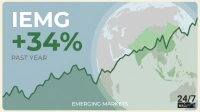
The alternatives, by contrast, have decades of history. VWO has returned 11.35% year to date, 12.51% over the past year, and 111.96% over ten years. IEMG has done even better recently, with a 21.78% year-to-date gain, 26.22% over one year, and 137.97% over ten years. The gap between VWO and IEMG in 2026 is itself instructive: two funds that both claim broad EM exposure can diverge by roughly 10 percentage points in a single year based on index differences, weighting, and treatment of South Korea. VEEM’s factor tilt will produce its own tracking difference, and buyers should expect it to look nothing like either benchmark in any given year.
For structural context, IEMG’s most recent regulatory holdings snapshot as of May 31, 2026 shows the familiar EM anchors: Alibaba Group Holding Limited at roughly 1.82% of assets, alongside meaningful positions in PDD Holdings, Al Rajhi Bank, Saudi Aramco, Nu Holdings, NetEase, and Baidu. iShares MSCI Emerging Markets ETF (NYSEARCA:EEM), the older and more expensive sibling, shows a similar top cohort led by Alibaba at 2.08% and China Construction Bank at 0.81%. VEEM’s sentiment overlay will almost certainly under-weight or exclude some of these mega-caps when analyst momentum is stalling, which is the entire point of the strategy. The tradeoff is that the fund’s country and sector exposures will drift, sometimes sharply, from anything a plain EM index investor would recognize.
Does It Deliver?
This is where a portfolio fit article normally tests promise against reality. With VEEM, that test cannot yet be run. There is no NAV history available in our data set for 2026, no NPORT holdings snapshots between August and September 2026, and the snapshot endpoint returns null for expense ratio, holdings, NAV, and fact sheet. Investors evaluating VEEM today are effectively buying the concept and the issuer’s reputation, not measurable execution.
That is a meaningful admission. Analyst sentiment factors have shown positive backtests in academic literature and in developed-market factor products, but the EM implementation carries additional frictions: analyst coverage is thinner outside the top 200 names, sentiment revisions can lag actual price moves in less liquid markets, and rebalancing costs eat into gross factor returns. Until VEEM publishes several quarters of live results, buyers cannot know whether the strategy captures the factor cleanly or gives most of the alpha back in trading costs.
Tradeoffs Investors Should Weigh
Three constraints stand out for a fund at this stage.
- No track record. With only a handful of trading sessions of price data available, there is no way to evaluate tracking difference, factor loading, or drawdown behavior. Every performance claim about VEEM at this point is theoretical.
- Liquidity and spreads. New ETFs typically trade with wider bid-ask spreads and thinner volume than established peers. That is a real cost for investors who transact frequently, especially compared with VWO and IEMG, which trade millions of shares per day.
- Duplication risk. If an investor already owns VWO or IEMG as a core EM allocation, adding VEEM introduces overlap on the beta side while layering an active factor bet on top. The factor exposure is what the buyer is paying for, and it should be sized accordingly.
Who VEEM Fits and Who Should Wait
VEEM is a satellite holding: a factor sleeve for an investor who already has broad EM exposure through a low-cost fund and wants to tilt a portion of that exposure toward stocks with improving analyst sentiment. A reasonable position size for that use case is small, typically in the low single digits of total portfolio weight, sized so that a period of factor underperformance does not disrupt the overall EM allocation.
Investors who want simple, cheap, diversified emerging markets exposure should stay with VWO or IEMG, both of which have long histories, deep liquidity, and well-understood index methodologies. Investors who dislike active factor bets or who cannot tolerate the tracking error that comes with a sentiment overlay should also look elsewhere. VEEM earns a place on the watchlist for factor-oriented allocators, but the case for adding it in size will not exist until the fund has published enough live data to prove the strategy works as advertised.
Contact [email protected] for any questions or corrections.
Jake has been been working in financial media for almost 15 years. He focuses on all things personal finance for 24/7 Wall St. with high hopes to educate and entertain. Most recently, Jake spent 12 years working various roles at The Motley Fool. He started copy editing fool.com content, worked on premium and marketing campaigns, and helped launch The Ascent, a personal finance brand.
His work has been featured on platforms like MSN, Yahoo Finance, USA Today, and more. He's written about credit cards, social security, ETFs, savings accounts, and just about anything else you can imagine when thinking about money. Jake love to cook, play golf, and tell people he's never had a cavity. (It's true!)