Is Markel the New Berkshire Hathaway Blueprint for Value Investors Post-Buffett?
Warren Buffett's exit from Berkshire Hathaway reignited a debate value investors have circled for years: whether one smaller insurer running the same three-engine compounding model can fill the void, and whether its recent struggles make it a trap or an…

This post may contain links from our sponsors and affiliates, and Flywheel Publishing may receive compensation for actions taken through them.
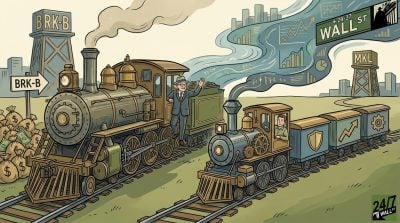
Warren Buffett has stepped down as board chair of Berkshire Hathaway, with Greg Abel now running the company. The handoff has revived a question value investors have batted around for a decade: with the Oracle off the field, is Markel Group (NYSE:MKL | MKL Price Prediction) the closest thing left to early Berkshire Hathaway (NYSE:BRK-B)?
Markel runs the same three-engine model: specialty insurance underwriting, a public equity portfolio, and wholly owned operating businesses inside Markel Ventures. It pays no dividend and returns capital through buybacks. CEO Tom Gayner told investors on the July 30, 2026, call that “We continue to work on building the system designed to relentlessly compound your capital.” Insurance float, the fuel for compounding, expanded to $18.84 billion in 2025. Buybacks totaled $429.5 million in 2025, cutting the share count to 12.4 million by mid-2026.
Where the Berkshire Comparison Breaks
Scale is the first wall. Markel’s market cap is near $22.1 billion. Berkshire’s is $1.1 trillion, with $380 billion in cash as of Q1. Rather than being a smaller copy of Berkshire, Markel is a fundamentally different kind of company.
Markel has been shrinking its business operations by shutting down or selling off unprofitable divisions. Global Reinsurance entered run-off after an August 2025 renewal-rights sale, and the troubled IP/CPI line was wound down, with losses falling to $64.3 million from $168.5 million. Insurance dominates: $9.35 billion of 2025 revenue versus $3.93 billion Industrial, $737 million Financial, and $1.38 billion Consumer. Activists have pressed the group on Ventures. Berkshire’s record rests on one investor’s lifetime judgment; Markel asks shareholders to trust a bench.
Underwriting Is Turning While Shares Lag
The underwriting book is genuinely healing. The Q4 combined ratio tightened three points to 92.9%, and the full-year ratio fell to 94.6% from 95.5%. Below 100% means the insurance book made money before investment income. Favorable prior-year reserve development totaled $484.0 million. Full-year revenue was $15.51 billion, net income $2.15 billion, shareholders’ equity $18.6 billion. Gayner said “every reportable segment [made] meaningful contributions” in 2025.
Investors are unimpressed. Markel is down 17.0% year to date; Berkshire B is up 1.0%. Over five years, Markel returned 47.6% against Berkshire’s 83.5%; over ten years, 95.2% against 250.1%. A cleaner underwriting baseline will not close that gap alone.
Markel mirrors early Berkshire in architecture but does not substitute for owning Berkshire. (For investors who want to borrow Buffett’s homework directly, we sorted his portfolio by valuation and identified the seven cheapest dividend payers in a free report here.) Watch three things on Markel: whether the combined ratio stays in the low 90s through 2026, whether buybacks hold the recent pace Gayner called “the highest and best use of capital,” and whether management keeps Ventures inside the group. If any of those three breaks the other way, the investment thesis falls apart.


Contact [email protected] for any questions or corrections.
Trey has been an editor and author at 24/7 Wall St. for more than a decade, where he has published thousands of articles analyzing corporate earnings, dividend stocks, short interest, insider buying, private equity, and market trends. His comprehensive coverage spans the full spectrum of financial markets, from blue-chip stalwarts to emerging growth companies.
Beyond 24/7 Wall St., Trey has created and edited financial content for Benzinga and AOL's BloggingStocks, contributing additional hundreds of articles to the investment community.
Trey's editorial expertise extends across multiple publishing environments. He served as production editor at Dearborn Financial Publishing and development editor at Kaplan, where he helped shape financial education materials. Earlier in his career, he worked as a writer-producer at SVE. His freelance editing portfolio includes work for prestigious clients such as Sage Publications, Rand McNally, the Institute for Supply Management, the American Library Association, Eggplant Literary Productions, and Spiegel.
Outside of financial journalism, Trey writes fiction and has been an active member of the writing community for years, moderating workshop sessions at regional conventions.