Berkshire Hathaway’s Cash, Earnings and Optionality Make It the Ultimate Value Play
Berkshire Hathaway (NYSE:BRK-B | BRK-B Price Prediction) is a stock built to own for decades because its structural design, a diversified industrial conglomerate sitting atop the largest discretionary cash pile in corporate America, is purpose-built to compound through every cycle…

Berkshire Hathaway (NYSE:BRK-B | BRK-B Price Prediction) is a stock built to own for decades because its structural design, a diversified industrial conglomerate sitting atop the largest discretionary cash pile in corporate America, is purpose-built to compound through every cycle without your supervision.
That sentence is the whole thesis. The rest is mechanics.
Pillar 1: Durability of the Business
Berkshire is a federation of cash-generative operating businesses, GEICO, BNSF railway, Berkshire Hathaway Energy, plus manufacturing, service and retail subsidiaries, stacked beneath an insurance float and a public-equity portfolio that includes stakes in Apple, American Express, Coca-Cola and Bank of America. The balance sheet reflects this fortress posture. Total assets stood at $1.22 trillion at year-end 2025, with shareholder equity of $717.4 billion and retained earnings of $763.2 billion. Leverage is conservative: a debt-to-equity ratio near 19%, with interest coverage above 11x. Q1 2026 operating earnings rose 18% year over year to $11.35 billion, driven by insurance underwriting and BNSF. This is durable earnings power across macro regimes, not a thematic bet.
Pillar 2: Compounding Through Capital Allocation
Berkshire pays no dividend. Compounding happens internally, through retained earnings reinvested into wholly owned subsidiaries, opportunistic equity purchases, and buybacks when shares trade below intrinsic value. Operating cash flow reached $45.97 billion in FY 2025, with free cash flow of $25.04 billion. Trailing earnings yield runs near 10%, and the stock trades at roughly 14 times trailing earnings. Insider behavior reinforces the value signal: CEO Greg Abel purchased $15 million in Class A stock in March 2026 and pledged his entire 2026 salary to further stock purchases, while General Counsel Michael O’Sullivan added 536 Class B shares in May 2026.
Pillar 3: Cycle Survival and Optionality
This is the part retirement investors should sit with. Berkshire ended Q1 2026 with a record $397.4 billion in cash and Treasuries. That is firepower, not idle money. It is what allowed Buffett to write the Goldman Sachs preferred in 2008, the Bank of America warrants in 2011, and the Occidental Petroleum position from 2022 onward. In any genuine drawdown, Berkshire is the buyer of last resort with a balance sheet that can actually pull the trigger. Succession is already operational, with Greg Abel running operations and Ajit Jain running insurance, and the culture of underwriting discipline is institutionalized.
The Scenario Where It Lags
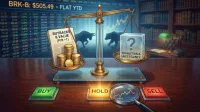
Berkshire underperforms in raging momentum and AI-CapEx bull markets. The data is current: BRK-B is down more than 4% over the past year, while SPY is up more than 27% over the same time. Conservative posture and cash drag are the price of admission for the optionality. That doesn’t change the forever thesis. The same discipline that lags chasing markets is exactly what shows up on the other side of a dislocation. Over 10 years, the stock is still up more than 240%.
For long-horizon investors, the structural design is what makes Berkshire a multi-decade compounder worth keeping an eye on.
Contact [email protected] for any questions or corrections.
Joel South covers large-cap stocks, dividend investing, and major market trends, with a focus on earnings analysis, valuation, and turning complex data into actionable insights for investors.
He brings more than 15 years of experience as an investor and financial journalist, including 12 years at The Motley Fool, where he served as an investment analyst, Bureau Chief, and later led the Fool.com investing news desk. He has also co-hosted an investing podcast and appeared across TV and radio discussing market trends.