Is Berkshire Hathaway Stock a Buy, Hold, or Sell Above $500?
Berkshire Hathaway has gone nowhere for a year while the S&P 500 climbed 12.5%, and the reasons behind that divergence reveal a company in the middle of a transformation that could resolve as either opportunity or permanent reset.

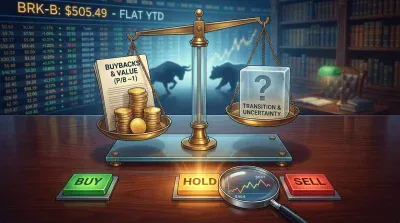
Berkshire Hathaway (NYSE:BRK-A | BRK-A Price Prediction, NYSE:BRK-B) Class B closed at $505.49, essentially where the shares started the year. Over the same stretch, the S&P 500 has returned 12.5%. The four-analyst consensus target is $547.67, a slim premium that carries less information than it would for a widely followed name.

Underneath that flat year, Berkshire Hathaway completed the most consequential leadership change in its history, resumed buybacks after a long pause, drew down a record cash pile, took a $10 billion private placement in Alphabet (NASDAQ:GOOG, NASDAQ:GOOGL) and, according to news reports, built close to a 10% stake in homebuilder Lennar (NYSE:LEN, NYSE:LEN-B).
Either the market is withholding judgment on a successor whose deals have not had time to prove out, or $500 is fair for a Berkshire that will grow more slowly and depend more on capital-intensive businesses than before. This tension is worth working out.
A Year of Going Nowhere
The stock has traded between a 52-week low of $464.01 and a high of $537.74, and currently sits closer to the middle. Year to date, the shares are up 0.5%, and the one-year return is 1.63%.
The five-year figure is 81.8%, so the recent flatness is a genuine pause rather than a fade of a long trend.
Only four sell-side analysts publish targets on this trillion-dollar company, split two Buy and two Hold. The consensus number is closer to a poll than a market-clearing view.

Leadership Transition in Motion
The stock data provided for this piece lists Greg Abel as chief executive, having transitioned from Warren Buffett. That attribution comes from a financial data feed rather than from a Berkshire press release, and it should be read as such.
The succession question is whether the prior era’s reputational advantage travels. Part of what made Berkshire a special buyer was that sellers brought deals to the door on favorable terms. Whether that continues under new leadership is genuinely unknown.
Cash Going to Work
Cash and cash equivalents stood at $40.6 billion at the end of the June 2026 quarter, against $100.5 billion a year earlier. That decline is the clearest signal that the new era is deploying cash aggressively.
In the latest quarter, Berkshire deployed roughly $23.5 billion into equities, becoming a net buyer of stocks for the first time in over three years, and bought back about $4.5 billion of its own shares.
The Alphabet placement plus the reported Lennar accumulation constitute a concentrated view: one large technology cash-flow compounder and a rate-sensitive homebuilder position. Readers who want to borrow the rest of Berkshire’s homework can start with the seven cheapest dividend payers still in the portfolio, which we pulled into a free report here. Deploying cash reduces flexibility. A large balance is itself an asset in a disruption, so spending it is a real trade-off.
Operating Business Underneath
Operating earnings have moved around significantly. The last four quarters ran $12.98 billion in Q3 2026, $11.35 billion in Q1 2026, $10.20 billion in Q4 2025, and $13.48 billion in Q3 2025.
BNSF net income of $1.6 billion in the latest quarter continues to grow modestly, though the railroad’s margins still trail the best operators by too wide a gap. Insurance underwriting has weakened, and buyback activity disciplined to intrinsic value is itself a valuation signal from the people with the best information.
Bull and Bear Case for BRK-B Stock
Book value per share reported at $522,225.90 for the Class A and a price-to-book near one, unusually cheap for this company, anchors the optimistic thesis. $750 billion of shareholder equity, and buybacks resumed in early 2026, with $15 million of personal insider buying, support an entry.
The flat year is rational under the pessimistic view. A slower, more capital-intensive Berkshire with less deal flow and a shrinking cash buffer deserves a lower multiple than the version that accumulated Treasuries and waited. If the Alphabet and Lennar positions do not clearly compound, the market’s patience will thin.
The variable that decides between them is repurchase behavior. A sustained return to net equity selling alongside heavier buybacks would signal that insiders think $500 is cheap. A quiet buyback pace and continued deployment into public equities would signal the opposite.
Above $500, the setup looks slightly constructive because the valuation is not stretched and the insider signals are consistent. But thin coverage, succession uncertainty, and shrinking flexibility keep the risk-reward closer to balanced than the five-year chart suggests.
Contact [email protected] for any questions or corrections.
Omor Ibne Ehsan is a writer at 24/7 Wall St. He is a self-taught investor with a focus on growth, cyclical, and dividend equities that have strong fundamentals, value, and long-term potential. He also has an interest in high-risk, high-reward investments such as penny stocks.