Diesel at $6 Just Ate J.B. Hunt’s Quarter. Truckers Can’t Raise Prices Fast Enough
Diesel just delivered J.B. Hunt its worst single-day drop in recent memory, yet Wall Street still sees shares climbing more than 25% from here. The question is whether management can close the gap between surging costs and lagging fuel surcharges…


Diesel has climbed past six dollars a gallon, and J.B. Hunt Transport Services (NASDAQ:JBHT | JBHT Price Prediction) is trading at $234.25 against a Wall Street consensus price target of $298.48. That leaves a mid-20s% gap between where the shares change hands and where analysts still say they belong.
At a mid-September industrials conference, CFO Brad Delco told investors third-quarter earnings would fall versus the second quarter because of driver-related expenses and a fuel headwind as diesel pushed past six dollars a gallon. The stock plunged 13% the next session, its worst day in recent memory.
Costs are arriving faster than prices. Delco called it a timing mismatch because intermodal fuel surcharges reset with a lag, and he insisted the gap closes in the fourth quarter. The stock, still up 21.2% year to date, is priced as though the freight recovery already arrived.
What Broke in Mid-September
The one-week drop was 13.39%, taking the stock from $270.45 to $234.25. Over the same week, the S&P 500 slipped 0.34%. This was company-specific pain.
Delco called the moves some of the most radical and abnormal fuel-price swings in company history, blaming a lag between diesel spikes and the surcharge cycle that follows onto customer invoices.
Driver costs compound the problem. Management flagged on the Q2 call that sign-on bonuses and targeted driver wage increases were underway. Recruiting and onboarding costs land now; pricing to cover them arrives later.
Fuel was already visible in Dedicated, where the company estimated fuel was close to a 100 basis point headwind to operating margin percentage in Q2. Diesel then kept climbing, with Bloomberg citing a national diesel average of $6.45 a gallon.

Why Analysts Kept the Faith
The Street target of $298.48 sits well above the current quote, and the ratings mix remains constructive: 2 Strong Buy, 12 Buy, 8 Hold, 2 Sell, and 0 Strong Sell.

Recent revisions trimmed but did not turn. Bank of America cut its target but kept its Buy rating and slashed its third-quarter earnings estimate.
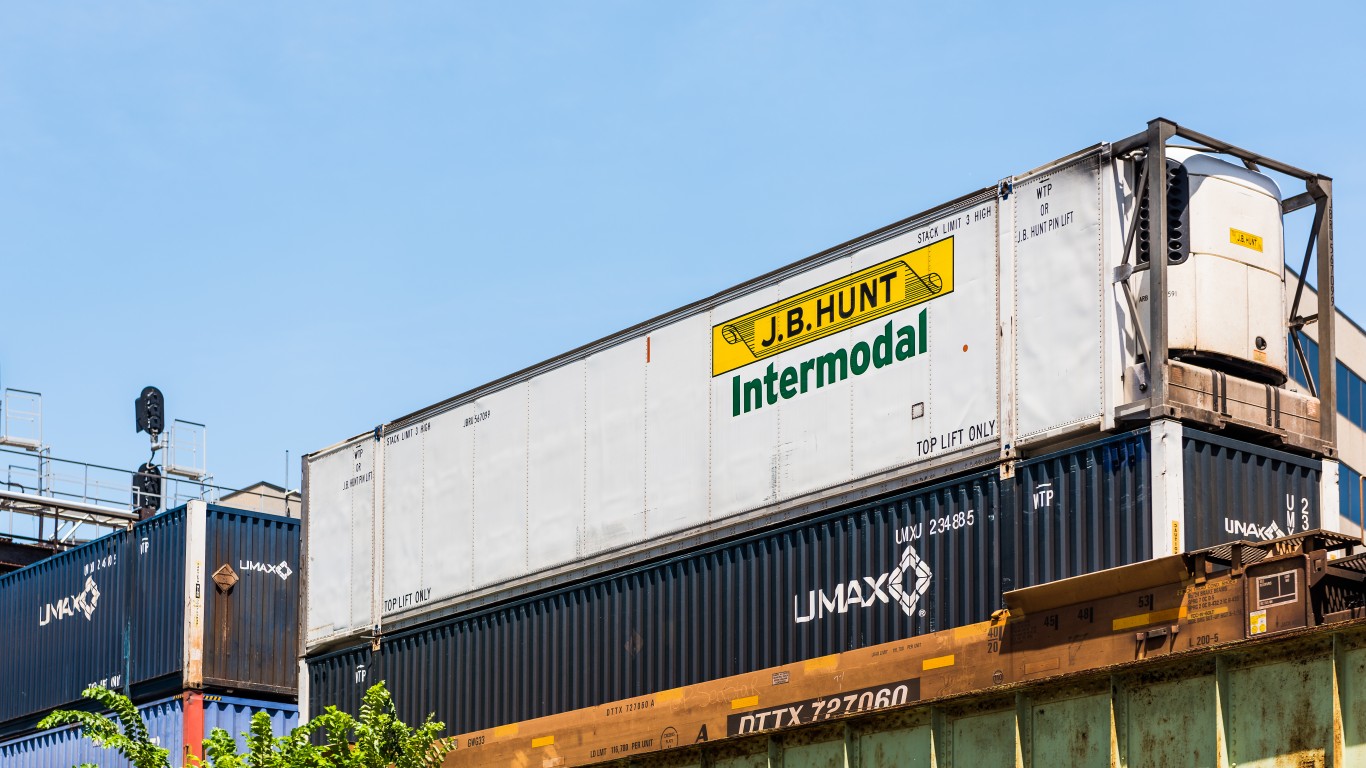
The bull argument leans on intermodal. Intermodal chief Darren Field said the current price gap versus highway is wider than normal because of rates that are now six, seven, eight, ten months old, and he expects new bids to close it. CEO Shelley Simpson added, “I fully anticipate Dedicated, Intermodal, JVT, ICS, all of the businesses will have the benefit of seeing improved pricing opportunities.”
If Delco is right that surcharges catch up in the fourth quarter and Field is right that the next bid season closes the intermodal-to-truckload gap, the third quarter reads as a timing air pocket rather than a broken model.

How Rivals Are Handling the Same Squeeze
Old Dominion Freight Line (NASDAQ:ODFL) leaned into pricing. In Q2, LTL revenue per hundredweight increased 15.2% while tons per day fell 4.1%, and its operating ratio improved 450 basis points to 70.1%. That counters Hunt’s cost-lag story.
XPO (NYSE:XPO) posted a Q2 adjusted EBITDA margin of 18.4%, with LTL yield ex-fuel up 4.4% and revenue per shipment including fuel surcharges up 11.9%. Higher surcharge revenue partly offset costs, which is what Hunt says it is waiting for.
Both peers are asset-based LTL, so the read-through is imperfect because Hunt’s intermodal exposure is the swing factor no LTL name mirrors. The direction is still clear, and the larger analyst-implied upside currently sits with JBHT because the drop was sharper and more idiosyncratic.
Bull and Bear Case for JBHT Stock
The bull case rests on Delco’s timing argument and Field’s bid-season math. Surcharges catch up in the fourth quarter, driver bonuses annualize into a stable expense line, and older intermodal contracts reset upward. A trailing PE of 33 compresses toward the 24 forward multiple as earnings normalize, and the $298.48 target becomes achievable.
The bear case is that Q3 is the first crack in a recovery priced for perfection. Shares are still up 74.84% over one year against the S&P 500’s 15.01%, leaving room to reprice lower if pricing does not catch up quickly. ICS gross margin is already compressed to 12.5% from 15.5%.
The deciding variable is diesel’s behavior over the next few weeks and the pace of intermodal bid resets. If diesel plateaus and surcharge income catches up as Delco insists, the third-quarter shortfall reads as a lag. If diesel grinds higher against demand too weak for shippers to swallow larger increases, analyst targets drift lower. The mechanism is contractual rather than hypothetical, but the entry price already reflects most of the good news.
Contact [email protected] for any questions or corrections.
Omor Ibne Ehsan is a writer at 24/7 Wall St. He is a self-taught investor with a focus on growth, cyclical, and dividend equities that have strong fundamentals, value, and long-term potential. He also has an interest in high-risk, high-reward investments such as penny stocks.