Seagate Went From $207 to $1,144. Where Does It Go Next?
Seagate just delivered a run that defied every expectation for a hardware stock, and Wall Street is still raising its numbers at a furious pace. Whether the next move is a collapse or another leg up depends on one tension…


Seagate Technology (NASDAQ:STX | STX Price Prediction) has done something almost no large-cap hardware stock has ever done. Shares ripped from $211.62 a year ago to a 52-week high of $1,144.18, and the mass-capacity storage business is finally being valued like an AI infrastructure name.
Year to date, STX is up 195.09%. The question after a run like that is whether the story is over. There is still a case for more upside. This article walks the path to $1,500 per share in 2027.

What’s Holding Seagate Back Right Now
The stock has cooled. Hard. Over the past month, STX is down 10.3%, and the last week alone shaved off another 6%. That is what a beta of 2.087 looks like when momentum turns.
A MarketWatch note flagged that Seagate underperformed competitors on Thursday despite a green day for the broader market, and that captures the recent tone. Some of this is simple digestion after a parabolic move.
Some of it reflects legitimate worries: hyperscaler concentration, the dilutive impact from Exchangeable Senior Notes due 2028, ongoing BIS settlement payments, and tariff and Middle East policy risk.
When a name goes from $207 to $1,144 in twelve months, every incremental buyer is asking the same question. Am I too late? That doubt, more than any fundamental crack, is what has shares stuck in a range near $803.
Wall Street Sees 40% Upside. Our Model Says 13%
The sell-side consensus target on STX is $1,125, backed by 4 strong buys, 18 buys, 2 holds, 0 sells, and 1 strong sell, with 88% of analysts bullish. Our own base case is more conservative at $904.03, implying 12.56% upside, with a bull scenario at $1,216.05 and a bear case at $688.96. Model confidence is high at 0.9.
I think our base case is too cautious. Analysts have raised the fiscal 2027 EPS estimate from $26.58 ninety days ago to $35.78 today, with 20 upward revisions in the last 30 days. When numbers are moving that fast, static price targets lag reality.

Path to $1,500 Per Share
Reaching $1,500 from today’s price of $803.13 would require a gain of 86.8%. With forward EPS of $23.12, a price of $1,500 implies a forward P/E of 65x. Our base case of $904 already implies 52x, meaning the bold target requires 13x of additional multiple expansion.
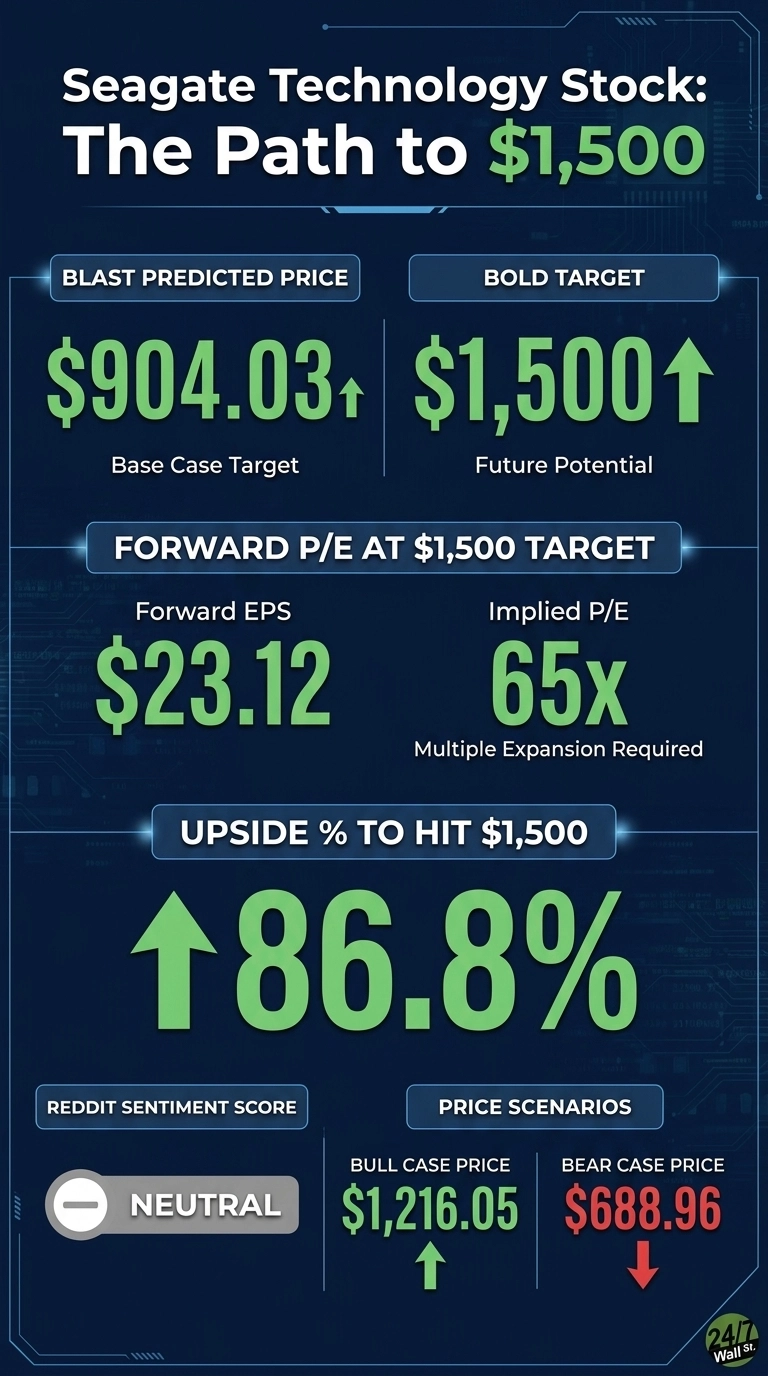

Here is why that math can work. Multiple compression happens naturally if fiscal 2028 EPS lands near the current analyst average of $55.37.
CEO Dave Mosley said Seagate is “now entering a period of structural growth,” with nearline capacity “almost fully allocated through calendar 2027” and the top three cloud providers sitting on $1.1 trillion in remaining performance obligations.
Q4 FY26 delivered revenue of $3.629B, up 48.49% YoY, and a non-GAAP gross margin of 52.7%. Any pause in hyperscaler capex resets the multiple fast.
Where Seagate Trades Today vs Its Earnings Power
At $803, STX trades at roughly 35x forward EPS of $23.12. That looks rich for a hardware name historically, yet reasonable for a business generating $3.105B in annual free cash flow (up 279.58% YoY) with margins still expanding.
Shares sit meaningfully below the 52-week high of $1,144.18 and far above the 52-week low of $207.94. Over ten years, STX has returned 3,256.83%. The forward P/E compression story is the entire bull case.

$1,500 Is a Stretch, But Here’s Why It’s Possible
Getting to $1,500 requires an 86.8% gain from here. That is a stretch.
But three things make it plausible: fiscal 2028 EPS estimates continuing upward toward $55 and beyond, Mozaic 4 and HAMR ramps holding gross margin above 50%, and hyperscaler build-to-order contracts locking in visibility through fiscal 2027. What derails it is a hyperscaler capex air pocket. We’ve outlined the blueprint for how Seagate could reach $1,500 in 2027.
Contact [email protected] for any questions or corrections.
Vandita Jadeja is a financial publisher with over a decade of experience writing about financial topics, including investment, savings, retirement, insurance and banking. Vandita is a Chartered Accountant who loves to debunk financial concepts for readers.
Her work has appeared on sites that include The Motley Fool, InvestorPlace, and Benzinga. She covers investing and focuses on stock picks and price prediction for 24/7 Wall St.
When not looking for the next stock investment opportunity, she can be found traveling, reading, chasing sunsets and enjoying her iced latte.