5 Midstream Giants That Raised Dividends Through Market Cycles: Your Guide to Recession-Resistant Income
Most investors assume energy dividends live and die with oil prices, but five pipeline operators have kept raising their payouts through every crash and recovery since 1999. The reason has everything to do with how midstream companies actually get paid.

This post may contain links from our sponsors and affiliates, and Flywheel Publishing may receive compensation for actions taken through them.
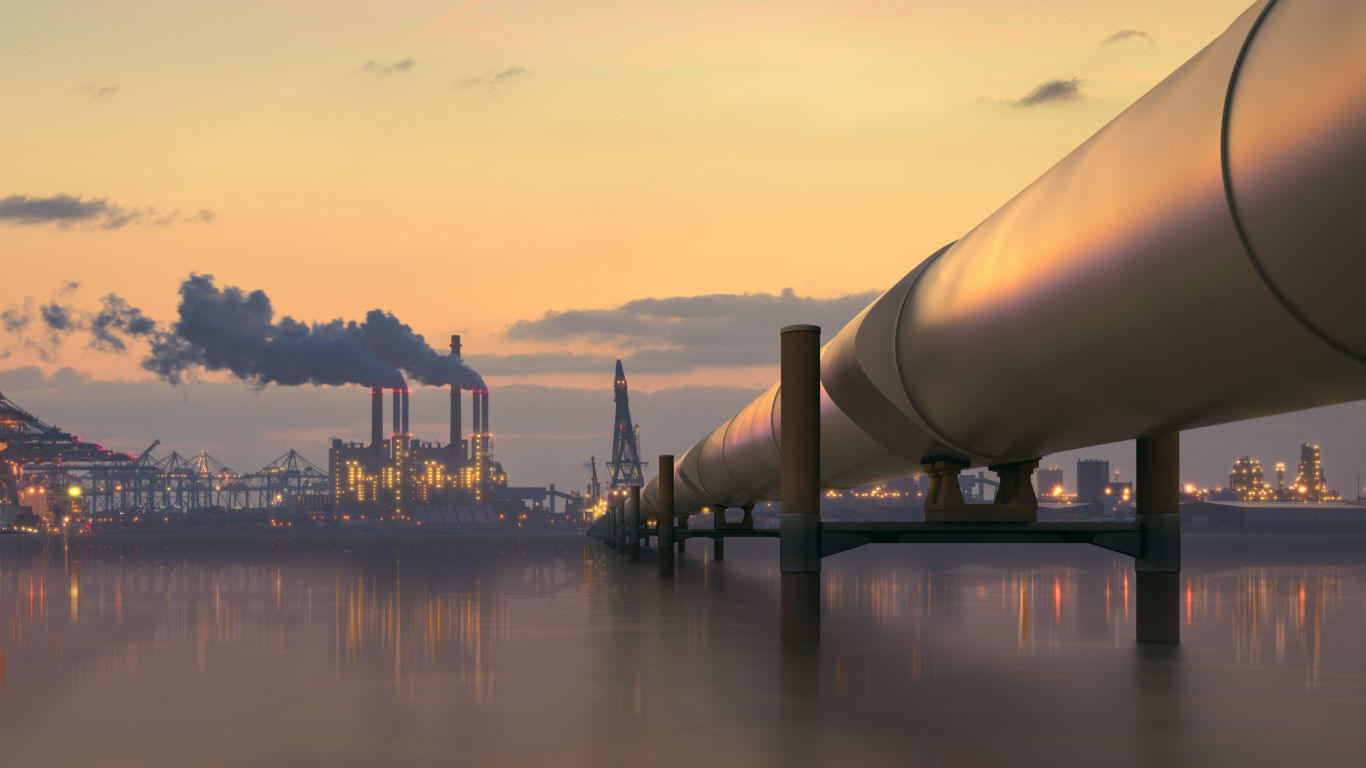
Retirees who assume every energy dividend rises and falls with oil are overlooking how pipelines get paid. Midstream operators collect fees to gather, process, move, store, and export natural gas and liquids, usually under multiyear contracts, so their cash flow follows the volumes running through the system. Upstream producers sell the barrel or the molecule itself, which ties their income directly to the commodity price. Volume is the variable that matters here, and it is headed higher: the U.S. Energy Information Administration expects U.S. LNG export capacity to increase to 27.7 Bcf/d by 2030. Each operator below backs its payout with contracted cash flow, measurable coverage, and a dividend record income investors can check line by line.
Enterprise Products Partners: Record Cash Flow Covers the Payout With Room to Spare
Enterprise Products Partners (NYSE:EPD | EPD Price Prediction) yields 5.87% at a recent unit price of $37.35, a high-yield level supported by the strongest coverage in this group. The latest quarterly distribution is $0.56, or $2.24 annualized, a 2.8% increase from a year ago.
Safety starts with coverage. Operational distributable cash flow hit a record $2.3 billion last quarter, covering the cash distribution 1.9x. The partnership paid out $1.2 billion and retained $1.1 billion, funding growth internally while still buying back $159 million of units. Debt principal outstanding stood at $34.2 billion as of the first-quarter disclosure. The payout record is long: distribution history runs back to 1999, and the quarterly amount has rose from $0.435 in 2019 to today’s level.
For income investors, the upside story is volume. Pipeline equivalent volumes set a record at 14.7 MMBPD (up 8%), and marine terminal volumes reached 2.8 MMBPD (up 33%). Another $6.5 billion of organic projects is under construction, including an LPG export terminal expansion due online by year end, two 300 MMcf/d Permian gas processing plants, and Frac 15 at Mont Belvieu. Units trade at about 13 times trailing earnings and 12 times forward earnings.
The caveat: Enterprise’s export growth leans on open sea lanes, and Middle East shipping disruptions are a identified risk to those marine volumes.
Energy Transfer: A Streak of Quarterly Raises Behind an Ultra-High Yield
Energy Transfer (NYSE:ET) yields 6.56%, which qualifies as ultra-high-yield, with units at $20.33. The latest quarterly distribution of $0.34 ($1.36 annualized) marked the partnership’s 19th consecutive quarterly distribution increase, up more than 3% year over year. Units have eased 3.42% over the past week but remain up 29.94% year to date.
Payout support comes from a sharply stronger earnings base. Adjusted EBITDA rose to $5.07 billion (up 31%), and net income to partners reached $2.09 billion, nearly doubling. EPS of $0.59 exceeded the $0.37 estimate. Full-year adjusted EBITDA guidance was raised to $18.8 billion to $19.1 billion, up from $18.2 billion to $18.6 billion. Total assets of $148.2 billion stand against $97.4 billion in total liabilities.
Exports and power drive the thesis. NGL exports rose 25% and NGL transportation volumes 13%, both records. The Hugh Brinson Pipeline is commercial and ramping toward 1.5 Bcf/d in Phase I, the Nederland NGL export expansion is fully subscribed, and new laterals serve coal-to-gas conversions and Texas data centers. Analysts lean positive, with 5 Strong Buy and 14 Buy ratings against 2 Holds.
History offers a caveat. Energy Transfer paid $0.305 per quarter through the August 2020 ex-date, then $0.1525 per quarter across its 2021 records, returning to $0.305 only in early 2023. Income investors should consider that reset alongside the current run.
MPLX: Double-Digit Distribution Growth Committed by Management
MPLX (NYSE:MPLX) carries the highest yield in the group at 7.32%, an ultra-high-yield figure, with units at $57.98. The quarterly distribution of $1.0765 works out to $4.306 on a forward annualized basis, up 12.5% from a year earlier. Management has committed to 12.5% annual distribution growth this year and next.
Distributable cash flow reached $1.45 billion last quarter, and leverage stands at 3.7x, inside the 4.0x target. MPLX still has roughly $1.0 billion left on its buyback after buying back $50 million of units in the quarter, a sign of cash available beyond the distribution. The record is steady: quarterly payouts rose from $0.1769 in 2013 to the current level, and the payout held at $0.6875 per quarter from 2020 into 2021.
Growth is where the income case compounds. Operated gathering throughput rose to 6,859 MMcf/d (up 15%), and Natural Gas and NGL Services adjusted EBITDA grew 11% to $614 million. Management raised growth capital by $500 million to $2.9 billion, with more than 90% aimed at Permian and Marcellus gas and NGL projects targeting mid-teens returns. The BANGL expansion to 300 mbpd and the Titan sour gas expansion are scheduled for the fourth quarter. Units trade near 13 times trailing earnings.
The caveat: MPLX depends heavily on its general partner, which is also its primary customer, so any change in that relationship would flow directly into cash flow.
Williams: Smaller Check, Faster Growth Engine on Natural Gas Demand
Williams (NYSE:WMB) yields 2.88% at a share price of $70.23, the lowest yield in this group coupled with one of its strongest growth prospects. The annualized dividend of $2.10 is a 5% increase from $2.00, and the next quarterly payment of $0.525 is scheduled for September 28.
Dividend support comes from contracted pipeline cash flow. Management guides to adjusted funds from operations of $6.085 billion to $6.315 billion for the year and raised adjusted EBITDA guidance to $8.3 billion to $8.5 billion after agreeing to acquire Momentum Midstream. Quarterly adjusted EBITDA rose 6% to $1.92 billion. A power joint venture adds $5.34 billion of committed capital at a capped 6.35% cost of equity. The quarterly dividend stepped up each year in the listed record, from $0.30 in 2017 to $0.525 now.
Momentum across the operations drives the story. CEO Chad Zamarin said on the second-quarter call that “Williams really is firing on all cylinders,” and management raised its long-term EBITDA growth target to 11%-plus compound annual growth through 2030. Momentum adds more than 4,000 miles of Haynesville pipe, Socrates Phase 1 finished on time and on budget, and Delta Access will add 2.25 Bcf/d of contracted capacity.
The caveat: leverage is rose. Management expects year-end leverage around 3.9 times and described balance-sheet pressure as primarily a 2026 and 2027 issue before earnings growth catches up.
Kinder Morgan: Self-Funded Growth With a Freshly Upgraded Balance Sheet
Kinder Morgan (NYSE:KMI) yields 3.76% at $31.25 a share. Its quarterly dividend of $0.2975, or $1.19 annualized, is a 2% increase over last year.
Coverage shows up in the cash flow statement. Year to date, Kinder Morgan generated $3.45 billion of cash flow from operations against $1.315 billion of dividends paid, and quarterly free cash flow came in near $1 billion. Net debt to adjusted EBITDA ended the quarter at 3.6x, the low end of its target, and Moody’s upgraded the company to Baa1. Executive Chairman Rich Kinder laid out the plan: “We can fund these projects almost completely with our internally generated cash flow while still continuing to pay a solid and growing dividend and maintaining a debt to EBITDA ratio at the lower end of our targeted range.”
The upside rests on a backlog built for power demand. It totals $9.6 billion, roughly 92% natural gas, with more than 60% tied to power generation and local distribution demand. Natural gas transport volumes rose 7% and gathering volumes 26%. Adjusted EPS of $0.37 came in ahead of the $0.31 estimate, and management now expects to exceed its EBITDA budget by more than 5%.
The caveat: Kinder Morgan has cut before. The quarterly dividend fell from $0.51 in late 2015 to $0.125 in 2016, and today’s payout remains below that earlier peak.
Contracted Volumes Tie This Income Group Together
All five operators get paid on volumes and contracts, which is why their payouts can hold steady while oil prices swing. MPLX and Energy Transfer deliver ultra-high yields backed by growth commitments and a raise run, Enterprise coupled a high yield with 1.9x coverage, and Williams and Kinder Morgan offer smaller checks tied to fast-growing gas demand. The next round of coverage and leverage figures will show which of these payouts is widening its buffer as LNG, Permian, and power-driven volumes keep flowing.
Contact [email protected] for any questions or corrections.
Chris Lange is a financial and geopolitical writer with more than a decade of experience covering a myriad of topics. He has published thousands of articles for 24/7 Wall St., with past coverage focused heavily on stocks, IPOs, healthcare, defense, global affairs, and technology.
His work has been quoted, or referenced by a number of outlets including Business Insider, USA Today, Yahoo Finance, MSN, The Motley Fool, and many other publications. A graduate of Southwestern University, he studied business with a focus on investments and has previous experience in banking and startups.
When not reading or writing the news, he is following his passion for Lacrosse, playing chess, or building solar projects with his dad.