Prediction: Microsoft’s Best Growth Opportunity May Still Be Ahead
Azure just crossed a milestone that resets how analysts should value Microsoft, yet the stock sits below where it traded a year ago. The reason behind that disconnect points to an opportunity most investors are overlooking.

Microsoft (NASDAQ:MSFT | MSFT Price Prediction) just closed a record fiscal year in which Azure surpassed $100 billion in annual revenue and Microsoft 365 Copilot passed 30 million paid seats. Yet shares are still down 2.3% over the past year, trading at $498.51. Our proprietary model says that gap is the opportunity.
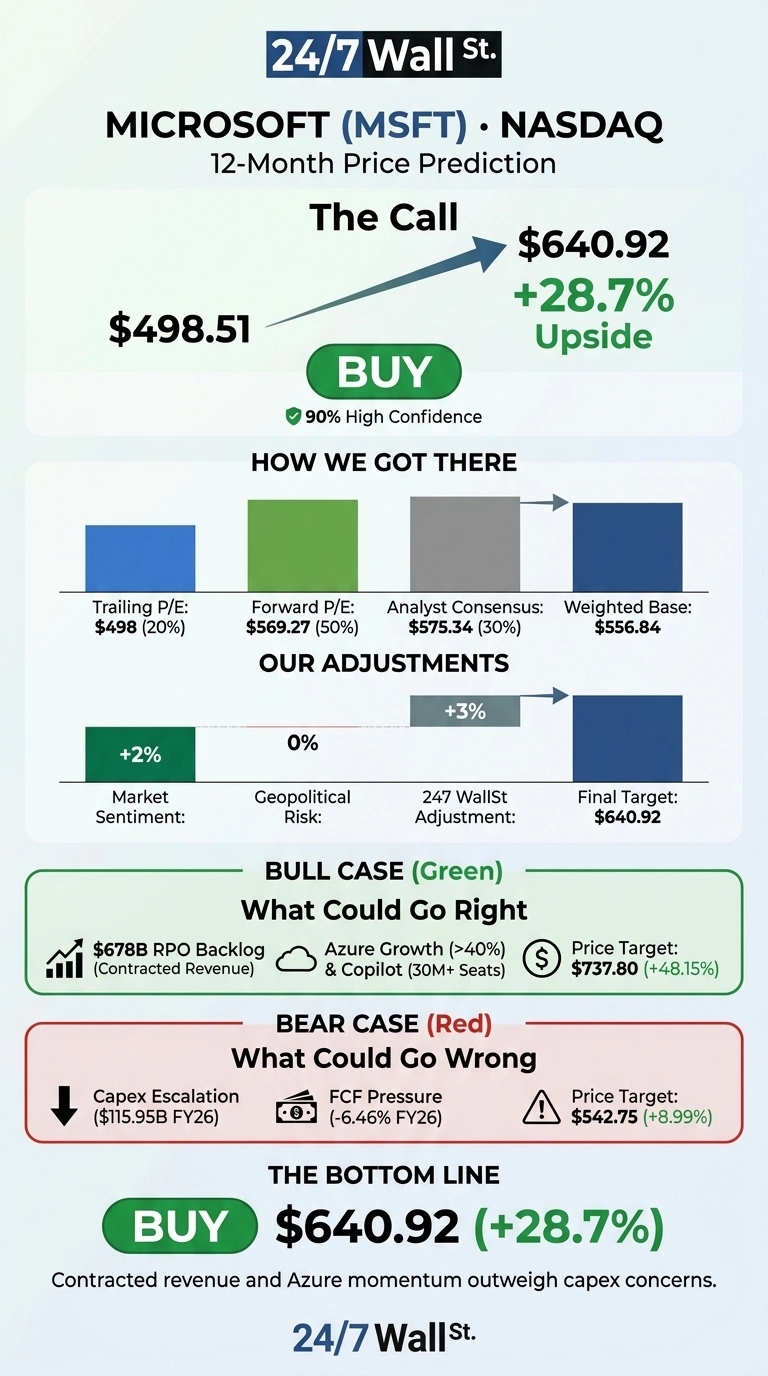
The 24/7 Wall St. price target for Microsoft is $640.92 over the next 12 months, implying 28.7% upside. Our recommendation is buy. A $678 billion RPO backlog gives multi-year visibility that the current 27x multiple does not fully price in.

24/7 Wall St. Price Target Summary
| Metric | Value |
|---|---|
| Current Price | $498.51 |
| 24/7 Wall St. Price Target | $640.92 |
| Upside | 28.7% |
| Recommendation | BUY |
| Confidence Level | 90% |
Azure at $100 Billion Resets the Growth Story
Microsoft is up 3.16% over the past month and 3.73% year to date.
Fiscal Q4, reported July 29, 2026, delivered $90.01 billion in revenue (+17.75% YoY) and non-GAAP EPS of $4.74, a fifth consecutive beat. Intelligent Cloud grew 32%, Azure jumped 43%, with management guiding fiscal Q1 Azure growth to approximately 45% in constant currency.

Why Bulls See a Breakout Ahead
The bull case rests on contracted revenue. Commercial RPO grew 84% to $678 billion, with RPO beyond 12 months up 112%. GitHub Copilot reached 50 million users with revenue accelerating more than 60% quarter over quarter. Foundry revenue more than doubled year over year, and Agent 365 registered nearly 40 million agents within two months of launch.
Satya Nadella framed the setup bluntly: “I’ve never been more confident in Microsoft’s opportunity to drive durable long-term growth.”
Our bull case scenario points to $737.80 within 12 months, a 48.15% total return, if Azure holds a 40%+ growth cadence and Copilot monetization shifts meaningfully to consumption pricing.

Risks Worth Watching
Capex is the pressure point. FY26 capital expenditures hit $115.95 billion, up 79.62%, with FY27 guided to approximately $175 billion. Free cash flow fell 6.46% for the full year.
More Personal Computing revenue declined 4%, with Xbox down 10%. Amy Hood emphasized “demand continues to exceed available supply.” The bear case still yields $542.75, an 8.99% return.

How Microsoft Compares to Alphabet and Amazon
Alphabet (NASDAQ:GOOGL) offers the sharpest valuation contrast. Google Cloud grew 82% in Q2 fiscal 2026, faster than Azure, yet trades at a P/E of just 16. However, Alphabet’s Q2 free cash flow was negative $5.86 billion after $44.9 billion in capex, while Microsoft still generated positive FCF. Quality justifies premium.
Amazon (NASDAQ:AMZN) is the direct AWS-versus-Azure comparison. AWS grew 37% in Q2 2026, its fastest in 18 quarters, and Amazon plans roughly $200 billion in 2026 capex. Amazon trades at a P/E of 35, notably above Microsoft. Against these peers, our $640.92 target looks reasonable relative to peers.
| Company | P/E | Cloud Growth |
|---|---|---|
| Microsoft | 27 | 43% |
| Alphabet | 16 | 82% |
| Amazon | 35 | 37% |
Microsoft Price Prediction 2026-2030
The 24/7 Wall St. price target of $640.92 with a buy rating and 90% confidence reflects a rare setup: acceleration on top of a $678 billion backlog, with the stock still below year-ago levels.
The factor tipping the scale is Azure guidance of 45% constant currency for fiscal Q1. The bull thesis strengthens if Azure holds above 40% into calendar 2027. The setup weakens if FY27 capex creeps above $200 billion without matched RPO growth.
| Year | 24/7 Wall St. Price Target |
|---|---|
| 2026 | $525 |
| 2027 | $640 |
| 2028 | $778 |
| 2029 | $857 |
| 2030 | $957 |
These projections assume Microsoft executes on Azure, Copilot, and Foundry. The suppliers powering that buildout, from grid capacity to cooling, are a story of their own; we profiled seven of them in a free report on the AI infrastructure trade. Upside or downside could result from OpenAI partnership economics or an AI capex reset across hyperscalers.
Contact [email protected] for any questions or corrections.
Vandita Jadeja is a financial publisher with over a decade of experience writing about financial topics, including investment, savings, retirement, insurance and banking. Vandita is a Chartered Accountant who loves to debunk financial concepts for readers.
Her work has appeared on sites that include The Motley Fool, InvestorPlace, and Benzinga. She covers investing and focuses on stock picks and price prediction for 24/7 Wall St.
When not looking for the next stock investment opportunity, she can be found traveling, reading, chasing sunsets and enjoying her iced latte.