Meta Connect Just Started and the Stock Is Already at a 52 Week High
Shares of Meta are surging into the Connect conference on the back of an AI assistant that is rewriting the company's growth story, but massive capital spending and looming legal battles put the rally on a razor's edge.

This post may contain links from our sponsors and affiliates, and Flywheel Publishing may receive compensation for actions taken through them.
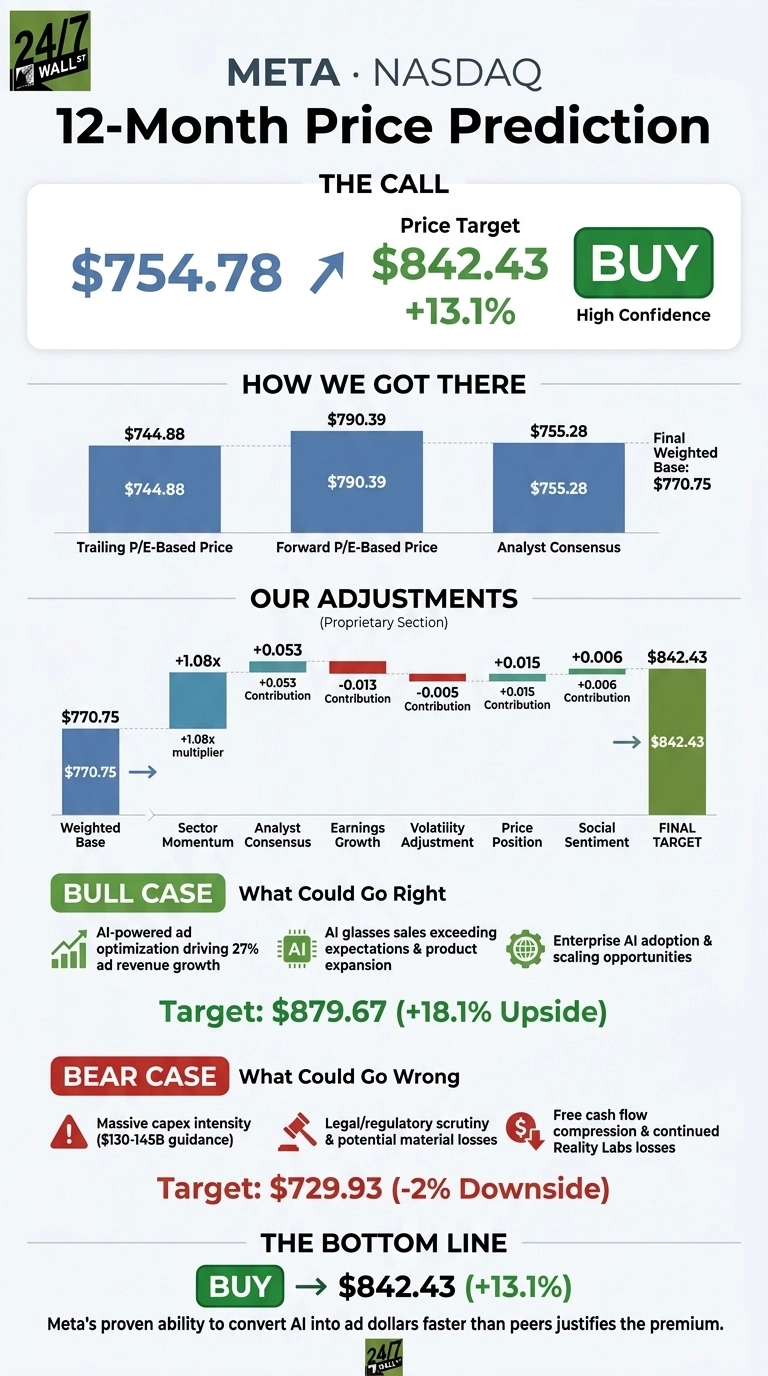
Meta (NASDAQ:META | META Price Prediction) opened its 2026 Connect developer conference today with shares at $754.78, up 37.35% in the last month. Our 24/7 Wall St. price target is $842.43, implying 13.1% upside over 12 months.
We rate the stock buy with high confidence, driven by AI-powered ad monetization and a glasses lineup flagged as a fast-growing consumer electronics category.
24/7 Wall St. Price Target Summary
| Metric | Value |
|---|---|
| Current Price | $754.78 |
| 24/7 Wall St. Price Target | $842.43 |
| Upside | 13.1% |
| Recommendation | BUY |
| Confidence Level | 90% |

A Muse-Powered Rally Into Connect
Meta is having its best month in 13 years on enthusiasm around the Muse AI assistant. The stock is up 12.69% in the last week and 14.62% year to date, nearing its $758.54 52-week high as CEO Mark Zuckerberg takes the Connect stage.
Instacart signed on as a Muse partner, reinforcing the enterprise AI narrative. Q2 2026 delivered $60.8 billion in revenue, up 28%, though EPS of $6.18 missed the $7.22 consensus after $2.4 billion in legal charges and $1.2 billion in severance.

Why Bulls See a Breakout Above $880
The bull thesis rests on AI monetization. Zuckerberg said on the Q2 call that “on a dollar basis, our ads business is reporting faster year over year revenue growth than any other company’s reported ad business.”
Advantage Plus is already running at a $75 billion annual run rate, Meta AI daily interactions jumped 60% after the Muse Spark integration, and glasses sales are exceeding expectations.
Our bull scenario points to $879.67, an 18.1% return, on the assumption Connect unveils a bigger glasses lineup and enterprise Muse deals like Instacart continue to close.

What Could Go Wrong
Capex is the counterweight. Meta guided 2026 spending to $130 to $145 billion, free cash flow collapsed to $784 million in Q2, and long-term debt now sits at $83.66 billion. Forbes flagged today that the new AI may not scale to justify the spend. U.S. youth-safety trials also carry material-loss risk.
Bulls counter that excluding legal and severance, Q2 operating income would have grown 9%, and that the infrastructure buildout is a moat that justifies the spend (the power, cooling, and networking suppliers riding that same buildout are the subject of a free report you can grab here). Our bear case still shows just $729.93, a manageable 2% drawdown.
How Meta Compares to Alphabet and Snap
Alphabet (NASDAQ:GOOGL) is the cleanest comparable on ads and AI infrastructure. It trades at a 16 P/E versus Meta’s 28, with Google Cloud growing 82% in Q2. On that comparison our Meta target looks aggressive, but Meta’s 41.44% operating margin trumps Alphabet’s 32%, justifying a premium.
Snap (NYSE:SNAP) is the AR-glasses counterpoint via its SPECS launch. Snap grew ad revenue just 9% in Q2 and remains unprofitable with a negative P/E. The gulf makes Meta’s premium look earned rather than stretched, and reinforces our buy.
Meta Price Prediction 2026-2030
The 24/7 Wall St. price target of $842.43 reflects a buy at 90% confidence. The tipping factor is Meta’s proven ability to convert AI into ad dollars faster than any peer.
The bull case strengthens if Connect delivers a credible consumer glasses roadmap and enterprise Muse traction. The thesis weakens if Q3 capex guidance climbs again or if the youth-safety trials produce a nine-figure settlement.
| Year | 24/7 Wall St. Price Target |
|---|---|
| 2026 | $762.57 |
| 2027 | $844.89 |
| 2028 | $905.80 |
| 2029 | $997.24 |
| 2030 | $1,063.66 |
These projections assume Meta continues executing on AI-driven ad monetization and glasses adoption. Meaningful upside or downside could come from enterprise Muse revenue scaling or from regulatory outcomes in the pending youth-safety trials.
Contact [email protected] for any questions or corrections.
Vandita Jadeja is a financial publisher with over a decade of experience writing about financial topics, including investment, savings, retirement, insurance and banking. Vandita is a Chartered Accountant who loves to debunk financial concepts for readers.
Her work has appeared on sites that include The Motley Fool, InvestorPlace, and Benzinga. She covers investing and focuses on stock picks and price prediction for 24/7 Wall St.
When not looking for the next stock investment opportunity, she can be found traveling, reading, chasing sunsets and enjoying her iced latte.