PG vs. KMB: Bigger Yield Isn’t Everything. Here’s Which Stock Truly Delivers for Retirees
Kimberly-Clark hands retirees a fatter dividend check every quarter, but one look at what sits behind that payout changes the picture fast. Before you choose the bigger yield, consider what happens when the income has to last decades.


Procter & Gamble (NYSE:PG | PG Price Prediction) or Kimberly-Clark (NASDAQ:KMB): which household staples dividend is the better hold for retirement income right now? Kimberly-Clark pays the bigger check. P&G backs its check with far more cash, a longer record and a wider brand advantage, and that is what matters when the income has to last decades.
The market is already signaling stress at Kimberly-Clark. Its shares fell 15.05% over the past year and 9.71% in the past month, while P&G slipped just 1.1% over the year.
Yield and Payout Safety: Kimberly-Clark’s Extra Income Carries Extra Risk
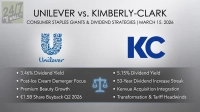
Kimberly-Clark yields 5.23%, with an annualized forward dividend of $5.12 at $98.43 per share. P&G’s forward dividend is $4.354 on shares trading at $146.27, so Kimberly-Clark pays more per dollar invested.
Coverage tells the real story. Kimberly-Clark’s trailing diluted EPS of $5.06 sits below its $5.08 dividend per share, and Q2 net income fell 32.3% year over year. Free cash flow was $1.639B in FY2025. P&G earned core EPS of $6.89 in FY2026, well above its payout, and generated $15.835B in free cash flow against plans for over $10 billion in dividends. Winner: P&G.


Dividend Growth and Track Record: 70 Years Tops 54
P&G just logged its 70th consecutive year of dividend increases and its 136th consecutive year of payments. Its quarterly dividend rose from $0.28 in 2006 to $1.0885 today, including a 3% raise in FY2026.
Kimberly-Clark’s streak stands at 54 consecutive years. Its quarterly payout rose from $0.49 in 2006 to $1.28, but the latest step from $1.26 was modest. Price history widens the gap: P&G’s adjusted shares gained 117.42% over 10 years, versus 11.83% for Kimberly-Clark. Winner: P&G.
Business Durability: P&G’s Brand Wall Resists Store Brands Better
Both companies face retailer leverage. P&G’s North America sell-in fell 1% while consumption rose 2%, partly on retailer inventory cuts. Kimberly-Clark’s North American shipments lagged consumption by about 170 basis points, and management noted retailer-backed diaper imports entering the market.
Kimberly-Clark’s mix is concentrated in paper-based necessities like Huggies, Kleenex and Scott, exactly where store brands compete hardest. It also takes on a China diaper disruption worth roughly $70 million of second-half operating profit, plus a ~$48.7B Kenvue acquisition for a company valued at $32.7B.
P&G covers Tide, Gillette, Crest, Olay and SK-II, where performance claims justify premium pricing. Beauty grew 6% in Q4, and 9 of 10 categories held or grew organic sales for the year. Its roughly $1B after-tax commodity headwind is real, yet guidance still calls for core EPS of $6.89 to $7.11. Winner: P&G.
Verdict: P&G Is the Retirement Dividend Built to Last
Kimberly-Clark’s case deserves a hearing. It trades at a forward P/E of 13, carries a beta of 0.273, and analysts target $116.2. Management says of Kenvue, “The closer we look at this thing, the better it gets.” An investor who needs maximum current income and can stomach integration risk gets paid more to wait.

P&G wins all three dimensions for anyone who cannot afford a dividend scare. Its payout is covered by earnings and cash flow, its streak is longer, and its brands defend pricing against store labels.
What would flip the call: Kimberly-Clark closing Kenvue on schedule and issuing a 2027 outlook that lifts EPS well back above its $5.12 dividend, or P&G’s core EPS falling below the $6.89 guidance floor. Kimberly-Clark’s 2027 update is worth watching, as management plans it closer to the deal close.
Contact [email protected] for any questions or corrections.
Chris Lange is a financial and geopolitical writer with more than a decade of experience covering a myriad of topics. He has published thousands of articles for 24/7 Wall St., with past coverage focused heavily on stocks, IPOs, healthcare, defense, global affairs, and technology.
His work has been quoted, or referenced by a number of outlets including Business Insider, USA Today, Yahoo Finance, MSN, The Motley Fool, and many other publications. A graduate of Southwestern University, he studied business with a focus on investments and has previous experience in banking and startups.
When not reading or writing the news, he is following his passion for Lacrosse, playing chess, or building solar projects with his dad.