Kimberly-Clark Keeps Raising Its Dividend. The Question Is Whether It Is Keeping Up With Your Costs
Kimberly-Clark just logged its 54th straight year of dividend increases, but a shrinking raise, falling free cash flow, and a massive acquisition in progress raise a pointed question for income investors living on those checks.


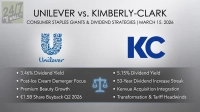
The dividend increase streak at Kimberly-Clark (NASDAQ:KMB | KMB Price Prediction) reached 54 consecutive years in 2026. That raise lifted the quarterly payout from $1.26 to $1.28. For a retiree living on that check, the size of each step matters more than the length of the streak.
Smaller Raises Meet Rising Prices
The quarterly rate moved from $1.18 in 2023 to $1.22 in 2024, $1.26 in 2025 and $1.28 in 2026. The 2026 increase is clearly smaller than the two before it. Meanwhile, the Consumer Price Index rose from 324.245 in September 2025 to 334.131 in August 2026, the high of that series, with the latest month up 0.4%.
Price appreciation has not filled the gap. Shares trade at $98.55, down 15.6% over one year and 9.64% over five years, against an annualized forward dividend of $5.12.
Thin Cash Coverage Limits Faster Raises

Free cash flow fell 34.78% to $1.639 billion in 2025 as capital spending jumped 57.84%. Full-year 2025 EPS of $7.53 compares with a trailing dividend of $5.10, and management guides adjusted EPS attributable to the company to a low single-digit decline this year. A $2 billion North American supply chain overhaul runs through 2028. On the second-quarter call, CEO Mike Hsu described the customer base frankly:
“Consumers are clearly under increased pressure. I think we’re seeing sentiment, especially among low-income consumers, is weakening.”
Management expects “right around $150 million of gross input cost headwinds” in the second half, with North American price increases of “low single digits overall.”
How P&G and Colgate Stack Up
The quarterly dividend from Procter & Gamble (NYSE:PG) rose from $1.0568 to $1.0885, its 70th consecutive increase, backed by fiscal 2026 free cash flow of $15.835 billion, up 12.74%. Shailesh Jejurikar called fiscal 2026 “a year of foundation building” in “a very challenging geopolitical and economic environment.”
Colgate-Palmolive (NYSE:CL) reached 63 years of increases and generated $3.634 billion of 2025 free cash flow, which grew 2.48%. Noel Wallace said the company expects to “deliver consistent, compounded earnings per share growth.” Both peers entered this period with growing cash flow. Kimberly-Clark’s smaller.
Portfolio Reshaping Changes the Math
The company left U.S. private label diapers, is moving its IFP business into a joint venture with Suzano, and has a pending $48.7 billion Kenvue (NYSE:KVUE) deal. Hsu said:
“Our pending acquisition of Kenvue remains on track to close by the end of this year.”
No management commentary on dividend policy appeared in the second-quarter call.
Verdict: A Yield Holding That Happens to Raise
Kimberly-Clark has quietly become a yield holding with a raise attached. Falling free cash flow, a guided EPS decline and heavy integration spending point to token increases that protect the streak while trailing prices. Watch the next dividend declaration, which came on January 27 this year. A raise larger than the one declared in 2026, after Kenvue closes, would argue the growth story is intact.
Contact [email protected] for any questions or corrections.
Chris Lange is a financial and geopolitical writer with more than a decade of experience covering a myriad of topics. He has published thousands of articles for 24/7 Wall St., with past coverage focused heavily on stocks, IPOs, healthcare, defense, global affairs, and technology.
His work has been quoted, or referenced by a number of outlets including Business Insider, USA Today, Yahoo Finance, MSN, The Motley Fool, and many other publications. A graduate of Southwestern University, he studied business with a focus on investments and has previous experience in banking and startups.
When not reading or writing the news, he is following his passion for Lacrosse, playing chess, or building solar projects with his dad.