Jim Cramer Says Netflix “Too Cheap” To Overlook As Deutsche Bank Upgrades Stock To Buy
Jim Cramer and Steve Eisman are staring at the same Netflix data and reaching opposite conclusions, and with Q3 results approaching, one of them is about to look very wrong.

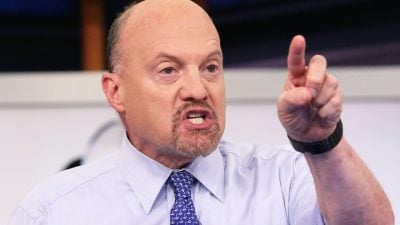
Jim Cramer used his Mad Dash segment on CNBC Tuesday morning to back Deutsche Bank’s upgrade of Netflix from hold to buy, saying he was “shocked” to see the company trading at 18 times 2027 earnings. His case: international exposure makes Netflix (NASDAQ:NFLX | NFLX Price Prediction) too cheap. That call arrives four days after Steve Eisman of The Big Short fame said Netflix has hit a growth wall and that the only way to increase revenue seems to be price increases.
The stakes are visible in the stock. Shares traded at $70.57 Tuesday morning, down 41.71% over one year and 13.64% in the past month. Bloomberg reported that analysts are souring on the stock as growth fears mount, and Cramer noted a recent Wells Fargo move that trimmed its price target by five dollars.

Deutsche Bank Says Wall Street Measures the Wrong Metric
Cramer cited Deutsche Bank’s view that the market’s focus on time spent has overlooked Netflix’s addressable market and healthier engagement. Management made the same argument on its July call:
“There is not a linear relationship between view hours and revenue and profit because all hours are not created equal.”
CFO Spence Neumann added that Netflix is “under 45% penetrated into addressable households around the world.”
Eisman’s Growth Wall Meets Netflix’s Revenue Mix
Eisman described the streaming wars as a food fight for market share. In an August episode of The Real Eisman Playbook, he outlined the gap separating Netflix from Disney (NYSE:DIS) and Warner Bros. Discovery (NASDAQ:WBD):
“Today Netflix has a market cap of over 300 billion. The next biggest entertainment company market cap is Disney at 178 billion… The company is very profitable, but growth is slowing.”
Pricing does matter. Co-CEO Greg Peters said recent price changes in the U.S., Mexico and Spain performed as expected, adding: “We price behind that value that we are delivering.” Advertising adds a second driver, with 2026 ad revenue expected to roughly double to ~$3B. Q2 revenue rose 13.37% to $12.56B, with Latin America up 21%.

Warner Bros. Fight Leaves Netflix Holding Cash
Netflix announced an all-cash deal for Warner Bros. at $27.75/share, then walked away, booking a $2.80B termination fee in Q1. Cramer said of that fight that people “just said they don’t have it anymore.” Co-CEO Ted Sarandos adjusted expectations: “We are primarily builders, not buyers.” Netflix bought back $4.7B of stock in Q2, its largest buyback quarter ever, with $27.1B remaining.
Bulls and Skeptics Before Q3 Results
Trailing P/E sits near 26, against FY2026 guidance for 31.5% operating margin and ~$12.5B of free cash flow. On the Halftime Report, Steve Weiss defended his position, saying he can’t imagine the company misses for a third quarter. Tom Rogers countered on Fast Money that big content budgets carry less leverage, describing a film made by “one guy with his computer working at night for just under $25,000.”

Netflix said it will announce third quarter 2026 financial results. Its guidance calls for revenue of $12.86B, operating margin of 33.2% and diluted EPS of $0.82. Ad growth and regional revenue will show whether Cramer or Eisman reads the story correctly.
Data Sources
- Cramer vs Eisman Netflix debate: Cramer’s endorsement of the Deutsche Bank upgrade and the 18 times 2027 earnings figure.
- Same source: Deutsche Bank’s time-spent thesis, the Wells Fargo target trim and Cramer’s Warner Bros. Discovery comment.
Contact [email protected] for any questions or corrections.
AJ spent 10 years writing about financial markets at The Motley Fool. His coverage centers on technology stocks and the broader macroeconomic trends, from interest rates to geopolitics, that shape where markets are headed next. AJ is drawn to the stories where big-picture economics and individual companies collide.