PepsiCo Walks a Tightrope: Dividend Growth Meets Operating Cash Flow Squeeze
PepsiCo just handed shareholders another dividend raise even as profits fell sharply, and the real question is not whether the payout is safe today but whether the cash engine behind it can survive what comes next.

This post may contain links from our sponsors and affiliates, and Flywheel Publishing may receive compensation for actions taken through them.
PepsiCo (NASDAQ:PEP | PEP Price Prediction) keeps lifting its dividend even as reported net income fell from $9.626 billion in fiscal 2024 to $8.295 billion in fiscal 2025. For an income investor near retirement, that gap raises a fair question: what is actually paying for the raises?

Where the Dividend Stands Right Now
The quarterly payment rose from $1.4225 to $1.48, a 4% raise that sets the annualized forward rate at $5.92. Shareholders collected $5.805 per share over the trailing 12 months. At $128.81, the stock yields 4.35%, helped partly by a 7.52% slide in the share price this year.
Why Reported Earnings Mislead Income Investors
Net income is the wrong lens for this dividend. Fiscal 2025 absorbed $1.993 billion in Rockstar and Be & Cheery intangible impairments. Those are accounting write-downs of past acquisitions; no cash left the building. The third quarter alone carried $142 million in restructuring charges and $221 million in acquisition items. Strip those out and core EPS came in at $8.14, beating the $8.11 estimate.

Cash Flow Test Holds the Real Answer
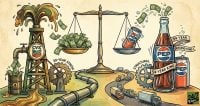
The mechanic is simple. Cash from operations pays for capital spending first, and whatever remains funds the dividend. In fiscal 2025, PepsiCo generated $12.087 billion in operating cash flow and spent $4.415 billion on capex, then paid $7.638 billion in dividends, up from $7.229 billion a year earlier.
The buffer is thin. PepsiCo’s free cash flow yield of 4.37% sits almost exactly on its 4.35% dividend yield, meaning nearly every dollar of free cash goes out as dividends. Yet the 2026 plan calls for $7.9 billion in dividends plus $1.0 billion in buybacks. Operating cash flow also slipped 3.36% in 2025, and first-quarter 2026 operating cash flow was just $41 million, though that quarter is seasonally weak. (A yield rising past 4% on a shrinking cash buffer is the exact setup we flagged in a free report on dividend trap warning signs.)
Peers face similar math. Coca-Cola (NYSE:KO) has posted stronger recent volume and EPS growth, giving its payout more room. Mondelez (NASDAQ:MDLZ) is balancing dividend growth against the same consumer affordability squeeze hitting Frito-Lay.

What Would Have to Change
Real pressure would come from free cash flow conversion falling below management’s 80% floor, deeper North American volume drops, or tariff costs like the 11 ppt hit PBNA absorbed in the fourth quarter. Leverage leaves limited room, with net debt at 2.31 times EBITDA.
The fix is earnings growth. Guidance calls for 4% to 6% core constant currency EPS growth, backed by what Chairman and CEO Ramon Laguarta described in February:
“We also aim to deliver a record year of productivity savings which will help fund investments to accelerate growth.”
International momentum helps. Second-quarter EMEA revenue rose 10% and LatAm Foods grew 15%. During the July call, Laguarta pointed to “the fastest growth in volumes since 2022.”
Can PepsiCo Keep Raising the Payout?
Yes, on a cash basis the dividend is covered, and the shrinking net income reflects write-downs more than a weaker cash engine. The margin for error is slim, though. Future raises will likely track free cash flow closely, so the buyback is the first option to give if cash falls short. Monitor operating cash flow and the 80% conversion target in the third-quarter earnings report.
Contact [email protected] for any questions or corrections.
Chris Lange is a financial and geopolitical writer with more than a decade of experience covering a myriad of topics. He has published thousands of articles for 24/7 Wall St., with past coverage focused heavily on stocks, IPOs, healthcare, defense, global affairs, and technology.
His work has been quoted, or referenced by a number of outlets including Business Insider, USA Today, Yahoo Finance, MSN, The Motley Fool, and many other publications. A graduate of Southwestern University, he studied business with a focus on investments and has previous experience in banking and startups.
When not reading or writing the news, he is following his passion for Lacrosse, playing chess, or building solar projects with his dad.