4 Tesla Entry Points Show the Milestones Investors Cheered Were Not Always the Best Times to Buy
Tesla investors who celebrated the biggest milestones in company history did not always walk away with the biggest gains, and the gap between some of those entry points is staggering enough to reframe how investors think about riding hype.

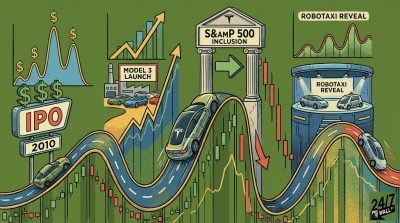
Tesla (NASDAQ:TSLA | TSLA Price Prediction) investors celebrated milestones that turned out to be the worst moments to buy. The returns below all anchor to the final close of $354.81 on September 30, 2026. All entry prices are split-adjusted.
IPO Day Buyers Locked In a Return That No Later Milestone Approached
Tesla began trading on June 29, 2010, as a money-losing niche carmaker. After adjusting for splits, the entry price was $1.59, and the return through the anchor close is 22,177.73%. It tops this list by a wide margin.
Model 3 Handover Buyers Caught the Mass Market Turn
Tesla began its first Model 3 customer deliveries on July 28, 2017, marking the move to the mass market. Buyers who purchased that day paid $22.34 and have earned 1,488.37%. That is a strong result but a small fraction of what the IPO buyer collected.
S&P 500 Inclusion Delivered Validation at a Steep Price
CNBC reported that Tesla would join the S&P 500 in a single step before the open on December 21, 2020. Inclusion was widely interpreted as institutional approval and triggered one of the largest index fund trades on record.
An investor who bought at $216.62 has earned 63.79% after waiting the better part of six years, only slightly ahead of a robotaxi buyer who entered the stock nearly four years later. Approval and a good entry price are two different things.
Robotaxi Night Buyers Paid the Pre-Reveal Close
NPR reported that Tesla would unveil its robotaxi at the We, Robot event on the evening of October 10, 2024, after the market closed. This entry point uses the closing price of $238.77 from that day, recorded before the Cybercab appeared on stage. The stock has returned 48.6% since then.
On its Q2 2026 call, Tesla said the Robotaxi fleet had expanded to seven U.S. markets, with “more than 380,000 miles of unsupervised Robotaxi” logged. Steve Eisman remains a skeptic, saying on his podcast that “Elon Musk has a history of overpromising and underdelivering” on robotaxis.
Every Milestone Buyer Is Still Ahead, but Recent Ones Are Sliding
Measured against Thursday’s premarket price of $355.90, Tesla is down 20.0% over the past year and 20.1% year to date. The five-year return is 37.8%, and the ten-year return is 2,516.5%.
Fundamentals explain the recent slide. Q2 2026 EPS of $0.33 missed expectations by 38.5%; operating margin fell to 1.4%; and free cash flow was negative $1.09 billion. Management expects full-year capex of “more than $25 billion.” Shares trade at 333 times trailing earnings and 159 times forward earnings, the kind of multiple that makes knowing when to leave the party the real question. (We wrote a free handbook on riding a mania and planning the exit here: The Bubble Survivor’s Handbook.)
Price Paid Outweighs Years Held
The S&P 500 buyer waited years longer than the robotaxi buyer for a slightly larger result. Entry price determines returns. Next, watch earnings, robotaxi expansion, and whether heavy capex restores margins.


Contact [email protected] for any questions or corrections.
Trey has been an editor and author at 24/7 Wall St. for more than a decade, where he has published thousands of articles analyzing corporate earnings, dividend stocks, short interest, insider buying, private equity, and market trends. His comprehensive coverage spans the full spectrum of financial markets, from blue-chip stalwarts to emerging growth companies.
Beyond 24/7 Wall St., Trey has created and edited financial content for Benzinga and AOL's BloggingStocks, contributing additional hundreds of articles to the investment community.
Trey's editorial expertise extends across multiple publishing environments. He served as production editor at Dearborn Financial Publishing and development editor at Kaplan, where he helped shape financial education materials. Earlier in his career, he worked as a writer-producer at SVE. His freelance editing portfolio includes work for prestigious clients such as Sage Publications, Rand McNally, the Institute for Supply Management, the American Library Association, Eggplant Literary Productions, and Spiegel.
Outside of financial journalism, Trey writes fiction and has been an active member of the writing community for years, moderating workshop sessions at regional conventions.