Don’t Count on the Market Broadening Out. Count Your Tech Exposure Instead.
Tech earnings keep breaking records, strategists say positioning is neutral, and yet your retirement account may be far more concentrated in a handful of giant stocks than you realize. Finding out takes less than ten minutes.

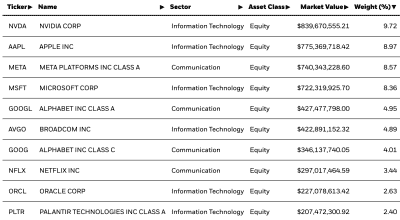
The institutional view on technology leadership is bullish. Strategist Dennis DeBusschere stated on the On Investing podcast: “It’s very, very rare to get a broadening out. It’s very rare to have market leadership not driven by tech. The only times that happens are when positioning in tech is overextended. That’s not where we are right now. Positioning in tech looks pretty neutral.”
If you hold large growth funds, that sounds reassuring. But research from Morningstar suggests a different priority: find out how much tech you already own.
Earnings Keep Tech at the Front of the Market
Recent earnings reports support the strategist’s view. Nvidia (NASDAQ:NVDA | NVDA Price Prediction) reported fiscal second-quarter revenue of $96.22 billion, up 105.8% from a year earlier. Non-GAAP EPS came in at $2.22 against a $2.09 consensus, its fifth consecutive earnings beat. The company guided next-quarter revenue to $108.0 billion. Microsoft (NASDAQ:MSFT) beat EPS expectations for a fifth consecutive quarter, posting $4.74 against $4.24. Azure grew 43%, and commercial remaining performance obligations (contracted revenue not yet recognized) rose to $678 billion. Apple (NASDAQ:AAPL) reported EPS of $2.02 against $1.89 expected, its ninth consecutive EPS beat.
Exposure Shows How Crowded a Trade Already Is
Exposure measures how heavily investors already own a trade. It matters because once nearly everyone owns something, little new money is left to push it higher. Strategist Eric Liu said on the On Investing podcast that the average three-month forward return in the S&P 500 is about 3%, and that extremely long positioning has gone with a negative return. When positioning is extremely short, the market is typically up 10% or more over the next three months. He called it “vast dispersion.”
A neutral reading on tech means the sector is not crowded by this measure. That reading describes today’s conditions. Using it to time trades in a retirement account pushes it past its purpose.
Morningstar Finds the Tech Inside Growth Funds
Morningstar’s Bryan Armour on the Investing Insights podcast described Fidelity Blue Chip Growth ETF (NYSEARCA:FBCG) as more than half technology: “The fund’s more than half tech, you could almost say it’s tech blue chips. It’s done really well, but obviously a very aggressive fund.”
Strong Returns Still Fail Morningstar’s Risk Screen
Morningstar’s Russel Kinnel explained why some top performers are excluded: “Vanguard Capital Opportunity, Vanguard Prime Cap, and Vanguard Prime Cap Core are producing great returns but don’t have a risk rating below high. We screen those out because investors do better with more moderate risk funds.”
A fund can be excellent and still be wrong for someone drawing down a portfolio. A sharp decline during withdrawals locks in losses that younger savers have years to recover from. (We walked through that early-retirement sequence problem, and how to defend against it, in a free guide here.)
Count Your Tech Exposure Before a Drawdown Does It for You
Waiting for the market to broaden leaves risk management to chance. A practical audit works better:
- Look up the sector breakdown of every fund you own, regardless of what the fund is called.
- Review each fund’s top holdings.
- Note how often the same large technology companies appear across multiple funds.
Concentration in these three names is sharp. Nvidia has a market value near $5.6 trillion, Apple near $4.8 trillion, and Microsoft near $3.8 trillion. Their share prices have also moved differently this year: Nvidia is up 22.3%, Apple 21.9%, and Microsoft 8.4%. Owning three different growth funds can mean owning the same concentrated position three times.
Smart Money Has the Leadership Call Right, and the Next Step Is an Audit
The earnings record supports the strategist’s view that tech leadership remains intact and uncrowded. The useful step today is to learn how much of your retirement money depends on a few technology companies, then decide whether that concentration matches the downside you can bear.
Contact [email protected] for any questions or corrections.
Trey has been an editor and author at 24/7 Wall St. for more than a decade, where he has published thousands of articles analyzing corporate earnings, dividend stocks, short interest, insider buying, private equity, and market trends. His comprehensive coverage spans the full spectrum of financial markets, from blue-chip stalwarts to emerging growth companies.
Beyond 24/7 Wall St., Trey has created and edited financial content for Benzinga and AOL's BloggingStocks, contributing additional hundreds of articles to the investment community.
Trey's editorial expertise extends across multiple publishing environments. He served as production editor at Dearborn Financial Publishing and development editor at Kaplan, where he helped shape financial education materials. Earlier in his career, he worked as a writer-producer at SVE. His freelance editing portfolio includes work for prestigious clients such as Sage Publications, Rand McNally, the Institute for Supply Management, the American Library Association, Eggplant Literary Productions, and Spiegel.
Outside of financial journalism, Trey writes fiction and has been an active member of the writing community for years, moderating workshop sessions at regional conventions.