GE Vernova’s Consolidation Looks Promising For One Simple Reason
GE Vernova's cash outlook just surged while the stock sat still, and that gap between price and reality has analysts lining up on one side of the trade.

This post may contain links from our sponsors and affiliates, and Flywheel Publishing may receive compensation for actions taken through them.

GE Vernova (NYSE:GEV | GEV Price Prediction) trades at $987.29, and the stock has been moving sideways since its last earnings report while management has sharply raised its cash outlook.
GE Vernova builds gas turbines, grid and electrification equipment, and wind turbines. Demand from AI data centers and utilities upgrading the grid has driven strong order growth across the business. Shares are up 51.34% year to date. They also sit 17.4% below the 52-week high of $1,195.94 and trade between the 50-day average of $968.41 and the 200-day average of $913.15.
GE Vernova’s Backlog Is Turning Into Cash at a Rapid Pace
Second-quarter free cash flow came in at $5.10B. Management raised full-year free cash flow guidance to $11.5B to $12.5B, up from $6.5B to $7.5B. Bookings rose 88% organically to $24.20B, and data center orders in Electrification exceeded $5 billion in the first half (GEV is one of the clearest non-chipmaker AI infrastructure plays, and we highlighted seven of these picks-and-shovels names in a free report here).
Management expects backlog to reach $200 billion in 2027 and is targeting $56B in revenue with a 20% adjusted EBITDA margin by 2028. The cash is already reaching shareholders. The dividend doubled to $0.50 per share, and the buyback authorization grew to $10B.
Down Payments Inflate the Cash Story, and the Multiple Leaves No Margin for Error
Working capital supplied $6.4 billion of cash in the quarter, mostly from customer down payments. CFO Ken Parks said first-half free cash flow will be “substantially higher than the second half.” Second-quarter EPS of $2.47 missed the $3.17 estimate.
At a forward P/E of 39 and EV/EBITDA of 81, the price assumes perfect delivery. Wind is still a drag, with an expected ~$400M EBITDA loss this year and orders down 40% in the quarter.
Second-Half Cash Flow Will Decide Whether the Range Breaks
Second-half results will provide the proof. Management expects positive free cash flow in the third quarter, with revenue and EBITDA peaking in 4Q26. If slot reservations convert into orders on pace toward at least 125 GW under contract by year-end, the optimistic view holds up. If margins slip, the bears gain ground.
Analyst Targets Sit Well Above the Trading Range
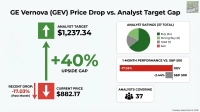
The stock trades at $987.29, while the average analyst target of $1,230.34 implies 24.6% upside. Sentiment across the 37 covering analysts tends positive:
- Strong Buy: 6
- Buy: 24
- Hold: 7
- Sell: 0
Over the past year GE Vernova rose 63.25%, and the S&P 500 advanced 14.3%. Over the past month the stock added 9.88%, compared with 0.3% for the index. The trailing P/E stands at 27.
Cash Flow Keeps Building While the Stock Pauses
At $987.29, GE Vernova trades below the average analyst target while its cash outlook improves.
Since the last earnings report, the share price has moved sideways while the cash outlook rose sharply. Down payments flow straight into capacity, and management says those payments fund the expansion. Annual gas turbine output is set to reach 20 GW starting this quarter, which turns backlog into revenue that customers have already partly paid for.
The most important drivers over the next two quarters are positive third-quarter free cash flow and the conversion of slot reservations into orders. A sharp drop in conversions or a stall in margins would break the thesis.
Strong cash generation keeps paying for buybacks and capacity while the stock moves sideways, so this consolidation looks like a reset with the stock trading below the analyst targets.
Contact [email protected] for any questions or corrections.
Alex Sirois is a financial writer with experience spanning both retail and institutional investing. He has written for InvestorPlace and held roles at BNY Mellon and Bernstein, giving him a perspective that bridges Main Street portfolios and Wall Street analysis.
Alex holds an MBA from George Washington University and has built his career across multiple industries, including e-commerce, education, and translation — a breadth of experience that informs how he breaks down complex financial topics for everyday investors. His writing is conversational, actionable, and grounded in long-term, buy-and-hold investing principles.
At 247 Wall St., Alex focuses on delivering analysis that is both accessible and useful, with a clear emphasis on helping readers make more informed decisions with their money.