Is MercadoLibre Finally Ready to Pay Off on Its Promise?
MercadoLibre grew revenue nearly 50% last year and still watched its stock fall 18%. The reason comes down to a single bet the company made on purpose, and whether it pays off depends on a clock that started ticking two…


MercadoLibre (NASDAQ:MELI | MELI Price Prediction) has spent a year punishing shareholders for growing faster. Shares trade at $1,829.56, down 9.17% year to date and 18.56% over the past year. That leaves the stock roughly 24.6% below its 52-week high of $2,428, even after a 7.84% jump in today’s session. The decline came while revenue sped up. Second-quarter 2026 revenue reached $10.169 billion, up 49.76% year over year. So the question for this Comeback Case is a narrow one: does the calculated margin sacrifice finally turn into earnings, or is it a permanent tax on the business?
Margin Sacrifice Meets a Maturing Credit Book
What Actually Went Wrong
The problem is profitability, and it was a choice. In Q2 2026, operating margin fell 550 basis points year over year to 6.7%. Operating income came in at $683 million, down 17.21%, and net income slipped 10.9% to $466 million. Q1 looked the same: operating margin was 6.9% and adjusted free cash flow went negative at -$56 million.
Before that, earnings expectations broke down. EPS missed in three straight quarters. Q2 2025 came in 13.26% below consensus. Q3 2025 EPS of $8.32 missed by 10.51%, hit by Argentine peso FX losses and a higher tax rate. Q4 2025 EPS of $11.03 also came in short. The balance sheet took on more weight as well: net debt rose to $6.4 billion from $4.7 billion at the end of 2025.

Some of the challenges sit outside management’s control. In Mexico, tax reform, a weaker economy, and lower consumption during the World Cup weighed on commerce. Argentina’s slower spending shows in its revenue growth of 20%, compared with 59% in Brazil and 55% in Mexico. The market’s tolerance has run out. A Q1 2026 result that met expectations sent shares down 12.7% on earnings day. The Q2 beat still drew a 4.81% earnings-day decline.
Credit Card Seasoning Is the Catalyst to Track
The investment cycle also has a new owner. Ariel Szarfsztejn replaced co-founder Marcos Galperin as chief executive starting January 1, 2026. The most important catalyst on his watch is the credit card portfolio reaching maturity. In Brazil, MercadoLibre issued 2.6 million cards in Q2, compared with 1.6 million a year earlier. In Q1, the card portfolio grew 104% to $6.6 billion, reaching 47% of the total loan book. Management says card groups usually reach break-even after 12 to 18 months, and most of the portfolio was issued in the last two years. That makes the cost of fast issuance a timing issue: the losses come first, and the returns follow as each group seasons.
The early signs are holding up. The total credit portfolio reached $16.4 billion, up 75%. The 15-to-90-day NPL ratio was 7.0% for the full portfolio and 4.6% for cards, levels management called “close to historical lows.” NIMAL (net interest margin after losses) improved from 18% in Q1 2026 to 21% in Q2 2026. Card users are also two to three times more likely to become ecosystemic users, meaning they use both the marketplace and Mercado Pago. That group grew 37% year over year, and management says each one generates contribution profit that is “multiples of the sum of a marketplace-only user and a FinTech-only user.”
Supporting Catalysts in Brazil and in AI
Brazil’s lower free-shipping threshold of R$19 has now run for a full year. Items sold in Brazil grew 56%, compared with 26% a year earlier. Items per buyer rose 19%, and conversion improved 1.1 percentage points. AI is already showing up in costs. Product development expense fell from 8.4% to 7.2% of revenue, and management said 2026 is likely the first year in many years in which the engineering team did not grow. Cross-border trade adds another driver: volume from the China fulfillment center rose 170% quarter over quarter, and advertising passed a 10% share of the Latin American digital ad market.
How the Valuation Compares With Its Own History
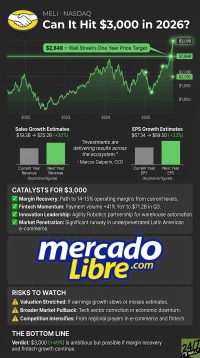
MercadoLibre trades at 46 times trailing earnings and 33 times forward earnings. At the end of 2025, the stock closed at $2,014.26 against $39.40 in combined 2025 quarterly EPS. That works out to roughly 51 times trailing earnings. The multiple has contracted even though revenue growth sped up, which means the market is pricing in lasting margin damage. Wall Street’s mean target of $2,269.94 comes from 5 Strong Buy, 17 Buy, and 4 Hold ratings, with 0 Sells.


What Has to Go Right
- Margin turnaround: Operating margin needs to rise from the 6.7% to 6.9% range as card groups season. One early sign: operating expenses fell two and a half points as a share of revenue from Q1 to Q2.
- Cash generation: Adjusted free cash flow recovered to $214 million in Q2 while the company still put $2.1 billion into credit-book growth. That needs to hold.
- Self-sustaining engagement: Brazil buyers have to keep buying more often without a permanent increase in shipping subsidies.
- Stable markets: Argentina’s FX and spending need to stabilize, and Mexico’s acquiring margins have to recover once the one-time device restocking charge passes.
What Would Falsify the Case
The thesis fails if operating margin stays below 7% through 2027, if card NPLs rise sharply as the faster issuance seasons, or if free cash flow goes back below zero. It also breaks if Mexico’s tax reform permanently reduces the seller base or if a slowdown in Brazilian consumer spending stalls the engagement cycle that justifies the spending.
Verdict: The Card Book Decides the Outcome
The comeback case holds. Revenue has topped estimates in every quarter on record, EPS is back to beating expectations, and credit quality is near historical lows even as issuance runs at a record pace. Cash flow turned positive again in Q2. Earnings now depend mostly on how card groups season over the next 12 to 18 months, and that is the metric to watch each quarter.

Contact [email protected] for any questions or corrections.
After two decades of patrolling the dark corners of suburbia as a police officer, Rich Duprey hung up his badge and gun to begin writing full time about stocks and investing. For the past 20 years, he’s been cruising the markets looking for companies to lock up as long-term holdings in a portfolio while writing extensively on the broad sectors of consumer goods, technology, and industrials. Because his experience isn’t from the typical financial analyst track, Rich is able to break down complex topics into understandable and useful action points for the average investor. His writings have appeared on The Motley Fool, InvestorPlace, Yahoo! Finance, Money Morning, and, of course, 24/7 Wall St. He has been featured in both U.S. and international publications, including MarketWatch, Financial Times, Forbes, Fast Company, and USA Today.