Will GE Vernova, MercadoLibre, or NVR Be the Next Big Stock Split?
Wall Street is rediscovering the stock split playbook. In May 2026, KLA (NASDAQ: KLAC | KLAC Price Prediction) announced a 10-for-1 forward stock split alongside a fiscal Q3 earnings beat and a roughly 21% dividend hike, with shares trading in…

Wall Street is rediscovering the stock split playbook. In May 2026, KLA (NASDAQ: KLAC | KLAC Price Prediction) announced a 10-for-1 forward stock split alongside a fiscal Q3 earnings beat and a roughly 21% dividend hike, with shares trading in the $1,800 range. Earlier this year, Booking Holdings (NASDAQ: BKNG) completed a 25-for-1 split announced in February 2026, bringing its share price from over $4,000 down to roughly $155.
Investors are hunting for the next four-figure ticker that could follow suit. Three names keep surfacing: GE Vernova (NYSE: GEV), MercadoLibre (NASDAQ: MELI), and NVR (NYSE: NVR). None of them has announced anything. Here we rank split likelihood based on price level, capital allocation history, and management posture.
3. Least Likely: NVR
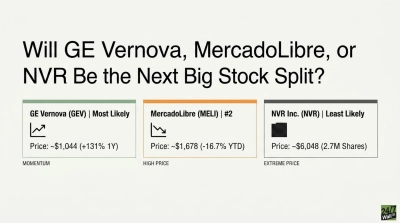
Shares of the Reston, Virginia, homebuilder behind Ryan Homes, NVHomes, and Heartland Homes closed at $6,047.87 on May 21, 2026, supporting a market cap of $16.3 billion on just 2.7 million shares outstanding. The trailing P/E is 16x.
The bull case for a split is straightforward: NVR carries the highest nominal price of any S&P 500 homebuilder, locking out small retail buyers and complicating options markets. The bear case is overwhelming: Management has refused to split for decades by design, channeling capital almost entirely into buybacks. The company repurchased 90,180 shares for $631.96 million in Q1 2026 and authorized a fresh $750 million repurchase program.
Fundamentals argue against a split. Q1 2026 revenue of $1.88 billion missed the $2.02 billion consensus by 6.94%, with EPS of $67.76 missing the $79.20 estimate by 14.44%. Settlements fell 22% to 4,015 units and gross margin compressed to 19.6% from 21.9%. NVR will almost certainly stick to its playbook.


2. MercadoLibre
MercadoLibre runs Latin America’s dominant e-commerce and fintech platform. Shares closed at $1,677.90 on May 21, 2026, down 16.7% year to date, on a market cap of about $85.1 billion.
Q1 2026 revenue jumped 49% year over year to $8.85 billion, beating consensus by 6.27%, with EPS of $8.23. The fintech credit card portfolio expanded 104% year over year to $6.6 billion, and fintech monthly active users hit 83 million. Brazil revenue alone grew 55% year over year.

The bull case: MercadoLibre carries one of the highest nominal share prices on Nasdaq, options accessibility is poor, and retail interest in LatAm fintech is climbing. The bear case rests on its history. MercadoLibre has never executed a stock split since its 2007 IPO, and management is reinvesting aggressively. Operating margin compressed to 6.9%, down roughly 600 basis points, with adjusted free cash flow swinging to negative $56 million. A board focused on lower free shipping thresholds and credit card issuance is unlikely to spend governance bandwidth on cosmetic share math.


1. Most Likely: GE Vernova
GE Vernova is the power and electrification spin-off of the old General Electric and is riding the AI data center buildout. Shares closed at $1,043.82 on May 21, 2026, up 59.7% year to date and 130.4% over the past year, on a market cap near $280.5 billion.
Q1 2026 revenue rose 15.8% year over year to $9.30 billion, with organic orders up 71% to $18.30 billion. Electrification booked $2.4 billion in data center equipment orders in Q1 alone, more than all of 2025. Management raised 2026 guidance to revenue of $44.5 billion to $45.5 billion and free cash flow of $6.5 billion to $7.5 billion. CEO Scott Strazik stated: “We had a solid start to 2026 as we continue to serve the growing, long-cycle electric power market.”
The bull case is strongest. The share price recently crossed $1,000, momentum is intact, and management signaled a shareholder-friendly tilt by doubling the quarterly dividend to $0.50 and executing a $1.3 billion buyback at an average $720 per share. As a young public company spun out in 2024, GE Vernova carries no entrenched anti-split culture, and the retail AI-power narrative is exactly the audience that splits court. The bear case is simply that the board has not signaled anything yet.


What This Means for Investors
A stock split is cosmetic, leaving market cap, fundamentals, and intrinsic value unchanged while shifting retail demand, options accessibility, and short-term sentiment, which is why the KLA and Booking announcements drew attention. None of GE Vernova, MercadoLibre, or NVR has announced a split or signaled a timeline. If the splits playbook spreads, GE Vernova’s near-four-figure price, accelerating AI-linked orders, young capital structure, and shareholder-friendly posture make it the most plausible among these candidates to join the club.
Contact [email protected] for any questions or corrections.
Trey has been an editor and author at 24/7 Wall St. for more than a decade, where he has published thousands of articles analyzing corporate earnings, dividend stocks, short interest, insider buying, private equity, and market trends. His comprehensive coverage spans the full spectrum of financial markets, from blue-chip stalwarts to emerging growth companies.
Beyond 24/7 Wall St., Trey has created and edited financial content for Benzinga and AOL's BloggingStocks, contributing additional hundreds of articles to the investment community.
Trey's editorial expertise extends across multiple publishing environments. He served as production editor at Dearborn Financial Publishing and development editor at Kaplan, where he helped shape financial education materials. Earlier in his career, he worked as a writer-producer at SVE. His freelance editing portfolio includes work for prestigious clients such as Sage Publications, Rand McNally, the Institute for Supply Management, the American Library Association, Eggplant Literary Productions, and Spiegel.
Outside of financial journalism, Trey writes fiction and has been an active member of the writing community for years, moderating workshop sessions at regional conventions.