AMD and Microsoft Haven’t Undertaken Stock Splits for 20+ Years And Investors Shouldn’t Care
AMD's data center business exploded while Microsoft rents the very racks AMD fills, yet one of these stocks looks dangerously priced for anything less than a perfect Helios launch. Here is what actually separates the safer AI bet from the…

This post may contain links from our sponsors and affiliates, and Flywheel Publishing may receive compensation for actions taken through them.

Advanced Micro Devices (NASDAQ:AMD | AMD Price Prediction) and Microsoft (NASDAQ:MSFT) last split their shares in 2000 and 2003. Both just reported quarters where AI demand outran supply. AMD sells the chips; Microsoft rents the compute and sells the software. Those businesses matter far more to returns than share count.
Both Stocks Soared Over Ten Years Without a Split
A split cuts each share into smaller pieces without changing the company’s value. Over ten years, AMD rose 9259.26% and Microsoft gained 923.23% with no splits. Fractional share trading means a high share price rarely keeps small investors out.
Data Center Doubles at AMD While Azure Grows 43%
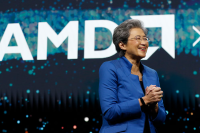
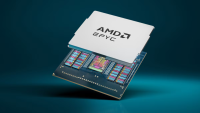
AMD’s revenue rose 50.1% to $11.54 billion. Data Center sales jumped 107% and now make up 58% of revenue. Lisa Su said “customer demand for Venice is stronger than for any prior EPYC generation.” Gaming fell 31%.
Microsoft’s revenue rose 17.8% to $90.01 billion, and Azure grew 43%. Copilot passed 30 million paid seats. Commercial backlog reached $678 billion but grew only 25% excluding OpenAI. CFO Amy Hood said “demand continues to exceed available supply.”
| Lens | AMD | Microsoft |
|---|---|---|
| Growth Engine | EPYC CPUs, Instinct GPUs | Azure, Copilot |
| Weak Spot | Gaming | Xbox, PCs |
| Forward P/E | 40x | 25x |
| Beta | 2.476 | 1.108 |
AMD Supplies the Racks Microsoft Is Buying
The two companies do business with each other. Microsoft “will deploy Helios at scale on Azure,” AMD said. Microsoft also makes its own chips and runs NVIDIA (NASDAQ:NVDA) hardware, and Satya Nadella stressed that “any given model at any given time is swappable.” Being able to switch suppliers gives Microsoft pricing leverage over vendors like AMD. Microsoft expects capital spending of about $175 billion in fiscal 2027, and much of that money becomes revenue for chipmakers, along with the power, cooling, and networking suppliers we profiled in a free report on seven AI infrastructure names outside the chip aisle.
Helios Shipments Will Decide Who Pulls Ahead
AMD guided third-quarter revenue to about $13 billion. Su said Helios shipments start in Q3 and step up in Q4. Yields on that rack bear watching, since Su admitted the product is “highly complex.” For Microsoft, keep an eye on whether Azure hits its guided 45% growth while all those new data centers come online.
Why Microsoft Offers Steadier AI Exposure
AMD gained 283.65% over the past year, while Microsoft rose 2.35%. After a run like that, AMD’s valuation leaves little room for a delayed Helios ramp. Microsoft offers a lower multiple and the breadth of a platform that benefits whichever chip wins. AMD’s order book from OpenAI, Meta Platforms (NASDAQ:META) and Anthropic gives it the stronger growth profile, along with sharper swings. My view could shift if Microsoft’s growth outside OpenAI slows. Neither company’s split history moves my view either way.
Contact [email protected] for any questions or corrections.
Alex Sirois is a financial writer with experience spanning both retail and institutional investing. He has written for InvestorPlace and held roles at BNY Mellon and Bernstein, giving him a perspective that bridges Main Street portfolios and Wall Street analysis.
Alex holds an MBA from George Washington University and has built his career across multiple industries, including e-commerce, education, and translation — a breadth of experience that informs how he breaks down complex financial topics for everyday investors. His writing is conversational, actionable, and grounded in long-term, buy-and-hold investing principles.
At 247 Wall St., Alex focuses on delivering analysis that is both accessible and useful, with a clear emphasis on helping readers make more informed decisions with their money.