This High-Yielding REIT’s AFFO Coverage Is Telling You Something Its Yield Is Not
Global Net Lease's 9% yield is drawing income investors in, but a closer look at its cash flow numbers reveals a coverage ratio that keeps shrinking quarter by quarter, and a wall of debt maturities closing in fast.

Real estate investment trusts, or REITs, are extremely popular among income investors for their strong yields. But oftentimes, there’s more to the story than the payout.
Global Net Lease (NYSE:GNL) pays 76 cents per share each year. At a closing price of $8.14 on Oct. 5, that works out to a yield of about 9.34%. Income investors notice a number like that. A high yield only matters if the company can keep paying it, though, and Global Net Lease’s own cash flow numbers say the safety margin is getting thinner.
However, you have to judge it yourself: A dividend is unsustainable when the cash the business generates, its debt load and its refinancing schedule can’t comfortably pay for it, whatever the yield says.
Global Net Lease (GNL)
Why the Yield Looks Tempting
Global Net Lease is an equity REIT. It has buildings and collects rent from them. A mortgage REIT is a different animal: it lends money and earns the spread between its borrowing costs and its loan yields. That makes a mortgage REIT’s risk mostly about interest rates.
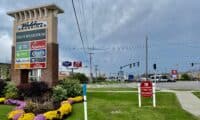
For Global Net Lease, the risks are tenants, lease rollover, property values, and refinancing. On the surface, the portfolio looks solid. Occupancy is 97% across 798 properties, 63% of tenants are investment grade or implied investment grade, and the weighted average remaining lease term is 5.7 years. Fitch and S&P both raised the company to investment-grade BBB- in 2025.
Why AFFO Is the Right Yardstick
Measuring REIT dividends against earnings per share (EPS) gives a misleading picture. GAAP earnings subtract depreciation, which is a non-cash charge, along with impairments and losses on property sales. For a landlord, those charges can be large. Global Net Lease posted a GAAP net loss of $225.46 million in fiscal 2025, which would make any EPS payout ratio meaningless. Adjusted funds from operations (AFFO) adds back depreciation and subtracts recurring capital spending. That gets much closer to the cash actually available to pay shareholders, and it’s the measure that matters here.
Coverage Is Shrinking
AFFO came in at $0.99 per share in 2025. Management’s 2026 guidance is 82 cents to 85 cents, even after raising it from 80 cents to 84 cents. Against the 76-cent dividend, that means an AFFO payout ratio of about 89% to 93%. The quarterly numbers point the same way.
AFFO per share was 24 cents in Q3 2025, then 22 cents in Q4, 21 cents in Q1 2026 and 22 cents in Q2 2026. Each of those quarters had to cover a $0.19 payout. In Q2, that meant about 86% of AFFO went out the door.
Revenue explains the slide. Asset sales since 2024 total about $3.4 billion, and fiscal 2025 revenue fell 38.47% to $495.29 million. Q2 2026 revenue of $112.47 million was down another 9.95% from a year earlier. The earnings base is getting smaller while the dividend remains the same.
Share Price Weakness Drives the Yield
Global Net Lease’s dividend has shrunk over time. The company paid 53.25 cents a quarter in 2019, then cut to 40 cents, 35.4 cents, 27.5 cents and finally to 19 cents starting in April 2025. The yield is high because the stock trades at low levels. The stock is down 7.83% over five years and 9.84% over the past month, even though it’s up 10.63% over 12 months. The yield was 10.1% at the end of Q2 2025 and 8.5% at the end of Q2 2026. Since then, the recent drop in the stock has pushed it back up.
Debt Maturities Are the Pressure Point
Leverage has come down. Net debt to adjusted EBITDA was 7.6x at the end of 2024 and is now 6.6x, against a target range of 6.5x to 6.9x. Even so, net debt still stands at $2.3 billion. The weighted average debt maturity has shortened to 2.7 years from 3.2 years. Short-term debt was $472.9 million on June 30, up from $94.5 million a quarter earlier, while current assets were just $156.1 million. Refinancing that debt at the current 4.1% weighted average rate keeps the math manageable. If rates on new debt come in higher, they eat straight into AFFO.
Leases add another layer of risk. About 8.5% of annualized straight-line rent expires in 2026 and 7.5% in 2027. Office properties, which make up 25% to 27% of the portfolio, are being sold into a weak market. Buybacks are also competing for cash: the company has spent $169.7 million buying back 20.9 million shares.
What Has to Go Right
Management is counting on an industrial portfolio acquisition that it expects to be about 4% accretive to AFFO per share without adding leverage. The deal would raise industrial exposure to around 50% of straight-line rent. Office sales also need to close at decent prices. CEO Michael Weil said on the August earnings call, “By no means do we want a fire sale.” Liquidity of about $919 million buys the company time.
The test worth watching is quarterly AFFO per share compared with the $0.19 dividend. If full-year 2026 AFFO comes in below the 82-cent low end of guidance, or if a quarterly figure slips toward $0.19, the buffer is gone. If the acquisition raises quarterly AFFO back toward the levels of late 2025, the warning weakens. A near-double-digit yield coupled with a shrinking coverage ratio is one of the classic patterns we flagged in a free guide to dividend trap warning signs.
Yield Alone Is Never the Thesis
When a dividend gets cut, the stock usually falls with it. Global Net Lease shareholders have been through that more than once. Right now the dividend is covered, but the buffer is getting smaller while debt maturities come closer. For income investors considering the yield, the AFFO line in the next earnings report is the number to keep an eye on.
Contact [email protected] for any questions or corrections.
Joel South covers large-cap stocks, dividend investing, and major market trends, with a focus on earnings analysis, valuation, and turning complex data into actionable insights for investors.
He brings more than 15 years of experience as an investor and financial journalist, including 12 years at The Motley Fool, where he served as an investment analyst, Bureau Chief, and later led the Fool.com investing news desk. He has also co-hosted an investing podcast and appeared across TV and radio discussing market trends.