Meta Could Hit $1,000, Says Wells Fargo. AI Is the Catalyst
Wells Fargo just slapped a four-digit price target on Meta, but the stock has gone nowhere in a year despite 28% revenue growth. Here is what has to happen for the math to actually work.

This post may contain links from our sponsors and affiliates, and Flywheel Publishing may receive compensation for actions taken through them.

Meta Platforms (NASDAQ:META | META Price Prediction | META Price Prediction) now sells intelligence as well as ads. Advertising revenue hit $59.36B last quarter, up 27%, as ad impressions rose 14% and price per ad climbed 12%.
Shares are up 11.37% this year but only 2.8% over the past 12 months. That’s a weak return for a business growing revenue 28%. Wells Fargo now says Muse can push the stock much higher. My question for this piece: can Meta hit $1,000 in 2027?

Why Meta Has Gone Nowhere in a Year Despite 28% Revenue Growth
Spending is what’s holding the stock back. Total costs rose 55% to $42.03B in Q2. Diluted EPS of $6.18 missed the $7.22 estimate, which ended a six-quarter run of beats. Operating margin fell to 31% from 43%.
Free cash flow dropped to $784M as capex reached $30.12B. On top of that, Meta took $2.40B in legal charges and still faces youth-related litigation. Shares slipped 0.74% last week after an 18.99% one-month rally. A beta of 1.185 means the stock swings a bit more than the market.
Wall Street Sees 8.4% Upside. Our Model Says 24.9%
The consensus target is $794.96, just 8.4% above today’s price. Ratings break down to 8 Strong Buy, 47 Buy, 7 Hold and 1 Sell.
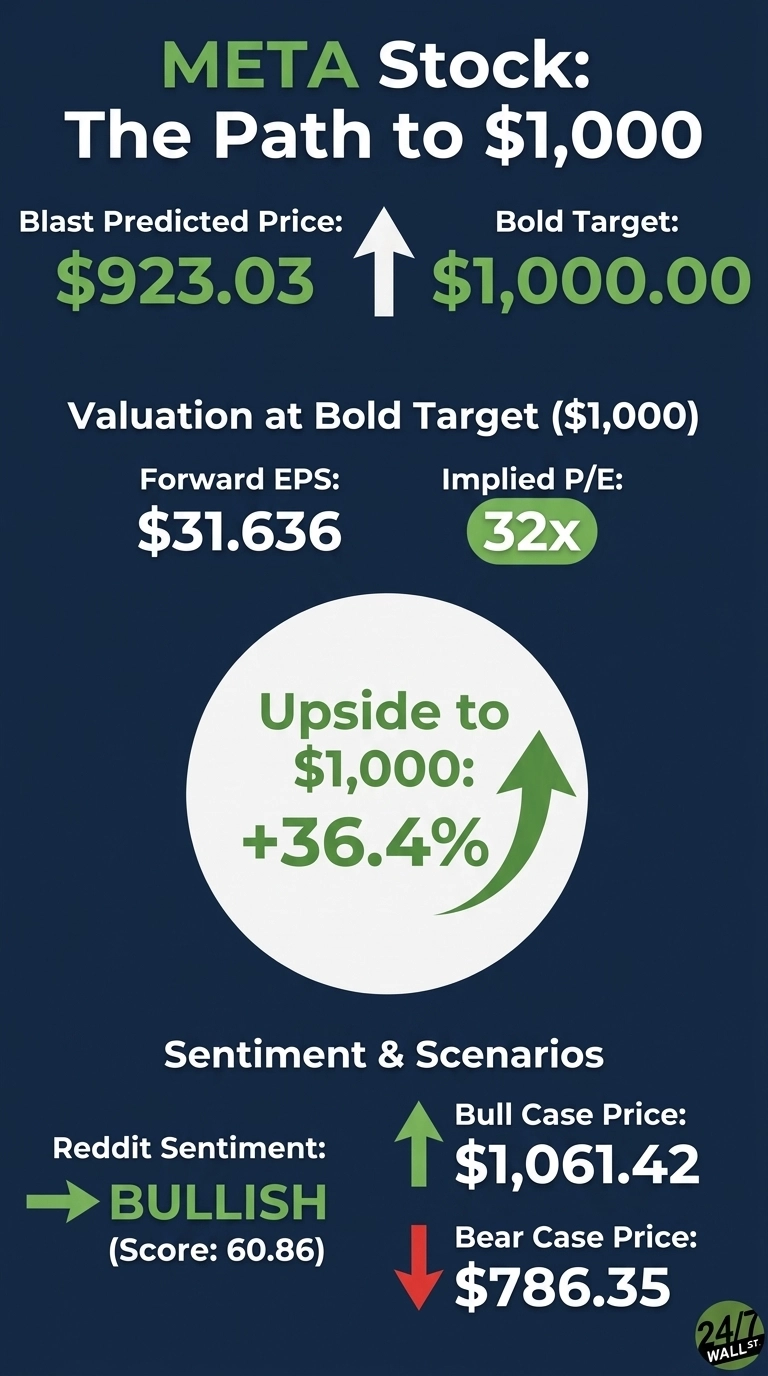
The base case stands at $923.03, representing 24.92% upside. Estimates span $786.35 in the bear case to $1,061.42 in the bull case, and our confidence score of 0.9 is high.
I think the Street is too cautious. 87% of analysts are bullish, yet their target stands just above the current price. Earnings growth was a slight drag in our model, at -0.013. Most of that came from one-time charges. Strip out the legal and severance costs and operating income would have grown 9%.

Here’s What It Takes for Meta to Reach $1,000
Getting from today’s $733.35 to $1,000 would take a gain of 36.4%. Forward EPS is $31.636, so a $1,000 share price works out to a forward P/E of 32x. The base case of $923.03 already means 23x, so the stock needs about 9x more multiple expansion to get there.

That’s a lot, but I can see how it happens. Strong analyst consensus helped push our 247Factor adjustment to 1.094. Analysts expect EPS of $34.0681 in 2027, up from $31.1683 for 2026, and that growth would bring the multiple down over time. Investors are piling into Meta’s top-charting AI agent.
Advantage Plus has passed a $75 billion annual run rate, and more than 1 million businesses use Meta Business Agents every week.
Zuckerberg said “AI is accelerating our core business today, powering our next generation of products, and opening the door to entirely new enterprise opportunities.” The main risk is that capex keeps growing faster than revenue.
Where Meta Trades Today vs Its Earnings Power
At today’s price, Meta trades at 23x forward earnings. That’s reasonable for a business with an 82% gross margin and revenue growing in the high 20s.
Shares sit closer the $779.82 52-week high than the $519.37 low. Over 10 years, the stock has returned 473.86%. If AI keeps raising ad pricing, the current multiple leaves room to rise.
Can Meta Really Hit $1,000? My Verdict
$1,000 would take a 36.4% gain. It’s a stretch, but a reachable one: our bull case crosses that level by September 2027.
Three things have to go right. Ad growth has to hold up, Muse and business agents need to start bringing in real revenue, and spending has to level off so margins can recover. A major legal loss or another capex increase would halt it. Investors shouldn’t expect this level of returns every year, but we’ve outlined the plan for how Meta Platforms could reach $1,000 in 2027.
Contact [email protected] for any questions or corrections.
Vandita Jadeja is a financial publisher with over a decade of experience writing about financial topics, including investment, savings, retirement, insurance and banking. Vandita is a Chartered Accountant who loves to debunk financial concepts for readers.
Her work has appeared on sites that include The Motley Fool, InvestorPlace, and Benzinga. She covers investing and focuses on stock picks and price prediction for 24/7 Wall St.
When not looking for the next stock investment opportunity, she can be found traveling, reading, chasing sunsets and enjoying her iced latte.