Prediction: Oracle Has 49% Upside as Cloud Backlog Signals Major Growth Shift
Oracle's cloud backlog keeps growing and its quarterly results keep beating estimates, yet the stock sits near a 52-week low. Something in that gap is either a serious warning sign or the biggest mispricing in megacap tech right now.

This post may contain links from our sponsors and affiliates, and Flywheel Publishing may receive compensation for actions taken through them.

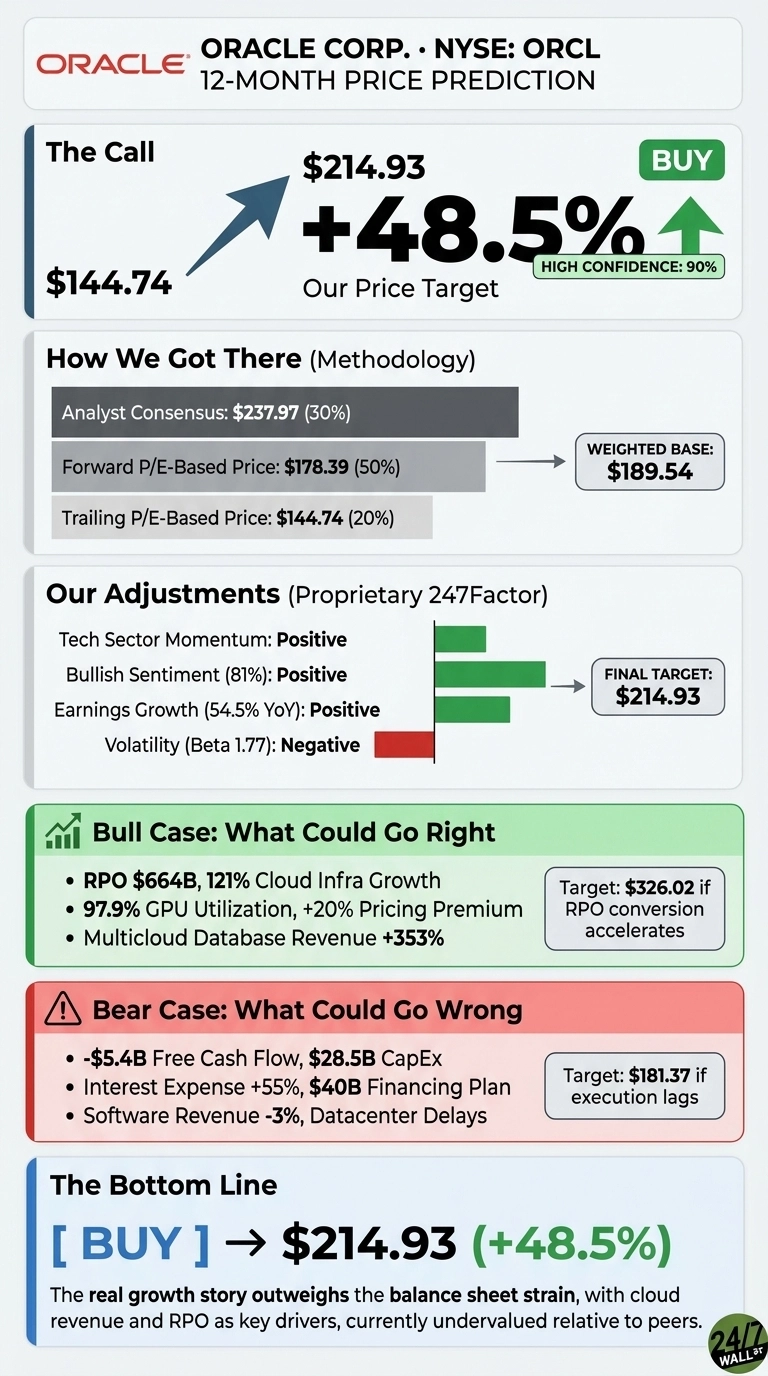
Our 24/7 Wall St. price target for Oracle (NYSE:ORCL | ORCL Price Prediction) is $214.93. That target means 48.5% upside from $144.74. Our model rates the stock a buy with high confidence.
24/7 Wall St. Price Target Summary
| Metric | Value |
|---|---|
| Current Price | $144.74 |
| 24/7 Wall St. Price Target | $214.93 |
| Upside/Downside | 48.5% |
| Recommendation | BUY |
| Confidence Level | 90% |
Oracle now carries $664B in remaining performance obligations (RPO) and guides to fiscal 2027 revenue of at least $90B. Even so, the stock trades as if that backlog is in question. Our model views the gap between those two facts as a mispricing.

A 50% Slide Despite Triple-Digit Cloud Growth
Oracle shares are down 26.28% year to date and 50.64% over the past year. They lost 10.38% over the past month and recovered 3.27% over the past week. The stock sits about 55% below its 52-week high of $319.46 and roughly 26% above its $114.50 low.
Fiscal Q1 revenue, by contrast, rose 29.61% to $19.345B, ahead of the $19.129B estimate. Non-GAAP EPS of $1.92 beat expectations of $1.74. Cloud infrastructure revenue jumped 121%, and management raised fiscal 2027 EPS guidance to $8.10. Two days later, Oracle’s chairman canceled a planned stock sale, according to a September 12 release.
Why Bulls See $326 on the Horizon
The bull case hits $326.02. Management expects about half of RPO to convert into revenue within 36 months. GPU utilization hits 97.9%, and renewed capacity was resold at a 20% premium.
Multicloud database revenue rose 353%, and the first NVIDIA (NASDAQ:NVDA) Vera Rubin systems ship in fiscal Q2. On Wall Street, 35 analysts rate the stock Buy or Strong Buy, and the consensus target is $237.97.

Cash Burn and Debt Are the Risks to Watch
Fiscal Q1 capital spending of $28.5B left free cash flow at -$5.4B. Interest expense rose 55% to $1.4B, and Oracle plans to raise about $40B through debt and equity. Software revenue slipped 3%. The bear case of $181.37 assumes slower RPO conversion. Permitting delays at the New Mexico and Wisconsin data centers could cause that.
On the other hand, operating cash flow climbed 184% to $23.1B. Most new contracts rely on prepayments or customer-supplied hardware, which limits how much Oracle has to fund itself.

Oracle Trades at a Discount to Microsoft and Amazon
Microsoft (NASDAQ:MSFT) runs Azure, Oracle’s most direct competitor for enterprise AI workloads.
Amazon (NASDAQ:AMZN) runs AWS, the largest cloud infrastructure platform. Oracle is growing faster than both and trades at a lower multiple.
| Company | Forward P/E | Quarterly Revenue Growth (YoY) |
|---|---|---|
| Oracle | 18x | 29.6% |
| Microsoft | 25x | 17.7% |
| Amazon | 24x | 19.6% |
At $214.93, Oracle would trade near 24x forward earnings. That matches Amazon and sits below Microsoft, so our target looks reasonable next to these peers.
Oracle’s Growth Outweighs the Balance Sheet Strain
The 24/7 Wall St. price target is $214.93, with a buy rating and 90% confidence. What tips the scale is a backlog that converts at premium pricing while the stock trades at a discount to its peers.
The thesis gets stronger if cloud revenue growth comes in within the 65% to 71% fiscal Q2 guidance range. It weakens if data-center delays push RPO conversion beyond fiscal 2028. On balance, the growth is real and the market is underpricing it.
Oracle Price Prediction 2026-2030
Here is where our model projects Oracle could trade if current growth trends continue.
| Year | 24/7 Wall St. Price Target |
|---|---|
| 2026 | $158.48 |
| 2027 | $236.29 |
| 2028 | $304.76 |
| 2029 | $352.05 |
| 2030 | $402.39 |
Oracle would need to keep executing its current strategy for these projections to hold. Faster RPO conversion could push the stock past these levels, and financing pressure or delays in power delivery could brought it below them.
Contact [email protected] for any questions or corrections.
Vandita Jadeja is a financial publisher with over a decade of experience writing about financial topics, including investment, savings, retirement, insurance and banking. Vandita is a Chartered Accountant who loves to debunk financial concepts for readers.
Her work has appeared on sites that include The Motley Fool, InvestorPlace, and Benzinga. She covers investing and focuses on stock picks and price prediction for 24/7 Wall St.
When not looking for the next stock investment opportunity, she can be found traveling, reading, chasing sunsets and enjoying her iced latte.