If You Invest $1,000 in Seagate Today, Here’s What It Could Be Worth by 2030
Seagate's hard drives quietly power the AI boom without a single chip, and the stock already rewarded patient investors with a 261% gain in one year alone. Whether that momentum still has room to run depends on a few factors…


A $1,000 stake in Seagate Technology (NASDAQ:STX | STX Price Prediction) buys into a stock priced at $807.57 per share. That price comes after a 261.04% gain over the past year.
Seagate makes the mass-capacity hard drives that cloud giants fill with AI-generated data, so the question for 2030 is how much of that momentum can still turn into returns from here.

What $1,000 Could Become: Base-Case Answer
The model’s longest horizon runs five years, to October 8, 2031. That is the nearest modeled horizon to 2030, so every concrete figure below is tied to it. Treat 2030 itself as an illustrative stop roughly a year short of the modeled target.
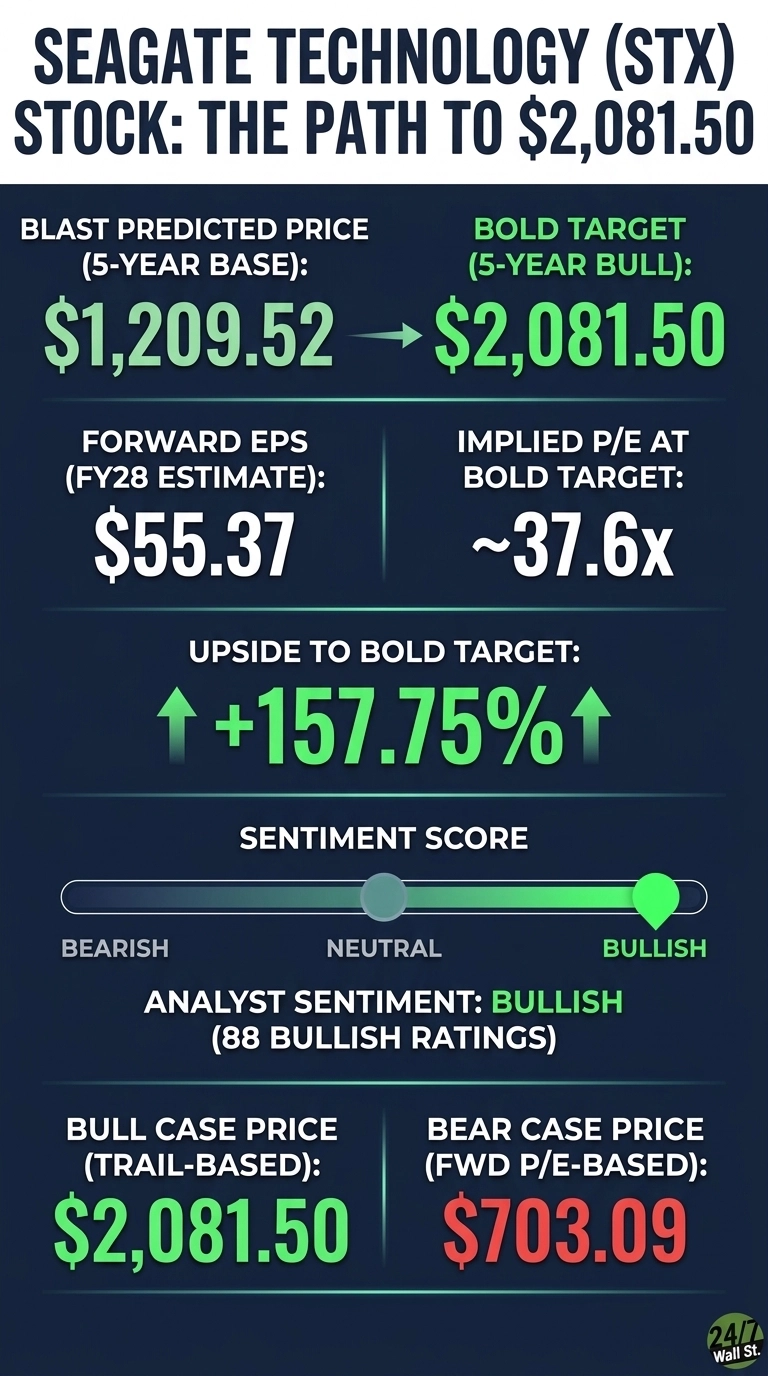
The base case suggests a $1,000 investment could be worth about $1,497.70 by the five-year mark, a total return of 49.77%. That outcome rests on a modeled share price of $1,209.52, which works out to 8.41% annualized. For a nearer checkpoint, the one-year base target of $908.18 (a 12.46% return) would lift the stake to $1,124.60.
Confidence in the model stands at 0.9, rated high. All of these figures cover share price only. Seagate’s $2.96 annualized dividend would come on top.
Bull, Base and Bear Scenarios for Your $1,000
| Scenario | Five-Year Target Price | Total Return | Value of $1,000 |
|---|---|---|---|
| Bull | $2,081.50 | 157.75% | $2,577.50 |
| Base | $1,209.52 | 49.77% | $1,497.70 |
| Bear | $703.09 | -12.94% | $870.60 |
Wall Street leans further toward the bull case than the model does. The consensus analyst target is $1,125, and the ratings break down to 4 Strong Buys, 18 Buys, 2 Holds and 1 Strong Sell. The model gives that analyst target a 0.3 weight and puts more weight on forward earnings, making its base case more conservative.

Three Drivers Behind the Upside
Record Earnings and Rising Estimates
Fiscal 2026 revenue reached $12.195 billion, up 34.06%, with EPS of $15.58 and a record $3.105 billion in free cash flow. In the fourth quarter, non-GAAP EPS came in at $5.71, beating the $5.09 estimate.
Management is guiding fiscal Q1 2027 to $7.30 ± $0.20 in EPS on revenue of $4.10B ± $100M. Analysts expect fiscal 2027 EPS of $35.7809 and fiscal 2028 EPS of $55.3714, and both figures sit above where they were 90 days ago.

Bigger Drives on the HAMR Roadmap
Mosaic 4, Seagate’s second-generation HAMR platform, delivers “up to 44 terabytes per drive” with minimal change to the bill of materials.
Mosaic 5 is aimed at 50 terabytes, with qualification shipments targeted for late calendar 2027. Packing more capacity into each drive, rather than shipping more units, is the main reason gross margin rose to 52.3% from 37.4% a year earlier.
Demand Locked In Through 2027
Management says nearline capacity is “almost fully allocated through calendar 2027“. It also raised its annual revenue growth target to “a minimum of 20% over the next few years.”
The CEO put it this way: “As AI accelerates data generation and its value, we see durable long-term demand for mass capacity storage.” Seagate is one of the suppliers absorbing that AI buildout without actually making chips, and we rounded up seven more like it in a free report on the non-chipmaker AI stocks.
Risks That Could Shrink Your Stake
Volatility is the first thing to plan for. Seagate’s beta is 2.081, and over the past 52 weeks the stock’s range spans $207.78 to $1,143.27. Hard drive stocks fell sharply late last week (as MarketWatch reported), leaving Seagate down 12.44% over one week.
Valuation leaves less room for mistakes. The stock trades at a trailing P/E of 58 and a forward P/E of 26. Growth also depends heavily on hyperscaler storage budgets. If cloud spending cools, or if a HAMR ramp runs into yield or qualification delays, earnings estimates could fall quickly.
Other pressures include tariff and trade policy, exposure to the Middle East conflict, possible dilution from the Exchangeable Senior Notes due 2028, and BIS settlement payments (per company disclosures). In the bear case, your $1,000 shrinks to $870.60.
Bottom Line on a $1,000 Seagate Position
At the five-year horizon, the model’s range for a $1,000 Seagate stake runs from $870.60 in the bear case, reaching $2,577.50 in the bull case, with $1,497.70 as the base case.
Use 2030 as an illustrative waypoint on that path, and keep an eye on the stock around each earnings report and Mosaic milestone. The projection is not investment advice, and none of these outcomes is guaranteed.
Contact [email protected] for any questions or corrections.
Vandita Jadeja is a financial publisher with over a decade of experience writing about financial topics, including investment, savings, retirement, insurance and banking. Vandita is a Chartered Accountant who loves to debunk financial concepts for readers.
Her work has appeared on sites that include The Motley Fool, InvestorPlace, and Benzinga. She covers investing and focuses on stock picks and price prediction for 24/7 Wall St.
When not looking for the next stock investment opportunity, she can be found traveling, reading, chasing sunsets and enjoying her iced latte.