Ryan Cohen Told Investors to Bet Against Him on the Same Day He Bought $22.8 Million More
On the same day Ryan Cohen went on a podcast and told listeners to bet against GameStop, he was quietly signing off on a very different kind of statement with the SEC.

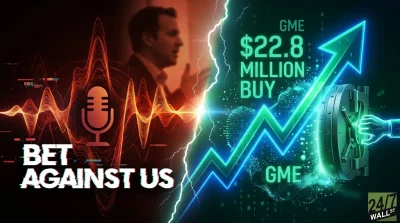
GameStop‘s (NYSE:GME | GME Price Prediction) president, CEO, and board chair, Ryan Cohen, filed a Form 4 on October 13, 2026. It reported two open-market purchases of GameStop Class A stock made that same day: 844,130 shares worth $22.8 million. Also on October 13, The Pomp Podcast published an episode with Cohen as the named guest. On the episode, he called his GameStop investment a mistake and told the audience to “Bet against us.”
The stock barely responded. GameStop opened at $27.71 on October 14.
Inside the Form 4: Two Purchases With No Trading Plan Behind Them
Both trades carry transaction code P, which means an open-market purchase. Cohen bought 67,130 shares at $26.75 and 777,000 shares at $27.00. After the trades, he held 42,492,652 shares directly. Table II, the section where warrants and other derivatives would show up, is empty.
Cohen left one box on the form unchecked. Insiders check it when a trade runs under a pre-arranged plan (a Rule 10b5-1 plan), which schedules purchases months ahead and gives the insider a legal defense against trading-on-inside-information claims. The box is blank, so these were discretionary purchases. A planned trade can reflect a decision made months earlier in a different market. A discretionary one shows what Cohen chose to do at these prices, on that day.
Mistake at Entry, Conviction Now
On The Pomp Podcast, Cohen said, “Investing in GameStop was a screw up.” He also said that “when you’re in a position where there’s no exit hatch, that’s when greatness is achieved.” Asked about his legacy, he answered: “Turning around GameStop.”
One reading is plain regret about how he got into the company. The second reading is a contrarian joke from someone who sees himself as stuck with GameStop yet committed to it. The filing supports the second reading. Someone who regrets a position does not add $22.8 million to it at their own discretion.
Paying Up After a Big Run Brings Its Own Risks
Cohen bought into strength, near the stock’s 52-week high. Shares rose 13.2% over the past week, 28.7% over the past month, and 38.6% year to date. Over five years, they are still down 39.5%. BeInCrypto, via Yahoo Finance, counts $97 million in reported purchases since September 10, with the first purchase priced at about $20. It also puts his holding at 46.2 million shares, or roughly 9.1% of the company, including warrants. This figure differs from the direct holding reported on the Form 4.
Dilution is the weak spot. BeInCrypto reports that an August debt-for-stock swap added about 55.5 million new shares, roughly 12% of the count at the time. GameStop also lists its proposed acquisition of eBay (NASDAQ:EBAY) as an execution risk. If a renewed eBay bid used cash and stock, it would dilute the stake Cohen is building.
Should Shareholders Give More Weight to the Filing or the Podcast?
The filing, a sworn SEC disclosure of a discretionary $22.8 million purchase, says more than a joke made on a podcast. What it shows is Cohen’s conviction, though, and that is no guarantee of returns. The trigger to check is GameStop’s next 8-K on eBay. If it involves paying partly in stock, Cohen will be diluting his own position, and his buying looks less like discipline. A close below $26.75 would put his newest shares underwater.

Contact [email protected] for any questions or corrections.
Trey has been an editor and author at 24/7 Wall St. for more than a decade, where he has published thousands of articles analyzing corporate earnings, dividend stocks, short interest, insider buying, private equity, and market trends. His comprehensive coverage spans the full spectrum of financial markets, from blue-chip stalwarts to emerging growth companies.
Beyond 24/7 Wall St., Trey has created and edited financial content for Benzinga and AOL's BloggingStocks, contributing additional hundreds of articles to the investment community.
Trey's editorial expertise extends across multiple publishing environments. He served as production editor at Dearborn Financial Publishing and development editor at Kaplan, where he helped shape financial education materials. Earlier in his career, he worked as a writer-producer at SVE. His freelance editing portfolio includes work for prestigious clients such as Sage Publications, Rand McNally, the Institute for Supply Management, the American Library Association, Eggplant Literary Productions, and Spiegel.
Outside of financial journalism, Trey writes fiction and has been an active member of the writing community for years, moderating workshop sessions at regional conventions.