Apple Stock Has 3 Things Going for It in 2027. Here’s My Price Target

This post may contain links from our sponsors and affiliates, and Flywheel Publishing may receive compensation for actions taken through them.

When Apple (NASDAQ:AAPL | AAPL Price Prediction) closed its fiscal year in September, Chief Executive John Ternus called the results the capstone of “our best fiscal year ever.”[1] The numbers support him.
Revenue reached $478.83 billion, up 15.06%[1], and EPS climbed to $8.98. Shares followed. At $348.51, the stock is up 28.64% year-to-date and 122.38% over five years.
Apple enters 2027 with a foldable iPhone, a rebuilt Siri and a record installed base. Here’s how shares could reach $450.

Wall Street Thinks Apple Is Fully Priced
The average 1-year analyst target is $345.63, which implies about 0.83% downside. Analysts still lean positive, with 6 strong buys and 18 buys against 13 holds. Their caution comes from memory costs.
Management called memory pricing “unprecedented”[2] and guided December-quarter gross margin to between 45% and 46%, down from 47.9%[1] last quarter. The fiscal 2027 EPS consensus of $9.4294 works out to only 5% growth, and it has slipped from $9.5395 90 days ago.

Apple has made a habit of beating these forecasts, though. It has topped EPS estimates for 10 consecutive quarters[3], most recently posting $2.10 against a $1.98 estimate[1]. December-quarter revisions are also moving higher, with 10 upward revisions in the past week and none lower.

Here’s What It Takes for Apple to Reach $450
Apple trades at 37x forward earnings. At $450, the multiple would rise to 48x fiscal 2027 estimates, or 42x the fiscal 2028 estimate of $10.598, which is up from 33x today.
Getting there requires the market to price Apple as an AI winner (the same megacap-plus-infrastructure theme we unpacked in a free report on seven AI buildout suppliers). A Barron’s headline today asked whether Apple might be about to become an AI stock.
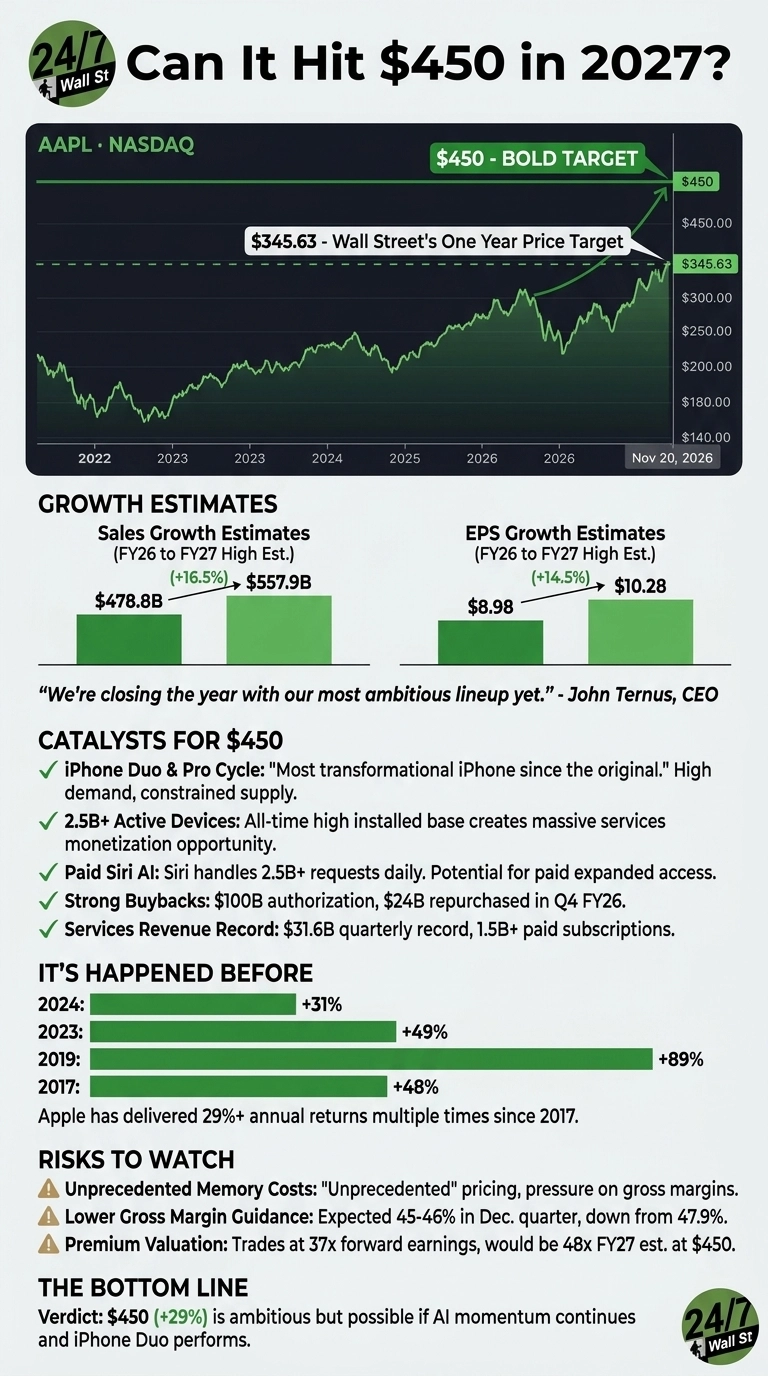
3 Things Going for Apple in 2027
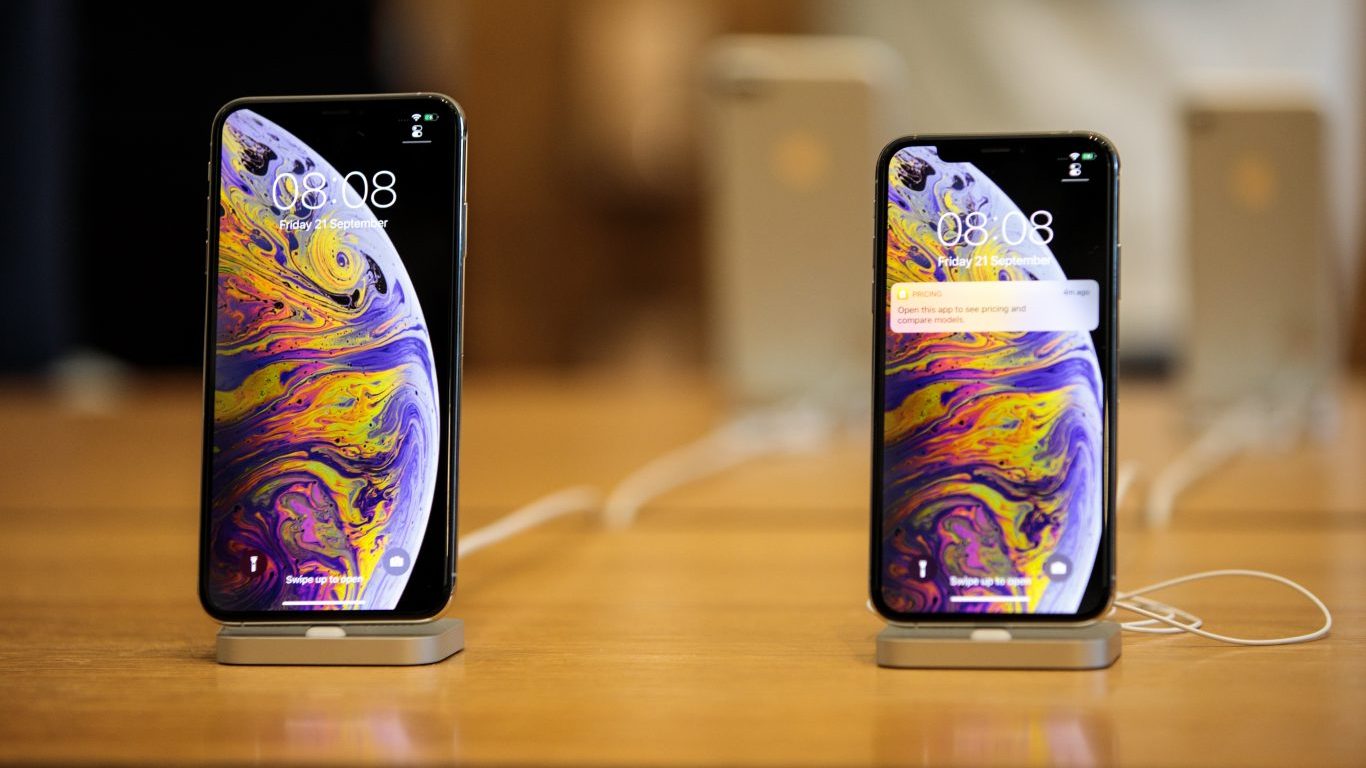
- An iPhone Duo upgrade cycle. Ternus called the foldable “the most transformational iPhone since the original.”[1] Operating chief Sabih Khan said “iPhone Duo is constrained as of today”[2] because demand is so high. iPhone revenue already rose to $57.58 billion from $49.02 billion[1] last quarter.
- Services built on 2.5 billion devices. Services hit an all-time high of $31.57 billion[1], and paid subscriptions topped 1.5 billion[2].
- Paid Siri AI. Siri handles more than 2.5 billion requests every day[2]. Ternus said heavy users “will be able to purchase expanded access in the future.”[2] Chief Financial Officer Kevan Parekh said AI “offers a compelling reason for customers to upgrade and switch.”
Buybacks also help. Apple added a $100 billion[4] repurchase authorization in April and bought back $24 billion[2] of stock last quarter.
Apple’s History Says 29% Gains Are Common
Reaching $450 requires a 29% gain. Apple has cleared that bar in six full years since 2017: 48% in 2017, 89% in 2019, 82% in 2020, 35% in 2021, 49% in 2023 and 31% in 2024. Big pullbacks happen too. Shares fell 30% in late 2018.

$450 Is a Stretch, but Here’s Why It’s Possible
A 29% gain from here would take Apple well past Wall Street’s target.
The bull case rests on three drivers: a foldable iPhone that Apple can’t build fast enough, a Services business with more than 1.5 billion[2] paid subscriptions, and a Siri AI that could become a paid product.
Memory costs and a premium multiple are the main hurdles. If the beat streak continues and investors treat Apple as an AI stock, $450 is within reach. Returns at this level are uneven from year to year, and this is the blueprint for how Apple could deliver outsized returns in 2027.
Contact [email protected] for any questions or corrections.
Vandita Jadeja is a financial publisher with over a decade of experience writing about financial topics, including investment, savings, retirement, insurance and banking. Vandita is a Chartered Accountant who loves to debunk financial concepts for readers.
Her work has appeared on sites that include The Motley Fool, InvestorPlace, and Benzinga. She covers investing and focuses on stock picks and price prediction for 24/7 Wall St.
When not looking for the next stock investment opportunity, she can be found traveling, reading, chasing sunsets and enjoying her iced latte.