If You Invest $1,000 in Meta Each Month Starting Now, This is What You’d Have in 5 Years
Meta is pouring over $130 billion into AI infrastructure while free cash flow craters and legal bills pile up, yet analyst sentiment sits near its most bullish in years. Here is what a steady monthly stake could turn into if…


Instead of trying to time Meta Platforms (NASDAQ:META | META Price Prediction), you could put $1,000 into the stock every month for the next five years. Meta shares traded at $744.34 in early trading today. That’s up 3.57% on the session and 13.95% over the past month.
The forward look matters because Meta is spending heavily on AI right now, and the next five years will show whether that spending pays off.

Your $60,000 Could Grow to About $86,252 in the Base Case
Over five years, $1,000 a month adds up to $60,000 invested. Our base-case model has Meta compounding at 14.49% a year. At that rate, the monthly plan could be worth about $86,251.91 in five years, meaning you’d earn 43.75% on the money you put in.
That figure rests on a five-year base-case share price target of $1,413.93. That’s a 96.74% gain from the model’s initial price of $718.67.
A monthly plan makes less than that headline gain because the money goes in gradually: your last few deposits have only weeks to grow. The stake figures assume each $1,000 is invested at the start of the month and grows steadily at the model’s annualized rate in each scenario. They leave out dividends, taxes and fees.
Bull, Base and Bear: What Your Monthly Plan Could Become
| Scenario | 5-Year Price Target | Stock Total Return | Annualized Return | Ending Value of $1,000/Month | Return on $60,000 Invested |
|---|---|---|---|---|---|
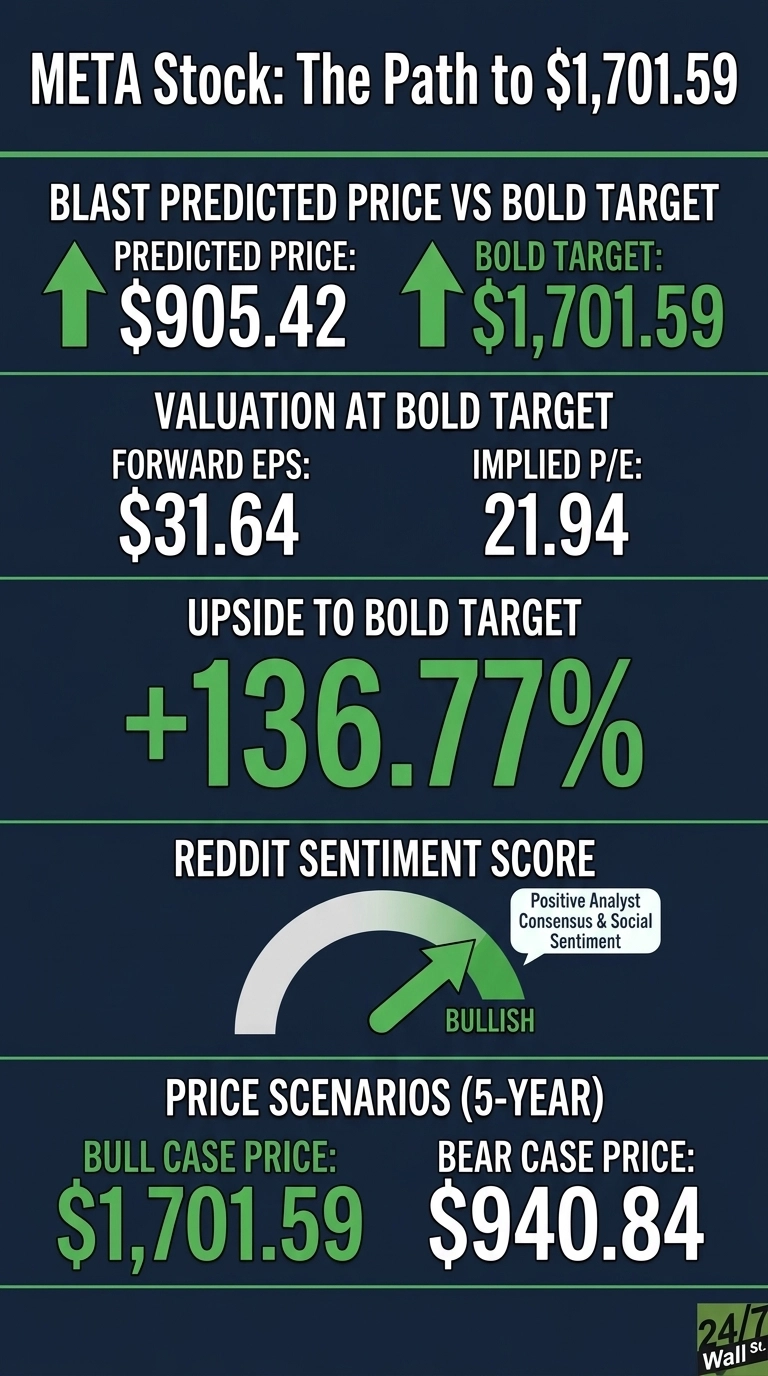
| Bull | $1,701.59 | 136.77% | 18.81% | $95,886.08 | 59.81% |
| Base | $1,413.93 | 96.74% | 14.49% | $86,251.91 | 43.75% |
| Bear | $940.84 | 30.91% | 5.54% | $69,021.40 | 15.04% |
The model rates its confidence at 0.9, a high reading. Over the next 12 months, its base-case target is $905.42, with a range of $774.02 in the bear case to $1,040.03 on the bullish side.
Wall Street’s consensus target is $799. Analyst ratings lean strongly bullish: 8 Strong Buy, 47 Buy, 7 Hold and 1 Sell.

Three Engines Behind the Upside
AI Is Lifting the Ad Machine
Second-quarter revenue reached $60.80 billion, up 27.96% year over year and above the $60.29 billion consensus. Meta grew on both volume and price: ad impressions rose 14% and the average price per ad climbed 12%.
Its Advantage Plus automated ad tools have passed $75 billion in annual revenue run rate. On the earnings call, Mark Zuckerberg said “We are now at a point where our investments in AI are accelerating every major part of our core business.”
New Revenue Streams Are Emerging
More than 1 million businesses use Meta’s AI business agents every week to talk to customers or close sales. Family of Apps other revenue exceeded $1 billion in a quarter for the first time, growing 73% on the back of WhatsApp paid messaging and subscriptions. Meta also launched its MetaOne subscription and a model API, both of which add income that doesn’t depend on ads.
Scale and Profitability
Meta reaches 3.60 billion daily active people across its apps. It also runs at an 82% gross margin with a 30.24% return on equity. Management expects 2026 operating income to exceed 2025 levels.
What Could Sink Your Monthly Plan
The spending bill is huge. Meta’s guidance calls for 2026 capital expenditures of $130 billion to $145 billion, the kind of AI infrastructure outlay that keeps the picks-and-shovels suppliers busy (we rounded up seven of them, from power to cooling, which you can read here: 7 Stocks Powering the AI Boom).
That pressure is already visible: second-quarter free cash flow fell to $784 million from $8.55B a year earlier. Diluted EPS of $6.18 missed the $7.2214 consensus by 14.42%, and operating margin contracted to 31% from 43%. Legal charges of $2.40 billion and severance costs of $1.18 billion drove much of that miss.
Management has noted several youth-related U.S. trials that could lead to material losses. In Europe, regulators are pushing back on Meta’s Less Personalized Ads offering.
Reality Labs lost $19.2B in fiscal 2025, and Meta still gets nearly all of its revenue from advertising, so a recession would hit it directly. The model’s bear case still ends with a gain, but real-world results can fall below every projected scenario, including a loss on the money you invest.
Where Your $1,000 a Month Could Land
Under the model’s scenarios, $1,000 a month in Meta for five years grows to between $69,021.40 and $95,886.08, with the central scenario at $86,251.91 on $60,000 invested.
Investing monthly spreads your purchase prices across the stock’s swings, but it can’t guarantee a gain. Track the stock around each earnings report for progress on capex returns, margins and legal results. These figures are estimates, not investment advice.
Contact [email protected] for any questions or corrections.
Vandita Jadeja is a financial publisher with over a decade of experience writing about financial topics, including investment, savings, retirement, insurance and banking. Vandita is a Chartered Accountant who loves to debunk financial concepts for readers.
Her work has appeared on sites that include The Motley Fool, InvestorPlace, and Benzinga. She covers investing and focuses on stock picks and price prediction for 24/7 Wall St.
When not looking for the next stock investment opportunity, she can be found traveling, reading, chasing sunsets and enjoying her iced latte.