Tesla’s New Roadster Can Fly in Short Bursts. It Won’t Be Built Until 2028
Tesla just launched a car that can hop over a Cybertruck and spin in midair, but the real question heading into earnings season is whether a 2028 halo car with no price does anything for investors sitting on a $1.43…

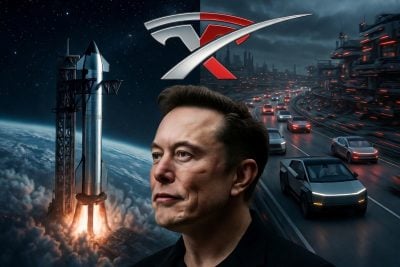
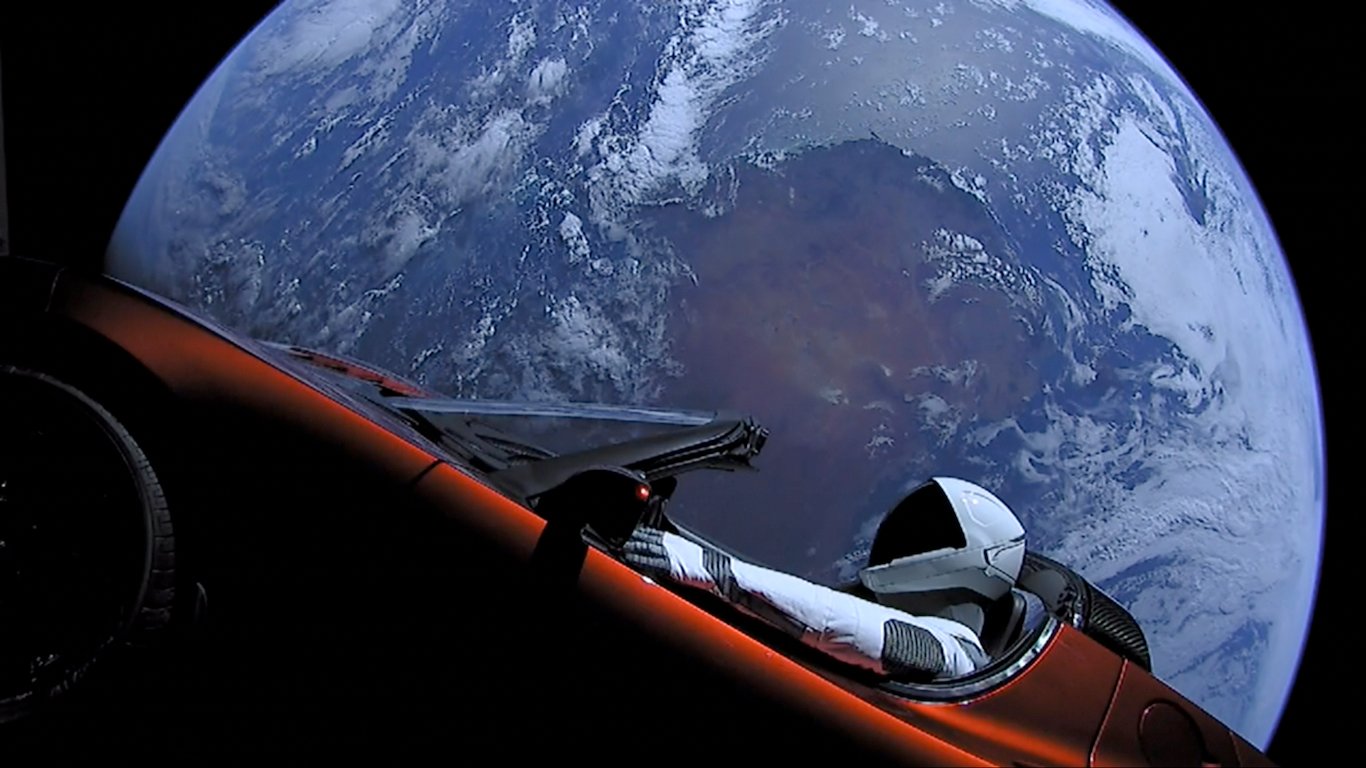
After the market closed on October 15, 2026, Tesla (NASDAQ:TSLA | TSLA Price Prediction) drove its second-generation Roadster up an inverted ramp outside Waco, Texas, spun it in midair, and landed it. Thrusters then lifted the moving car over a Cybertruck, Semi, Model Y, and Model 3, and Tesla showed it reaching 60 mph in one second.
“Flying” here means short lifts and hops powered by thrusters. Production begins in 2028, and Tesla did not give a price.
Shares closed at $362.44 before the reveal, down 1.29% on the day and 19.41% for the year. Tesla reports third-quarter results after the close on October 21, 2026. Investors have to consider what a 2028 halo car (a low-volume flagship built to lift the brand) does for shareholders.
What Tesla Committed To on October 15
Tesla showed three versions. The two-seat Performance gets active aerodynamics and a “multi-mode suction system,” and the limited-release Thrust adds rear cold-gas thrusters.
The one-seat Rocket is invite-only and claims a top speed of over 230 mph, but Tesla says it “isn’t approved for public road use.” Engineering VP Lars Moravy said 10 thrusters fed by 600 liters of compressed air lift and spin the car.
Reservations cost $50,000 for the Performance and $250,000 for the Thrust. Tesla calls the first payment “fully refundable,” and a $45,000 Performance balance is due within 10 days. Tesla also did not disclose a production volume or a factory.
How the 2017 Promises Shrank
The original Roadster, unveiled in November 2017, promised a 620-mile range, a top speed above 250 mph, four seats, a 1.9-second run to 60 mph, and production in 2020. The new car quotes a range of over 300 miles, and Tesla says the Performance version hits 60 mph in under 1.6 seconds.
Thrusters, air tanks, and suction hardware add weight and fill space that a bigger battery would need, so range likely paid for the stunts.
Elon Musk delayed the car in 2020, 2021, 2023, and 2024, and severe weather pushed back an October 1 reveal. The 2028 date deserves a discount, and anyone who places a deposit is tying up cash for a car that still has no price.
Why the Roadster Barely Touches Earnings
Musk said he’s “not sure it moves the needle massively from a revenue standpoint.” Automotive sales hit $20 billion in the second quarter alone.
Second-quarter non-GAAP EPS of $0.33 missed the $0.5367 consensus. Free cash flow was negative $1.092 billion, and management expects 2026 capital spending of “more than $25 billion.”
Musk called the Roadster “the best of the last of the human-driven cars.” That is an odd place to spend engineering time, because the company’s valuation rests on Robotaxi in seven U.S. metros and 1.48 million active FSD subscriptions.
What Matters More on October 21
Tesla is worth $1.43 trillion and trades at 377 times trailing earnings. At that price, investors expect autonomy and robotics to work at scale. The shares sit between a 52-week low of $297.38 and a high of $498.83.

Watch automotive gross margin excluding regulatory credits, which fell to 16.3% in the second quarter. Energy margin, at 20.4%, and Cybercab timing matter too.

Where TSLA Stock’s Valuation Leaves Investors Before October 21
Tesla stock looks highly valued ahead of October 21. The Roadster does nothing to change a triple-digit earnings multiple that sits on negative free cash flow.
After the last earnings miss, shares fell 14.52% on the day of the report, and margins remain under pressure. Tesla’s $43.52 billion in cash supports the balance sheet, so the concern is valuation.

This view is wrong if the October 21 report shows automotive margin excluding credits back above 16.3% and free cash flow positive again. A drop below the $297.38 52-week low would support it.
Contact [email protected] for any questions or corrections.
Omor Ibne Ehsan is a writer at 24/7 Wall St. He is a self-taught investor with a focus on growth, cyclical, and dividend equities that have strong fundamentals, value, and long-term potential. He also has an interest in high-risk, high-reward investments such as penny stocks.