BofA Warns AI Investors Could Lose Even If the Technology Works
Bank of America just invoked the ghost of the 1990s fiber optic collapse to explain why AI's biggest winners could still leave investors with nothing, even if the technology reshapes the world exactly as promised.

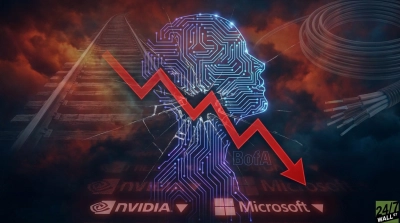
Railroads transformed America and fiber optic cable built the internet, yet many investors who funded both lost money. In a note reported on October 16, 2026, Bank of America investment strategist Sebastian Raedler argued AI is tracking the same path, writing that “most major capital cycles of the past have ended in disappointment, even though the underlying technology often lived up to expectations.”
Raedler argues that AI’s technology can succeed while investors in AI stocks still earn poor returns. Sebastian Raedler said 12-month forward consensus hyperscaler capex expectations rose from $330 billion in early 2025 to $1 trillion. Those figures forecast spending by the largest cloud operators over the next year.
The Nasdaq 100 fell 2.5%, and the Philadelphia semiconductor index posted its eighth straight loss, its longest run since 2008. After Bank of America’s note, NVIDIA (NASDAQ:NVDA | NVDA Price Prediction) slid 1.43% to $214.13, a market value of $5.17 trillion. On Raedler’s warning, Microsoft (NASDAQ:MSFT) fell 1.93% to $529.05, and its market value slipped below $4 trillion to $3.93 trillion.
How Capital Cycles Punish Investors
In a capital cycle, strong profits pull in a wave of investment until capacity exceeds demand. Prices then fall as competitors fight for customers, and returns on capital sink.
Railroads in the 1870s and fiber networks in the 1990s followed that pattern, and many builders went bankrupt even as their track and cable served the economy for decades.
The trick in any mania is planning the exit while it still runs, which we laid out in a free handbook here. Raedler put forward hyperscaler capex expectations at 3% of US GDP, above the 2.2% of the 1870s railroad boom and the 1.1% of the 1990s tech boom.
Falling Token Prices Hit Both Sides of the Trade
A token is a piece of text an AI model processes, and providers charge per token. Sebastian Raedler said average token prices have fallen around 50% since the summer.
When the price of each unit falls faster than volume grows, revenue stalls even as usage booms. Business AI spending data from Ramp, cited in the report, show spending has faded slightly since August while token volumes keep rising.
Raedler named the culprit. He wrote, “This monetization disappointment in the face of intense competition is precisely the failure mode seen in past capital cycles.”
Microsoft sells AI capacity through Azure, so cheaper tokens pressure its pricing, and its fiscal 2026 capex reached $115.95 billion while free cash flow fell to $66.99 billion. NVIDIA’s fiscal third-quarter revenue guidance of about $108.0 billion depends on those hyperscaler budgets holding.
Amazon (NASDAQ:AMZN) closed at $250.00. Alphabet (NASDAQ:GOOGL) Class A fell 2.47% to $340.59, and Meta Platforms (NASDAQ:META) dropped 3.72% to $709.33.
Bank of America’s note cited a 20% drop in Korea’s KOSPI since early October and the chip index at 13% below its recent high that morning. Chips fell further later.
Which AI Stocks Face the Most Pressure From a Spending Pullback
The bull case: NVIDIA is up 15.08% in 2026 despite a 6.61% drop in the week ended October 16, and Microsoft gained 7.9% over the month. Raedler’s warning targets investor returns and stops short of a crash forecast.
Suppliers paid upfront look safer, yet the bear case hits them hardest. NVIDIA’s sales depend on AI capex budgets, so any trim to Sebastian Raedler’s $1 trillion forward expectation hits its revenue directly, at 43 times trailing earnings.

Microsoft holds up better. Most of its capex buys short-lived chips that its finance chief said could slow if demand changes; cheaper tokens lower costs for its own Copilot products, and it trades at 29 times earnings.

My view: among AI stocks, Microsoft looks better positioned than NVIDIA to weather a slowdown in AI spending. The trigger to check is Microsoft’s next earnings report against guidance of about 45% constant-currency Azure growth, because a miss would show the token squeeze reaching a major seller of AI capacity.
Contact [email protected] for any questions or corrections.
Omor Ibne Ehsan is a writer at 24/7 Wall St. He is a self-taught investor with a focus on growth, cyclical, and dividend equities that have strong fundamentals, value, and long-term potential. He also has an interest in high-risk, high-reward investments such as penny stocks.