Coreweave Keeps Getting Crushed: This Analyst Says It’s Going to Quadruple In Price
CoreWeave's bond yields spiked to record levels and the stock cratered to its lowest point of 2026, yet dozens of analysts are racing to defend a price target more than double where shares trade today. The case for and against…

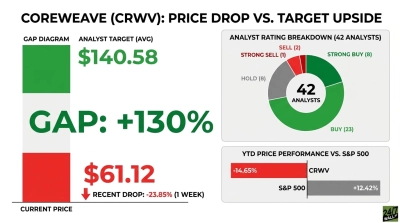
CoreWeave (NASDAQ:CRWV) currently trades at $61.12, and the average analyst price target is $140.58. The implied upside comes to about 130%.
CoreWeave rents NVIDIA (NASDAQ:NVDA | NVDA Price Prediction) GPU capacity to AI labs and enterprises. Management describes the company as sitting “between the models and the silicon”. Its revenue backlog reached $104 billion. The most aggressive call on the Street comes from Rosenblatt Securities’ John McPeake, who rates the stock Buy with a $250.00 target. That target means a gain of about 309%.
Upside that large signals either a market mispricing of a hypergrowth leader or analysts underpricing real balance-sheet risk.
Rate-Hike Fears Put CoreWeave’s Debt at the Center of the Selloff
Borrowing costs did the damage. New inflation data raised expectations of interest-rate hikes, and that put CoreWeave’s $50 billion debt load in focus. Shares fell 23.85% in a week and briefly hit their lowest point of 2026. Over the past year the stock is down 55.34%.
The credit market sent the same signal. The yield on CoreWeave’s October 2031 bond briefly rose above 16%, and the cost of insuring its debt hit records above 1,000 basis points. Second-quarter interest expense came in at $640 million, up from $267 million a year earlier, and management guided the third quarter to $860 million to $940 million. A pending shareholder investigation notice added more pressure.
The weakness spread across the sector. In a single Friday session, Nebius Group (NASDAQ:NBIS) dropped 10% and Applied Digital (NASDAQ:APLD) slipped 9%. Investors were also passing around a Gartner forecast that 80% of the neocloud market will cease to exist by 2030.
Goldman’s Upgrade Strengthens a Large Bull Camp
Of the 42 analysts covering the stock, 8 rate it Strong Buy, 23 Buy, 8 Hold, 2 Sell and 1 Strong Sell. Recent moves have been bullish. Goldman Sachs upgraded the shares to Buy from Neutral after the decline, citing tight computing capacity. Evercore kept its outperform rating and reasoned that markets are “extrapolating a higher secondary-market bond yield as evidence the business model has stopped working, which we don’t think is the case.”
Demand supports the optimistic thesis. Second-quarter revenue of $2.575 billion rose 112.3% and beat expectations. CoreWeave then added more than $25 billion in new commitments that are not yet counted in backlog. Management raised full-year revenue guidance to $12.4 billion to $13.2 billion. It also put through about 25% price increases across SKUs in July.
McPeake’s thesis leans on CoreWeave’s close supply ties to NVIDIA, capacity shortages at the hyperscalers, and a path for revenue to reach $26B+. The near-term targets are adjusted operating margins in the low teens by the fourth quarter and at least $250 million of managed inference ARR by the end of 2026. The weak spot is cash. Free cash flow was -$5.74 billion last quarter, and full-year capex guidance is $35 billion to $39 billion, so the thesis depends on capital markets staying open.
Every Neocloud Fell, but CoreWeave Has the Worst Year
All three stocks sold off alongside CoreWeave.
Nebius fell 26.87% over the past month but is still up 103.38% this year. At $170.24 against a $283.60 target, it offers about 66.6% implied upside, which is less than CoreWeave’s. Analysts split 2 Strong Buy, 12 Buy, 5 Hold, 1 Sell and 1 Strong Sell.
Applied Digital dropped 31.71% in a month and is down 21.49% this year. At $19.25 versus a $64.27 target, it carries about 233.9% implied upside, and none of its analysts rate it a Sell. CoreWeave is one of its major tenants, so the two stocks share risk.
Applied Digital shows the biggest expected gain among these stocks. CoreWeave sits in the middle, with the largest one-year loss of the three. Price targets are only one data point for any of these names.
CoreWeave Is Down 14.65% This Year as the S&P 500 Gained 12.42%
CoreWeave trades at $61.12. The consensus target from 42 analysts is $140.58, which means about 130% upside. The stock is down 14.65% year to date, while the S&P 500 is up 12.42%. Over one year, CoreWeave lost 55.34%, while the index gained 15.38%.
Shares sit near their 52-week low of $59.51, far from the $141.79 high. They are also well below the 50-day average of $87.03.
CoreWeave’s Upside Depends on Its Debt
Margins reaching the low teens on schedule with sticky price increases would strengthen the optimistic view, because that would show the backlog can support the debt. On the downside, rate hikes could keep driving financing costs higher while free cash flow stays very negative. In that case, a $104 billion backlog won’t save shareholders from dilution.
Demand looks real. The $250.00 call needs perfect execution, though, and credit markets will decide first whether the consensus target is reachable.
Contact [email protected] for any questions or corrections.
Alex Sirois is a financial writer with experience spanning both retail and institutional investing. He has written for InvestorPlace and held roles at BNY Mellon and Bernstein, giving him a perspective that bridges Main Street portfolios and Wall Street analysis.
Alex holds an MBA from George Washington University and has built his career across multiple industries, including e-commerce, education, and translation — a breadth of experience that informs how he breaks down complex financial topics for everyday investors. His writing is conversational, actionable, and grounded in long-term, buy-and-hold investing principles.
At 247 Wall St., Alex focuses on delivering analysis that is both accessible and useful, with a clear emphasis on helping readers make more informed decisions with their money.