Tesla’s Roadster Debut Reveals A Bigger Truth About Its Valuation
Tesla's long-awaited Roadster finally arrived, and Wall Street shrugged. The reaction points to a deeper question about what investors are actually paying for when they buy a stock trading at 328 times earnings.

Tesla (NASDAQ:TSLA | TSLA Price Prediction) trades at $368.06. Its Roadster debut showed that the stock’s value rests on AI ambitions far more than on the cars it sells.
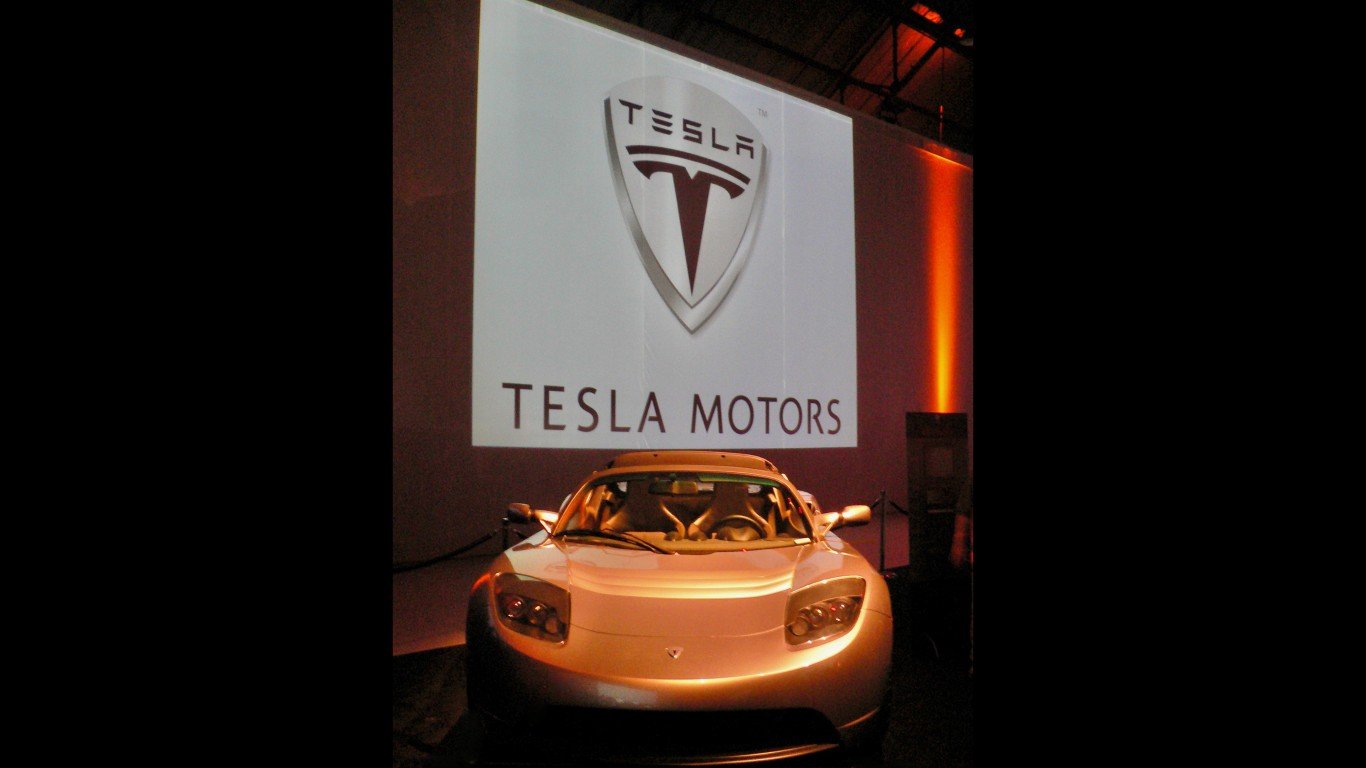
Tesla sells electric vehicles, Megapack storage and Full Self-Driving software, and it runs a Robotaxi service in seven U.S. metros. The stock is down 18.16% year to date. The Roadster arrived nearly nine years after its prototype. Previews promised a 0-to-60 time of roughly one second, a $200,000 base price and production of 2,000 units a year. Shares slipped after the flying car reveal (Forbes). Bloomberg’s Max Chafkin said the car has little commercial value and reads more like a push to build the case for a Tesla-SpaceX merger (Bloomberg).
FSD, Energy and Record Deliveries Give Bulls Real Growth
Second-quarter revenue rose 25.52% to $28.24B, beating the $26.36B consensus. Deliveries hit a Q2 record of 480,126. Active FSD subscriptions climbed 56% to 1.48M, energy deployments rose 41%, and Services and Other grew 50%.
Bulls also point to $43.52B in cash and a net cash position. A forward P/E of 159, about half the trailing multiple, implies sharp earnings growth ahead as Robotaxi miles grow at more than 10% a week.
A 328x Multiple Leaves Tesla No Room for Margin Slippage
Q2 non-GAAP EPS of $0.33 missed the $0.54 estimate by 38.5%. Operating income fell 56.9%, and operating margin narrowed to 1.4%. Free cash flow turned negative at -$1.09B as capex reached $5.79B. Management expects 2026 capex above $25 billion, with spending rising for two or three more years. Net income also included a $1 billion mark-to-market gain on SpaceX holdings.
At a trailing P/E of 328, a 2,000-unit supercar does nothing to close that gap.
Strong Demand and Heavy Spending Keep Tesla in Limbo
Demand is solid. Tesla ended Q2 with its largest order backlog since 2023, which supports the optimistic case. The return from the spending is still unproven, which supports the skeptical view. FSD approvals are still pending in China and most of Europe. Optimus is, in management’s words, “the hardest product to scale manufacturing that we’ve ever made at Tesla”.
Tesla Trails the S&P 500 Badly as Analysts Cluster at Hold
The consensus target of $397.83 implies 8.1% upside across 44 analysts. Analyst ratings break down as follows:
- Strong Buy: 4
- Buy: 15
- Hold: 21
- Sell: 2
- Strong Sell: 2
Tesla’s 18.16% year-to-date decline compared with a 12.42% gain for the S&P 500. Over one year, Tesla is down 16.22%, while the index is up 15.38%. Shares sit below the 200-day average of $387.99.
Tesla’s AI Spending Has to Reach the Margins
At $368.06, Tesla’s valuation depends on AI execution.
The Roadster made clear that investors are paying for Robotaxi, Optimus and AI compute. Today’s results can’t yet back that up. Two things would bolster the optimistic case: operating margin recovering well above 1.4% and free cash flow turning positive again while capex keeps climbing. A second miss on margins, or a Robotaxi safety incident, would supports the skeptical view.
The upcoming third-quarter report is the first test (Investopedia). After that, keep an eye on Cybercab volumes, FSD approvals overseas and whether energy margins recover from 20.4%. The consensus target leaves only modest upside, and the multiple offers little buffer if execution slips.
Tesla’s growth is real, but at 328 times earnings the AI return has to show up in its margins before the valuation looks supported.
Contact [email protected] for any questions or corrections.
Alex Sirois is a financial writer with experience spanning both retail and institutional investing. He has written for InvestorPlace and held roles at BNY Mellon and Bernstein, giving him a perspective that bridges Main Street portfolios and Wall Street analysis.
Alex holds an MBA from George Washington University and has built his career across multiple industries, including e-commerce, education, and translation — a breadth of experience that informs how he breaks down complex financial topics for everyday investors. His writing is conversational, actionable, and grounded in long-term, buy-and-hold investing principles.
At 247 Wall St., Alex focuses on delivering analysis that is both accessible and useful, with a clear emphasis on helping readers make more informed decisions with their money.