Credo Technology Crumbled By 15% Over 3 Months But Has 80% Gains In Store According to Two Wall Street Firms
Credo Technology just delivered triple-digit revenue growth and a beat-and-raise quarter, yet the stock has cratered while two major Wall Street firms argue the selloff has created one of the most compelling gaps between price and target in the AI…

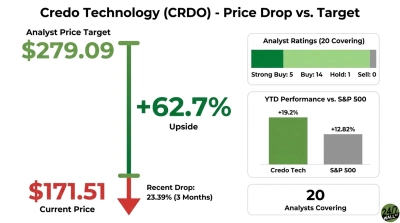
Credo Technology (NASDAQ:CRDO | CRDO Price Prediction) currently trades at $171.51, while Wall Street’s average price target sits at $279.09. That gap implies 62.7% upside.
Credo sells the high-speed wiring inside AI data centers: ZeroFlap active electrical cables, optical DSPs, retimers and OmniConnect memory interconnects. Fiscal 2026 revenue reached $1.335B, up 205.7%, which explains why analysts crowded into the name.
More aggressive desks push even further. Stifel’s Tore Svanberg and J.P. Morgan’s Joseph Cardoso both hold $310.00 targets, roughly 80.7% above present levels. With even the consensus implying substantial upside, the market is pricing in risks the analysts discount.
A Beat-and-Raise Quarter Sparked a 20% One-Day Plunge
Credo’s slide began with its own earnings report. Shares fell roughly 20% in a single session in early September, even though fiscal Q1 2027 revenue of $479.0M rose 114.7% and beat the $470.38M consensus. Non-GAAP EPS of $1.20 exceeded the $1.17 estimate, and Q2 guidance of $525M to $535M pointed higher.
Investors fixated on quality. GAAP gross margin contracted to 64.5% from 68.2% on acquisition amortization after the DustPhotonics deal pushed goodwill from $92.8M to $986.4M. Share-based comp hit $87.98M, and the three largest customers made up about 74% of revenue.
The pressure has remained. Credo is down 23.39% over three months and 13.51% in the past week, including a 7.3% single-session drop when the S&P 500 slipped just 0.1%. Most of this damage is company-specific.
Twenty Analysts, Zero Sells and Rising Estimates
Wall Street has held firm. Of 20 analysts, 5 rate it Strong Buy, 14 Buy, 1 Hold and none Sell. Estimates are moving up too: over 30 days, 15 analysts raised fiscal 2027 EPS forecasts against 3 cuts, and 16 raised fiscal 2028 against 1.
The bull thesis rests on Credo’s lead in AECs connecting dense GPU racks, expanding optical DSP and SerDes revenue, and hyperscaler capex from giants like Microsoft and Amazon (NASDAQ:MSFT, NASDAQ:AMZN). Credo is one of the non-chipmaker suppliers riding that expansion, a group we profiled further in a free report on seven AI infrastructure names. Consensus calls for fiscal 2027 EPS of $6.3063, climbing to $9.6906 in fiscal 2028.
That math drives the targets. On fiscal 2028 estimates, the stock trades near 18x earnings, against a trailing multiple of 60. The next test is the fiscal Q2 report, where consensus expects revenue of $531.65M and EPS of $1.2829. Targets carry no guarantee, though. The same analysts were bullish when shares hit $308.67.
Credo Fell Harder Than Its Connectivity Rivals
Credo dropped more than its peers. One rival rose over three months while the other declined far less.
Marvell Technology (NASDAQ:MRVL) gained 15.63% over three months despite a 10.53% weekly pullback. With the stock at $240.42 versus a $341.63 target, it implies 42.1% upside. Analysts split 8 Strong Buy, 32 Buy, 6 Hold, 0 Sell, though Marvell’s projected gain is smaller than Credo’s.
Broadcom (NASDAQ:AVGO) fell 13.33% over three months. With the stock at $334.37 versus a $527.59 target, it implies 57.8% upside, backed by 7 Strong Buy, 40 Buy and 3 Hold ratings. That is close to Credo’s upside.
Credo carries the group’s largest analyst-implied upside, but it also took the biggest drop, so analysts and the market disagree most sharply on this name.
Credo Still Beats the S&P 500 This Year Despite the Slide
At $171.51, Credo implies 62.7% upside to the $279.09 consensus from 20 analysts. Shares trade below the 50-day average of $206.02 and the 200-day average of $180.18.
Credo is up 19.2% year to date, and the S&P 500 has gained 12.82%. A beta of 3.249 explains why the moves run so large in both directions.
Credo’s Discount Looks Real if Margins Stabilize
Credo’s discount looks more credible if fiscal Q2 lands inside guidance, GAAP margins hold the 62.9% to 64.9% guided range, and the DustPhotonics optics push adds new hyperscaler wins. That path keeps fiscal 2028 estimates intact and makes the consensus target reachable.
The risk rises if hyperscaler capex slows down or a top customer shifts orders. With three accounts driving most revenue, one lost program could reset estimates quickly.
The data leans constructive. Rising estimates, a fast-shrinking forward multiple and no Sell ratings suggest the selloff priced in more risk than the fundamentals show. Still, the fiscal Q2 report needs to confirm the margin story first.
Contact [email protected] for any questions or corrections.
Alex Sirois is a financial writer with experience spanning both retail and institutional investing. He has written for InvestorPlace and held roles at BNY Mellon and Bernstein, giving him a perspective that bridges Main Street portfolios and Wall Street analysis.
Alex holds an MBA from George Washington University and has built his career across multiple industries, including e-commerce, education, and translation — a breadth of experience that informs how he breaks down complex financial topics for everyday investors. His writing is conversational, actionable, and grounded in long-term, buy-and-hold investing principles.
At 247 Wall St., Alex focuses on delivering analysis that is both accessible and useful, with a clear emphasis on helping readers make more informed decisions with their money.